How Do You Factorise Using a Common Factor?
Root Concept
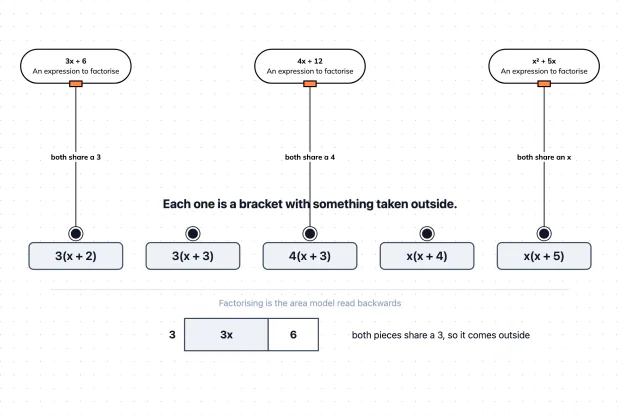
Factorising a common factor is the area model read backwards: the shared factor becomes the height, and what is left of each piece goes inside the bracket.
CodePLU Goal
Upgrading Human Mental Models
Learn how to think in Workflows

Concept Development By codeplu.com
Find the shared factor, take it outside — then match the bracket
What Does Factorising Actually Undo?
Multiplying out turns 3(x + 2) into 3x + 6. Factorising turns 3x + 6 back into 3(x + 2), and that is the whole of it — the same rectangle, read the other way round. The question changes from what does this bracket come to into what bracket would give me this.
Look at 3x + 6 and ask what both terms have in common. The first is 3 times x; the second is 3 times 2. Both contain a three, so the three can come outside, and what is left of each piece goes into the bracket: 3(x + 2). Draw it as a rectangle three units tall, split into a piece of width x and a piece of width 2, and you are looking at the same picture as before.
Two things to be careful about, and both appear in the playground below. Take out the biggest factor the terms share rather than any old one, or the expression is only half factorised. And the shared factor can be a letter as easily as a number — x² + 5x has an x in both terms, so it factorises to x(x + 5).
How Do You Take a Factor Out?
How do you find what the terms share?
Take the terms apart and look for what appears in all of them. For 4x + 12, the first term is 4 times x and the second is 4 times 3, so four is shared. For x² + 5x, the first is x times x and the second is 5 times x, so x is shared. Terms can share both a number and a letter: 6x² + 9x has a three in both numbers and an x in both letter parts, so 3x comes out and you get 3x(2x + 3). Check any factorisation by multiplying it back out. If you do not land exactly where you started, something was dropped, and multiplying back takes less time than wondering.
Why take out the biggest shared factor?
Because anything less leaves the job unfinished. 4x + 12 shares a two, so you could write 2(2x + 6) and everything in that line would be true. But the bracket still has a common factor inside it, so the expression has not really been factorised — it has been partly factorised, which in an exam is usually marked as incomplete. Taking out the four gives 4(x + 3), and now the bracket shares nothing, which is how you know you have finished. The test is simple and worth applying every time: look inside your own bracket and ask whether those terms still have something in common. If they do, go again.
What if the terms share nothing?
Then it does not factorise this way, and saying so is the correct answer rather than an admission of failure. 3x + 7 has no common factor at all: three and seven share only one, and the second term has no x. Forcing something out anyway produces nonsense. Beginners often feel that every expression must factorise somehow, because the exercises they are given always do. Real expressions frequently do not, and recognising that quickly is a skill. There are other kinds of factorising still to come in this track, so it is worth saying precisely what you mean: this one has no common factor, rather than this one cannot be factorised.
Real World Example
Why Would You Want the Bracket Back?
Factorising is useful exactly when the bracketed form says something the expanded one hides:
The quote, itemised
3x + 6
A builder quotes for three identical planters. The cost comes to 3x + 6 rupees, where x is the price of one planter's timber and the six covers fixings. Written this way it answers one question well: how the total splits between materials and hardware. Three lots of timber, and six rupees of screws and brackets across the whole job. It is a perfectly good description, and if what you want is to compare timber costs against hardware costs, it is exactly the form you want to be looking at. What it hides is what any single planter costs, and that is the question customers actually ask.
The same quote, factorised
3(x + 2)
Both terms share a three, so it can come outside: 3(x + 2). Now the quote is saying something different, and arguably more useful — three planters, each costing x + 2. Suddenly you can see the price of one planter, which was invisible in the other form. If the customer asks what a fourth planter would cost, the factorised version answers instantly: another x + 2. The expanded version would need you to work backwards first. Neither form is more correct, but they answer different questions, and factorising is how you get from one to the other.
Checking it went back properly
3 × x and 3 × 2
Multiply 3(x + 2) back out and you should land exactly where you started. Three times x is 3x, three times 2 is 6, giving 3x + 6, which is the original quote. That check takes a few seconds and catches the usual error, which is taking the factor out of the first term and forgetting the second — writing 3(x + 6), say, which would multiply back to 3x + 18 and be twelve rupees adrift. On a small job that is a rounding error; on thirty planters it is real money, and the check costs nothing either way.
FAQs
Final Words
Factorising with a common factor is multiplying out read backwards. Find what every term shares, write it outside a bracket, and put what is left of each term inside. The shared piece can be a number, a letter, or both at once.
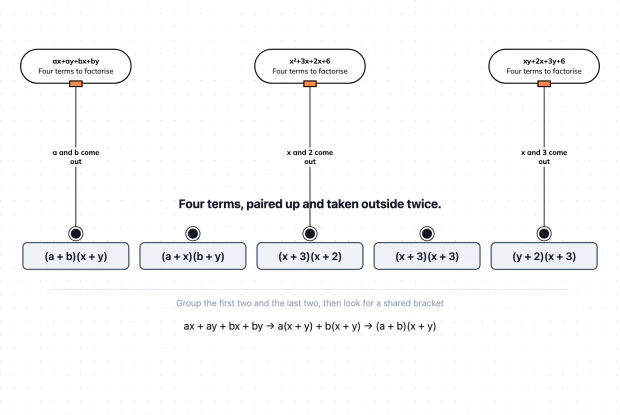
Two habits finish the job properly: take out the biggest shared factor, then look inside your own bracket to confirm nothing is still shared. Multiplying back out is the check, and it never lies. Next comes an expression with four terms, where the shared factor only appears after the terms are paired up.
Continue This Track
This concept is part 3 of Identities and Factorising.
What Is an Algebraic Identity?
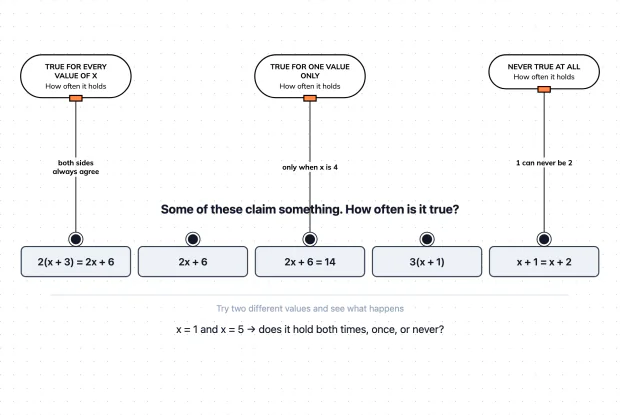
An equation is true for particular values; an identity is true for all of them. Learn to tell them apart and sort real statements in an interactive playground.
Why Does (a + b)² Not Equal a² + b²?
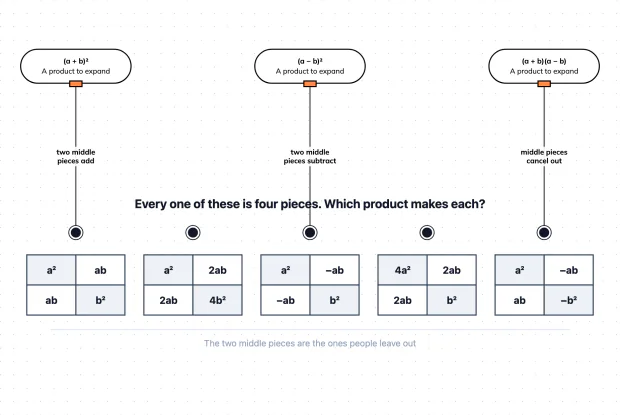
Squaring a bracket is not squaring each piece. Four pieces come out, and the two middle ones are the part people lose. See where they sit in an interactive playground.
How Do You Factorise Using a Common Factor?
Factorising is expanding run backwards. Learn how to find what all the terms share and pull it outside, then match expressions to their factorised forms in a playground.
How Do You Factorise an Expression With Four Terms?
Four terms with nothing shared by all of them can still factorise, if you pair them first. Learn the method and match expressions to their brackets in a playground.
How Do You Factorise by Spotting a Pattern?
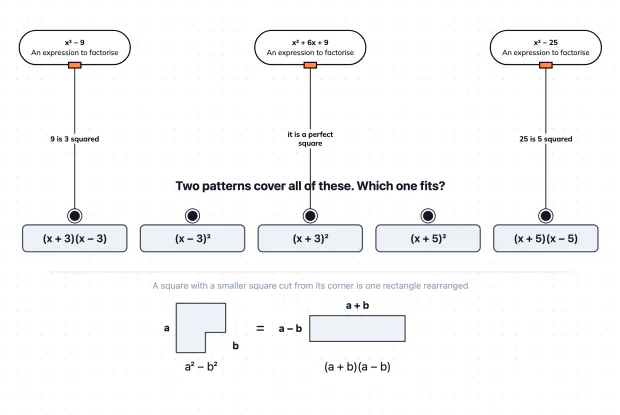
Some expressions factorise the moment you recognise them. Learn the difference of two squares and the perfect square, and match three to their brackets in a playground.