What Is Each Angle in a Regular Polygon?
Root Concept
In a regular polygon every angle equals 180° minus 360° divided by the number of sides.
CodePLU Goal
Upgrading Human Mental Models
Learn how to think in Workflows

Concept Development By codeplu.com
Regular means all sides equal and all angles equal. Drop either condition and the shape has no single angle to name.
What Does Regular Buy You?
So far every result in this track has been about totals. The angle sum of a polygon tells you what all its angles come to added together, and the exterior angle rule tells you the same for the outside. Neither says anything about an individual corner, because on an ordinary polygon the corners can be anything at all as long as they reach the right total.
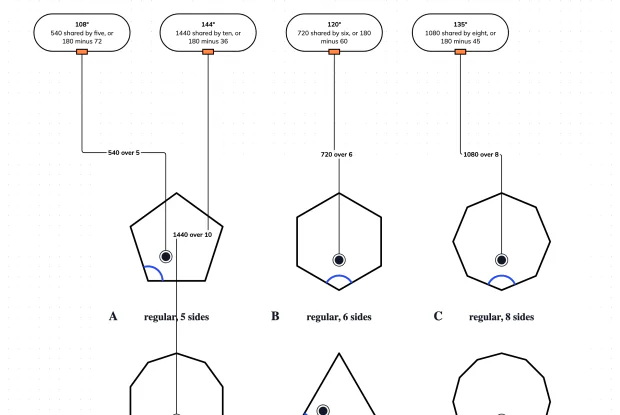
Regular changes that. A regular polygon has all its sides the same length and all its angles the same size, so the total is shared out evenly and one number describes every corner. A regular pentagon holds 540° between five identical angles, so each one is 108°; a regular hexagon shares 720° between six, giving 120°.
There is a second route that is usually quicker. Each exterior angle is 360° divided by the number of sides, and each interior angle is 180° minus that. For a pentagon: 360 ÷ 5 = 72, and 180 − 72 = 108°. Both routes give the same answer, and the playground below is a good place to try each and see which you prefer.
Two Routes, and When Each Is Better
The First Route: Share Out the Angle Sum
Work out the angle sum with (n − 2) × 180°, then divide by n. For a regular octagon that is (8 − 2) × 180 = 1080°, and 1080 ÷ 8 = 135°. This route has the advantage of using something you already know and of producing the total as a by-product, which some questions want as well. Its drawback is that the numbers get large quickly — a twenty-sided polygon means 3240° divided by 20 — and large numbers are where arithmetic slips happen. It is also the route that goes wrong most often in reverse: working out the number of sides from a known interior angle this way needs rearranging an equation, which is more work than the alternative below.
The Second Route: Go Through the Exterior Angle
Divide 360° by the number of sides to get each exterior angle, then subtract from 180°. For that same octagon: 360 ÷ 8 = 45°, and 180 − 45 = 135°. The numbers stay small the whole way, and for a twenty-sided polygon it is 360 ÷ 20 = 18 and 180 − 18 = 162°, which can be done in your head. This route is also far better backwards. Given an interior angle of 162°, the exterior angle is 18° and the number of sides is 360 ÷ 18 = 20, in two easy steps with no algebra. Most people who use these regularly settle on this route and keep the angle sum for when the total is what was actually asked for.
What Counts as Regular?
Both conditions have to hold: all sides equal and all angles equal. Neither implies the other, which surprises people. A rhombus has four equal sides and is not regular, because its angles come in two different sizes; a rectangle has four equal angles and is not regular, because its sides do not match. A square has both and is the regular quadrilateral. The same applies further up: an equilateral triangle is the regular triangle, and it is the only shape where equal sides do force equal angles, which is why triangles are the exception rather than the pattern. If a question says regular, you have been given both facts and may use either.
What Happens as the Number of Sides Grows?
The interior angles get closer and closer to 180° without ever reaching it. A regular hexagon has 120° corners, a regular twenty-sided polygon 162°, and a hundred-sided one 176.4° — corners so shallow that the shape is hard to tell from a circle by eye. The exterior angle route shows why: it is 180° minus 360 ÷ n, and as n grows the amount being subtracted shrinks towards nothing. The angle can never actually be 180°, because that would mean no turn at the corner at all and the shape would never close. This is the thinking behind treating a circle as a polygon with very many sides, which is how its area and circumference were first worked out.
Real World Example
Why Do Bathroom Tiles Come in So Few Shapes?
For tiles to meet cleanly at a corner, a whole number of their angles has to make exactly 360°, and very few regular shapes manage it.
The squares that work
90°, four of them
Square tiles meet four to a corner because each angle is 90° and four of them make exactly 360°, filling the space round the point with nothing left over. Equilateral triangles work too: each angle is 60° and six of them make 360°. Regular hexagons manage it with three, since 3 × 120 = 360, which is why honeycomb patterns turn up in tiling, in beehives and in the strongest lightweight panels. In each case the test is the same, and it is the only one that matters: does the polygon's angle divide exactly into 360? Nothing about the material, the size or the pattern can rescue a shape that fails it.
The pentagon that does not
108° leaves a gap
Regular pentagons have 108° angles. Three of them make 324°, which leaves a 36° wedge of bare floor, and four would make 432°, which is more than a full turn so they would have to overlap. There is no whole number of 108° angles that makes 360°, and so regular pentagons cannot tile a floor on their own however they are arranged. The same failure hits the regular octagon at 135°, which is why octagonal tiles are always sold with small squares to fill the gaps they leave, a pairing that has been used on floors since Roman times.
Why only three shapes
360 must divide exactly
Running the test on every regular polygon in turn gives only three successes: the equilateral triangle, the square and the regular hexagon. Beyond six sides the interior angle is always more than 120° and less than 180°, so two of them leave a gap and three overlap, and nothing else can fit. That is a complete answer arrived at purely from the angle formula, and it is why tile catalogues have looked much the same for two thousand years — the constraint is geometric rather than a matter of fashion, material or manufacturing, so no new technology has ever added a fourth shape to the list.
FAQs
Final Words
Regular means every side and every angle is the same, which is what allows a single number to describe every corner. Share the angle sum out equally, or divide 360° by the number of sides and subtract from 180° — the second route keeps the numbers small and is far easier to run backwards when the number of sides is what you are looking for.
That completes the angles side of polygons. You can now find the total for any polygon, the total of its exterior angles, and every individual angle when it is regular — and the tiling question at the end shows the kind of thing these results settle outright rather than merely describe.
Continue This Track
This concept is part 4 of Angles in Polygons.
Why Do a Quadrilateral's Angles Add Up to 360°?
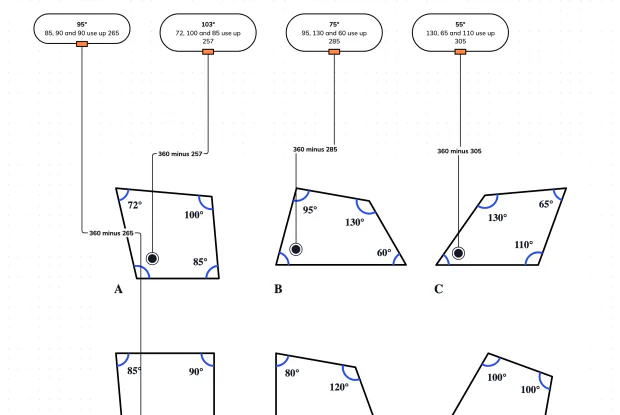
Every four-sided shape has angles totalling 360°, however lopsided it looks. The reason is a single diagonal: it splits any quadrilateral into two triangles, and two lots of 180° make 360°. Find the missing angle on six of them in an interactive playground.
What Is the Angle Sum of Any Polygon?
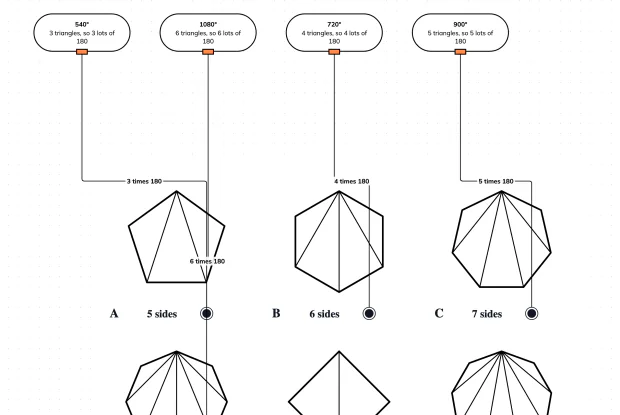
A triangle holds 180° and a quadrilateral 360°, and the pattern does not stop there. Any polygon can be cut into triangles from a single corner, and the number of triangles is always two fewer than the number of sides. Count them and multiply, in an interactive playground.
Why Do Exterior Angles Always Add Up to 360°?
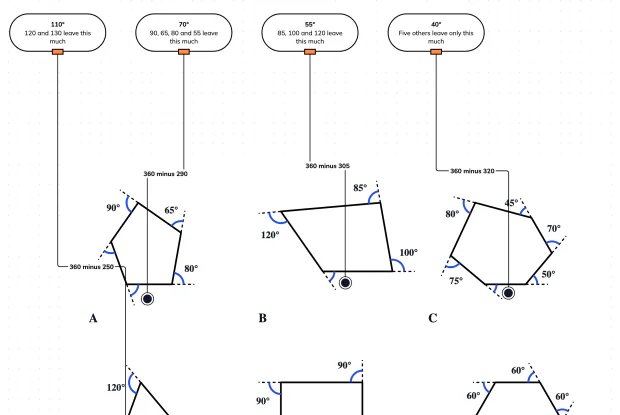
The interior angles of a polygon grow with every side you add. The exterior angles do not: they total 360° for a triangle, a hexagon and a hundred-sided shape alike. Walking round the outline shows why in one sentence. Find the missing exterior angle in an interactive playground.
What Is Each Angle in a Regular Polygon?
In a regular polygon every angle is the same, so one number describes the whole shape. You can find it by sharing out the angle sum, or far faster by going through the exterior angle. Compare the two routes on six regular polygons in an interactive playground.