Angles in Polygons
A triangle's angles total 180°, and everything in this track comes from cutting other shapes into triangles. One diagonal turns a quadrilateral into two of them, which is where its 360° comes from; a fan of diagonals from a single corner turns any polygon into two fewer triangles than it has sides, which is the general formula. Then the same shapes are looked at from the outside, and something unexpected happens: the exterior angles total 360° whether the shape has three corners or a hundred, because walking once round an outline is one full turn however it is divided up. The last tutorial puts both results to work on regular polygons, where every corner is identical and a single number describes the shape — and finishes with the reason only three regular shapes will tile a floor, which falls straight out of the angle formula rather than out of anything about tiles.
CodePLU Goal
Upgrading Human Mental Models
Learn how to think in Workflows
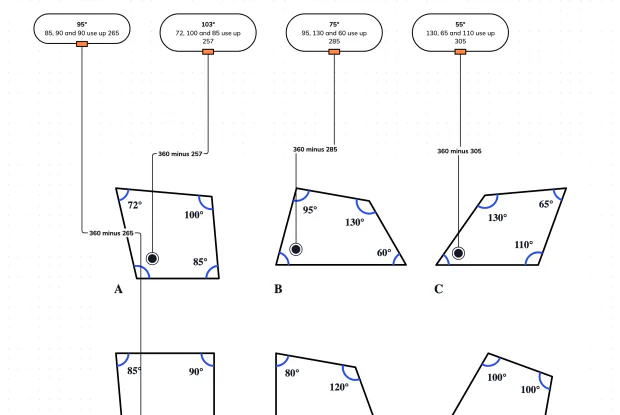
Why Do a Quadrilateral's Angles Add Up to 360°?
Every four-sided shape has angles totalling 360°, however lopsided it looks. The reason is a single diagonal: it splits any quadrilateral into two triangles, and two lots of 180° make 360°. Find the missing angle on six of them in an interactive playground.
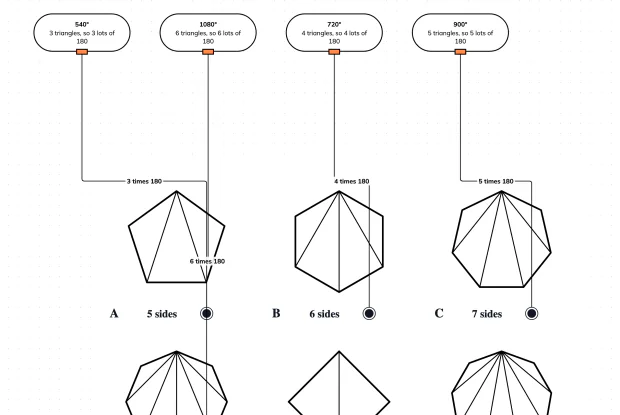
What Is the Angle Sum of Any Polygon?
A triangle holds 180° and a quadrilateral 360°, and the pattern does not stop there. Any polygon can be cut into triangles from a single corner, and the number of triangles is always two fewer than the number of sides. Count them and multiply, in an interactive playground.
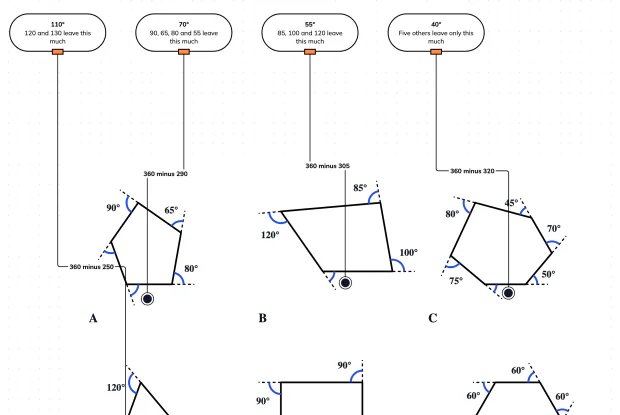
Why Do Exterior Angles Always Add Up to 360°?
The interior angles of a polygon grow with every side you add. The exterior angles do not: they total 360° for a triangle, a hexagon and a hundred-sided shape alike. Walking round the outline shows why in one sentence. Find the missing exterior angle in an interactive playground.
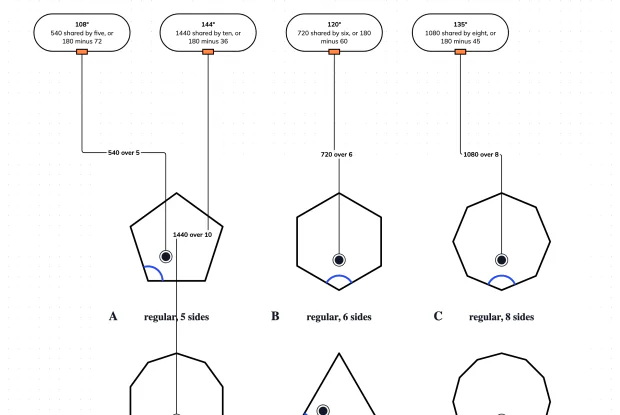
What Is Each Angle in a Regular Polygon?
In a regular polygon every angle is the same, so one number describes the whole shape. You can find it by sharing out the angle sum, or far faster by going through the exterior angle. Compare the two routes on six regular polygons in an interactive playground.