Why Do Exterior Angles Always Add Up to 360°?
Root Concept
Walking once round any polygon turns you through exactly one full circle, so its exterior angles total 360°.
CodePLU Goal
Upgrading Human Mental Models
Learn how to think in Workflows

Concept Development By codeplu.com
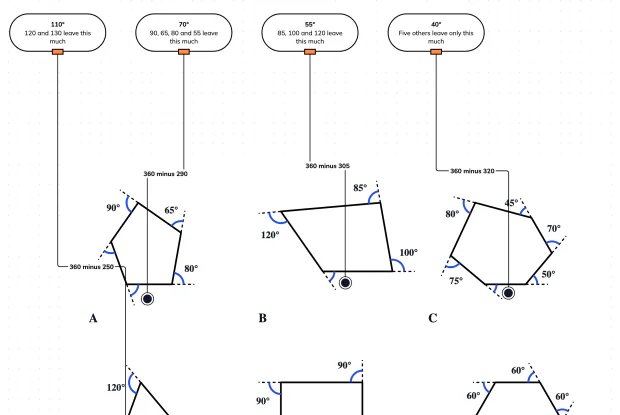
The dashed line at each corner is the side you arrived along, carried on. The exterior angle is how far you have to turn to set off down the next side.
Why Does the Number of Sides Stop Mattering?
Interior angles grow without limit: a pentagon holds 540°, an octagon 1080°, and every side you add brings another 180°. Look at the same polygons from the outside and something quite different happens. Extend each side past its corner and measure the angle between that extension and the next side, and those exterior angles total 360° — for every polygon there is.
A triangle, a square, a hexagon, a shape with a hundred sides: all of them, 360°. That is unusual enough to be worth a moment of suspicion, and the explanation is the most physical argument in this track. Imagine walking once round the outline of the shape. Along each side you walk straight, and at each corner you turn — and the amount you turn is exactly the exterior angle there.
By the time you arrive back where you started, facing the way you first set off, you have turned through one complete circle and no more. One complete circle is 360°, so the turns must total 360°. The number of corners changes how the turning is divided up, never how much of it there is.
What an Exterior Angle Is and What It Buys You
What Exactly Is an Exterior Angle?
It is the angle between one side carried on past a corner and the next side of the shape. The dashed lines in the playground are those extensions, and each marked angle sits between a dashed line and a solid one. The common mistake is to take the whole region outside the shape at that corner, which is a reflex angle and is not what is meant. Because the extension and the side it came from make a straight line, an exterior angle and the interior angle beside it are a linear pair, so they always total 180°. That relationship is the bridge between this tutorial and the last one, and it is how you convert between the two kinds of angle whenever a question mixes them.
Why Does the Walking Argument Work?
Set off along one side of the polygon facing forwards. Walk to the next corner and you have changed direction not at all. At the corner you turn, and the angle you turn through is precisely the exterior angle there, because the direction you were facing is the extension of the side you arrived along. Carry on round the whole shape and eventually you return to your starting point facing exactly the way you began. Facing the same way again means you have turned through a whole number of full circles, and because the shape is convex you never turned back on yourself, so it was exactly one. One full circle is 360°, and the turns that made it up were the exterior angles.
How Do You Use It in a Question?
Directly, when a missing exterior angle is asked for: add the ones you are given and subtract from 360. More often it is a shortcut for interior angles. If a regular polygon has nine sides, each exterior angle is 360 ÷ 9 = 40°, so each interior angle is 180 − 40 = 140° — usually faster than computing the angle sum and dividing. It also runs backwards, which is where it earns most of its marks: if each exterior angle of a regular polygon is 24°, then there are 360 ÷ 24 = 15 of them, so the shape has 15 sides. Finding the number of sides from an interior angle is fiddly; from an exterior angle it is one division.
Does It Hold for Awkward Shapes?
For every convex polygon, without exception, and the sides need not be equal or the angles alike. A long thin quadrilateral turns through the same total as a square. For concave polygons — the ones with a dent — the total is still 360°, but only if the turns at the dented corners are counted as negative, because there you turn back the other way. That convention is beyond most school courses, and it is the reason the rule is normally stated for convex polygons. What the rule never survives is a shape whose outline crosses itself, where a walk round the boundary genuinely does turn through more than one circle.
Real World Example
Why Does a Robot Vacuum End Up Facing the Same Way?
The robot only knows how far it has driven and how far it has turned, and the turning total is fixed before it starts.
Driving the walls
Straight, then turn
A robot vacuum following the walls of a room drives in straight lines and turns at corners. It has no map and no idea what shape the room is; all it records is how far it has driven and how many degrees it has turned. Each turn it makes is the exterior angle at that corner, because the direction it was travelling in is the wall it just followed, carried on past the corner. A rectangular room gives four turns of 90°; an L-shaped room or a bay window gives more turns of varying sizes.
Back at the dock
360° of turning, always
Whatever the room, by the time the robot arrives back at its dock it is facing the direction it originally set off in, which means its turns have added to exactly one full circle. Four turns of 90° in a rectangular room, or eight smaller turns round a bay, or three turns in an oddly triangular loft: 360° every time. The room's shape decides how the turning is shared out and never how much of it there is, which is the same statement as the exterior angle rule with the geometry replaced by a journey.
What that lets it check
A turn total that is wrong
This gives the robot a self-check that costs nothing. If it returns to the dock having turned through 340° or 380°, one of its turns was misjudged, most likely because a wheel slipped on a rug. The machine knows something is wrong without knowing the room, and can correct its heading rather than drifting further out on the next lap. The same logic is why a walked survey of a field is checked by adding the turns: the total has to come to one circle, and if it does not, the error is in the measurements rather than in the field.
FAQs
Final Words
However many sides a polygon has, its exterior angles total 360°. The reason is a walk rather than a calculation: going once round the outline turns you through exactly one full circle, and each turn you make is an exterior angle. More sides means more turns, each smaller, and the total never moves.
That fixed total is what makes exterior angles the fast route into regular polygons. Dividing 360 by the number of sides gives each exterior angle immediately, and subtracting from 180° gives each interior angle — which is the last tutorial of this track, where the two methods you now have are put side by side.
Continue This Track
This concept is part 3 of Angles in Polygons.
Why Do a Quadrilateral's Angles Add Up to 360°?
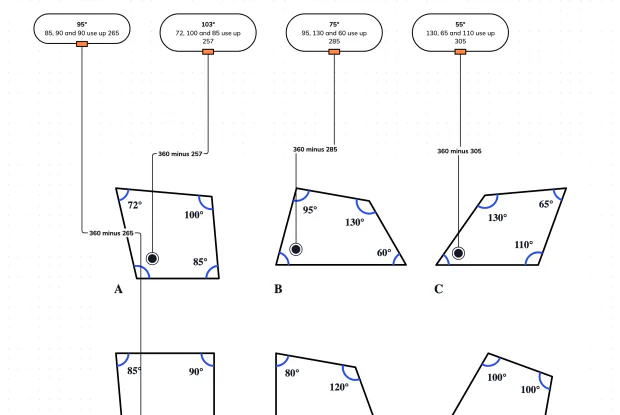
Every four-sided shape has angles totalling 360°, however lopsided it looks. The reason is a single diagonal: it splits any quadrilateral into two triangles, and two lots of 180° make 360°. Find the missing angle on six of them in an interactive playground.
What Is the Angle Sum of Any Polygon?
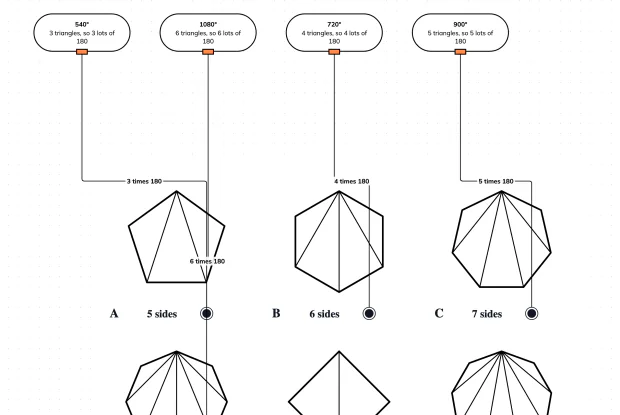
A triangle holds 180° and a quadrilateral 360°, and the pattern does not stop there. Any polygon can be cut into triangles from a single corner, and the number of triangles is always two fewer than the number of sides. Count them and multiply, in an interactive playground.
Why Do Exterior Angles Always Add Up to 360°?
The interior angles of a polygon grow with every side you add. The exterior angles do not: they total 360° for a triangle, a hexagon and a hundred-sided shape alike. Walking round the outline shows why in one sentence. Find the missing exterior angle in an interactive playground.
What Is Each Angle in a Regular Polygon?
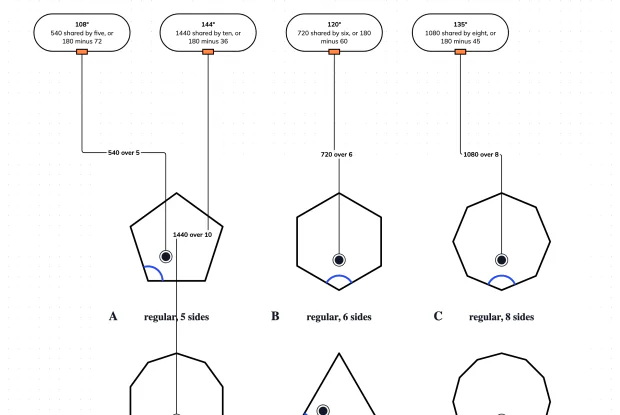
In a regular polygon every angle is the same, so one number describes the whole shape. You can find it by sharing out the angle sum, or far faster by going through the exterior angle. Compare the two routes on six regular polygons in an interactive playground.