What Is the Angle Sum of Any Polygon?
Root Concept
A polygon with n sides splits into n − 2 triangles, so its angles total (n − 2) × 180°.
CodePLU Goal
Upgrading Human Mental Models
Learn how to think in Workflows

Concept Development By codeplu.com
The diagonals are drawn from one corner only. That corner is already joined to its two neighbours, which is why two sides never produce a triangle.
Does the Pattern Keep Going?
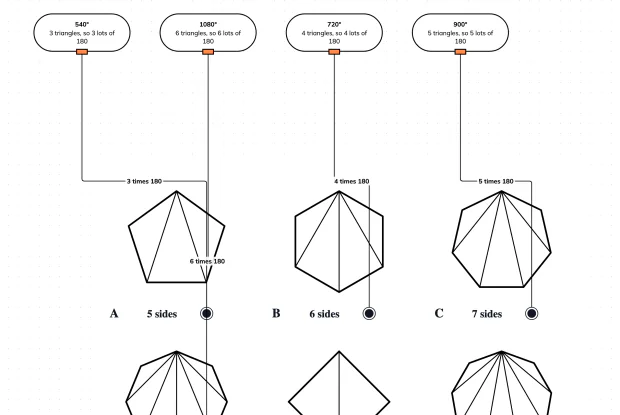
A triangle's angles total 180°. A quadrilateral's total 360°, and the reason was a single diagonal cutting it into two triangles. There is no reason to stop at four sides. Draw every diagonal from one corner of a five-sided shape and it falls into three triangles; do the same on a six-sided shape and you get four.
Once you see that, the rule writes itself. The angle sum is the number of triangles multiplied by 180°, and the number of triangles is always two fewer than the number of sides. A polygon with n sides therefore has an angle sum of (n − 2) × 180°. For a pentagon that is 3 × 180 = 540°, and for an octagon 6 × 180 = 1080°.
The two that go missing are worth understanding rather than memorising, and the playground makes them visible: the corner you are drawing from is already joined to the two corners either side of it, so those two sides never become the far side of a triangle. Count the triangles in each picture below and the formula stops being something to recall.
Where the Formula Comes From and How to Use It
Why Is It Always Two Fewer?
Pick a corner and join it to every other corner. It is already joined to the two corners next to it, by the two sides meeting there, so those two need no diagonal. That leaves n − 3 diagonals, and n − 3 cuts through a shape produce n − 2 pieces, in the same way that two cuts across a loaf give three slices. So a pentagon gets two diagonals and three triangles, a hexagon three diagonals and four triangles. The two that go missing are always the same two, regardless of the shape or which corner you pick, which is why the formula has a fixed − 2 in it rather than something that depends on the polygon. Counting the triangles in a drawing is a perfectly good substitute for remembering this.
How Do You Use the Formula?
Count the sides, subtract two, multiply by 180. A seven-sided polygon gives (7 − 2) × 180 = 5 × 180 = 900°. A twelve-sided one gives 10 × 180 = 1800°. The arithmetic is easier if you multiply by 18 and then add a zero, or work in half-turns and convert at the end. Run the sanity check that the answer grows by exactly 180° for each extra side, because that is the one pattern the formula guarantees: adding a side adds a triangle. If your answers for a seven-sided and an eight-sided polygon differ by anything other than 180°, one of them is wrong. The commonest mistake is forgetting to subtract the two and multiplying the side count itself by 180.
Does the Polygon Have to Be Regular?
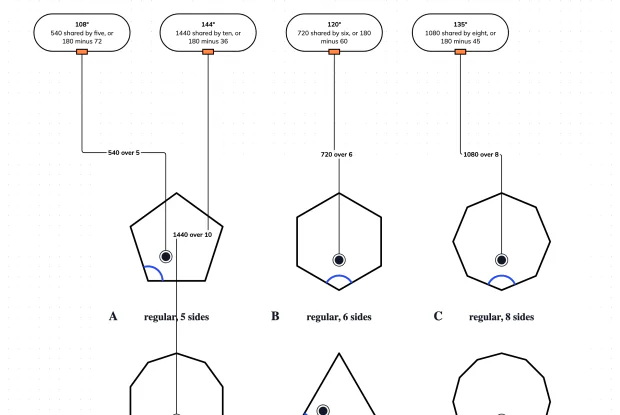
No, and this catches people out because textbook diagrams are usually neat. The angle sum depends only on how many sides a shape has, not on whether they are the same length or the angles the same size. A lopsided pentagon drawn freehand has exactly the same angle sum, 540°, as a perfectly regular one, because the cutting argument never looks at the lengths. What being regular does give you is the size of each individual angle, since the total is then shared out equally — but that is a separate question, and it is the subject of the last tutorial in this track. The angle sum itself is free of any regularity assumption.
What About Shapes With a Dent?
The formula still holds for a concave polygon, one with at least one corner pushed inwards, as long as the reflex interior angles are measured properly — as the angle inside the shape, which will be more than 180°. What changes is the cutting: on a concave shape you cannot always join one corner to every other without leaving the shape, so the simple fan of diagonals may not work from every corner. There is always at least one corner it does work from, which is enough to keep the argument alive. For school questions the polygons are almost always convex, and the rule can be applied without worrying about this.
Real World Example
How Does a Tiler Plan an Octagonal Floor Border?
The angle sum is the first number a tiler needs, because it decides what each corner of the tile has to be cut to.
Counting the sides
8 sides, 6 triangles
A tiler is laying an octagonal border pattern and needs to know what angle to cut each corner of the tiles to. The first step is not measuring anything but counting: eight sides means eight corners, and the fan of diagonals from any one corner cuts the octagon into six triangles. Six is two fewer than eight, as it always is, because the corner being drawn from is already connected to its two neighbours. This is the only counting the job requires, and it can be done from a sketch on the back of an invoice.
Turning it into degrees
6 × 180 = 1080°
Six triangles at 180° each give 1080° for the whole octagon. That number is not directly useful to a tiler on its own, because nobody cuts a 1080° angle, but it is the total that has to be shared out among the eight corners. It is also the number that would change if the pattern were redesigned: a hexagonal border would come to 4 × 180 = 720° and a decagonal one to 8 × 180 = 1440°. Each extra side adds exactly = 1440 degrees. Each extra side adds exactly one more triangle to the fan, and so exactly 180 degrees more to the total.
What the tiler actually cuts
1080 ÷ 8 = 135°
Because the tiles are regular octagons, with all sides and angles the same, the 1080° divides equally between the eight corners, giving 135° at each. That is the number the mitre saw is set to. Notice the order of the reasoning: the angle sum came first and did not need the tiles to be regular at all, and only the last step used that. If the tiles were irregular eight-sided pieces the total would still be 1080°, but the individual were irregular eight-sided pieces the total would still be 1080 degrees, but every corner would have to be measured on its own and the saw reset for each cut.
FAQs
Final Words
Any polygon can be cut into triangles from a single corner, and the number of triangles is always two fewer than the number of sides, because that corner is already joined to its two neighbours. The angle sum is therefore (n − 2) × 180°, and it depends on nothing except how many sides the shape has.
That formula tells you the total but says nothing about any individual angle, and it grows without limit as shapes get more sides. The next tutorial looks at the same polygons from the outside instead, where something surprising happens: the exterior angles always total 360°, no matter how many sides there are.
Continue This Track
This concept is part 2 of Angles in Polygons.
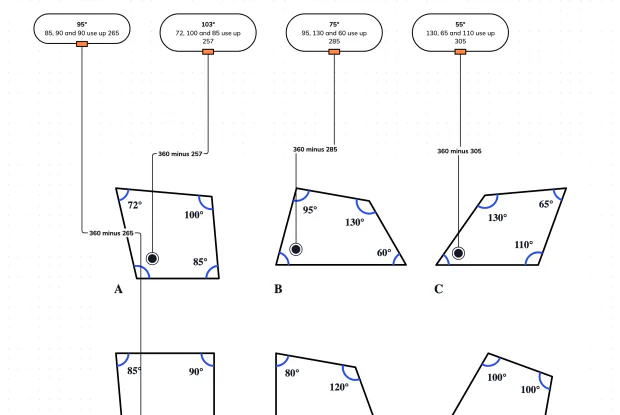
Why Do a Quadrilateral's Angles Add Up to 360°?
Every four-sided shape has angles totalling 360°, however lopsided it looks. The reason is a single diagonal: it splits any quadrilateral into two triangles, and two lots of 180° make 360°. Find the missing angle on six of them in an interactive playground.
What Is the Angle Sum of Any Polygon?
A triangle holds 180° and a quadrilateral 360°, and the pattern does not stop there. Any polygon can be cut into triangles from a single corner, and the number of triangles is always two fewer than the number of sides. Count them and multiply, in an interactive playground.
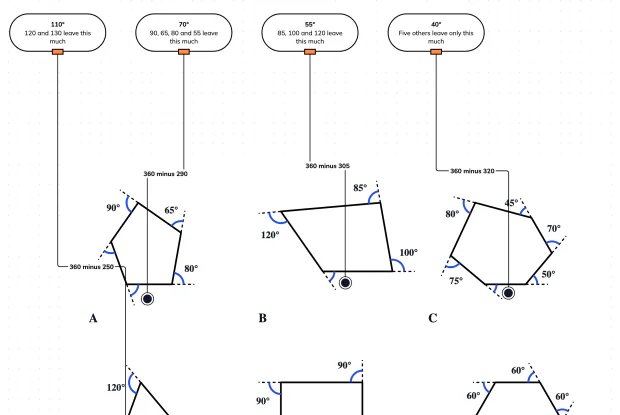
Why Do Exterior Angles Always Add Up to 360°?
The interior angles of a polygon grow with every side you add. The exterior angles do not: they total 360° for a triangle, a hexagon and a hundred-sided shape alike. Walking round the outline shows why in one sentence. Find the missing exterior angle in an interactive playground.
What Is Each Angle in a Regular Polygon?
In a regular polygon every angle is the same, so one number describes the whole shape. You can find it by sharing out the angle sum, or far faster by going through the exterior angle. Compare the two routes on six regular polygons in an interactive playground.