Why Do a Quadrilateral's Angles Add Up to 360°?
Root Concept
One diagonal turns any quadrilateral into two triangles, so its angles total 360°.
CodePLU Goal
Upgrading Human Mental Models
Learn how to think in Workflows

Concept Development By codeplu.com
Add the three angles you are given and take the total away from 360. If your answer comes out negative, one of the givens has been misread.
Where Does the 360 Come From?
The angle sum of a triangle is the one fact most people remember from geometry: 180°, always, whatever the triangle looks like. Quadrilaterals have a matching fact, and it is exactly twice as big. The four angles of any four-sided shape total 360° — squares, kites, awkward lopsided things with no name, all of them.
The reason is worth one line rather than memorising. Draw a diagonal from any corner of a quadrilateral to the opposite corner. The shape falls into two triangles, and every angle of the quadrilateral ends up inside one triangle or the other, with nothing left over and nothing counted twice. Two triangles carry 180° each, so the quadrilateral carries 360°.
That makes any three angles enough to find the fourth, which is the whole content of the practice below. Add the three you are given, subtract from 360, and you are done — with one check worth making, since an answer that comes out negative or larger than 360 means a number was misread rather than that the shape is unusual.
Using the Rule, and Knowing When It Applies
Does It Work for Every Quadrilateral?
For every convex one, which is every quadrilateral that does not have a corner pushed inwards. Squares, rectangles, rhombuses, kites, trapeziums and shapes with no name at all all obey it, because the diagonal argument does not care what the shape looks like. It matters that the shape has four straight sides and is genuinely closed. The rule also holds for a concave quadrilateral — one with a dent, where a single interior angle is reflex — provided you measure that reflex angle properly, as the angle inside the shape, which may be more than 180°. What the rule does not survive is a shape with a curved side or a shape that crosses over itself, since neither can be cut cleanly into two triangles.
How Do You Find a Missing Angle?
Add the angles you know and subtract the total from 360. If three angles are 72°, 100° and 85°, they use up 257°, so the fourth is 360 − 257 = 103°. That is the whole method, and the only common slip is dropping a number when adding three at once, which is worth guarding against by adding them twice in different orders. A second useful check is that the answer must be sensible for the drawing: an angle that looks clearly acute should not come out at 130°. Diagrams in exam questions are often marked not to scale precisely so you cannot rely on this, but when a diagram is to scale it is free information and worth glancing at.
What Can You Say Without Being Told Anything?
More than you might expect. Because the four angles total 360° and there are four of them, the average angle is 90°, so a quadrilateral cannot have four acute angles or four obtuse ones. At least one angle must be 90° or more, and at least one must be 90° or less. It also means a quadrilateral can have at most three acute angles, and if it has three the fourth must be reflex, which forces the shape to be concave. Facts like these are the kind exam questions lean on when they ask whether a described shape can exist at all, and they come straight out of the angle sum with no extra work.
How Does This Connect to Other Shapes?
It is the second step of a pattern rather than an isolated fact. A triangle has 180°, a quadrilateral 360°, and the reason the second is twice the first is that a quadrilateral is two triangles. The same cutting trick keeps working: a five-sided shape splits into three triangles, a six-sided one into four, and so on. That is the subject of the next tutorial, and if you want to guess the rule before reading it, count how many triangles a shape with n sides falls into when you draw every diagonal from one corner. The answer is always two fewer than the number of sides, which is the whole formula in one sentence.
Real World Example
How Does a Glazier Check an Old Window Frame?
An old frame is rarely a rectangle any more, and the pane has to match what is actually there rather than what was built.
Three corners measured
85°, 90° and 90°
A glazier measuring an old window frame finds the building has settled: the frame is still a quadrilateral but no longer a rectangle. Three of its corners measure 85°, 90° and 90°. The fourth is up in an awkward position behind a shutter, where a protractor will not sit flat, so measuring it directly means removing fittings. It does not need to be measured at all. Whatever the frame has done, it still has four straight sides, so its be measured at all. Whatever the frame has done, it still has four straight sides, so its angles still total 360 degrees, and three measurements have already pinned the fourth one down.
The fourth follows
95°, unmeasured
The three known corners use up 85 + 90 + 90 = 265°, so the last one must be 360 − 265 = 95°. The glazier can cut the pane to that angle with confidence, and the arithmetic is quicker and more reliable than a measurement taken at arm's length from a ladder. Notice what the numbers say about the frame: two corners are still true right angles, and the other two have gone five degrees out in opposite directions, which is exactly what happens when a frame leans into a parallelogram rather than crushing.
The check that costs nothing
Do they total 360?
The same rule works as a check rather than a calculation. If the glazier does measure all four corners and they total 358° or 362°, at least one measurement is wrong, because a genuine quadrilateral cannot total anything but 360°. That is a more useful test than it sounds, since a protractor read at an awkward angle is easy to misjudge by a degree or two, and the error only shows up when the pane does not fit. Adding four numbers on site takes seconds and catches the mistake while the glass is still uncut.
FAQs
Final Words
Four straight sides mean 360°, always, and the reason takes one diagonal: the shape becomes two triangles, and two lots of 180° make 360°. Three angles are therefore always enough to find the fourth, and the same rule read backwards makes a useful check on four measurements that should not have been taken separately.
The cutting argument is more general than the result it just produced. A five-sided shape falls into three triangles, a six-sided one into four, and the pattern keeps going. The next tutorial turns that into a formula that works for a polygon with any number of sides at all.
Continue This Track
This concept is part 1 of Angles in Polygons.
Why Do a Quadrilateral's Angles Add Up to 360°?
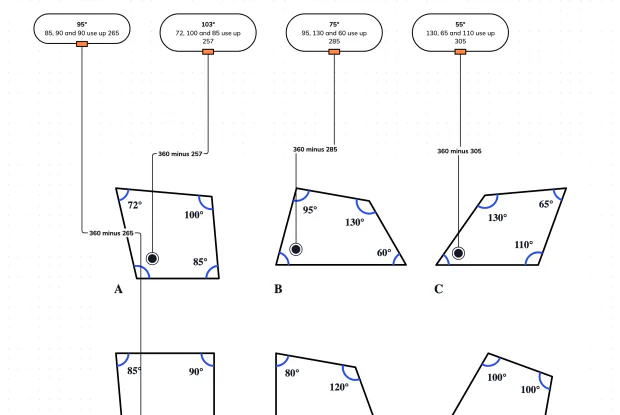
Every four-sided shape has angles totalling 360°, however lopsided it looks. The reason is a single diagonal: it splits any quadrilateral into two triangles, and two lots of 180° make 360°. Find the missing angle on six of them in an interactive playground.
What Is the Angle Sum of Any Polygon?
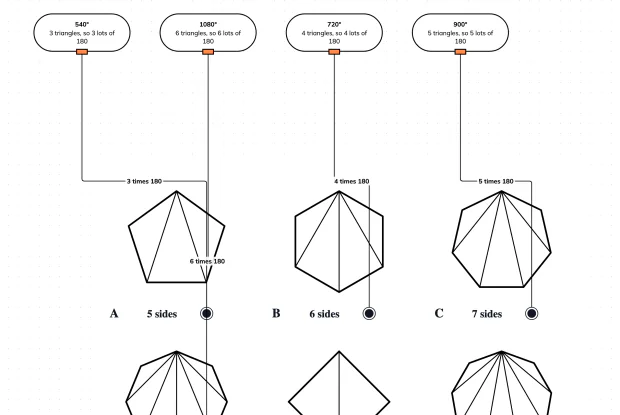
A triangle holds 180° and a quadrilateral 360°, and the pattern does not stop there. Any polygon can be cut into triangles from a single corner, and the number of triangles is always two fewer than the number of sides. Count them and multiply, in an interactive playground.
Why Do Exterior Angles Always Add Up to 360°?
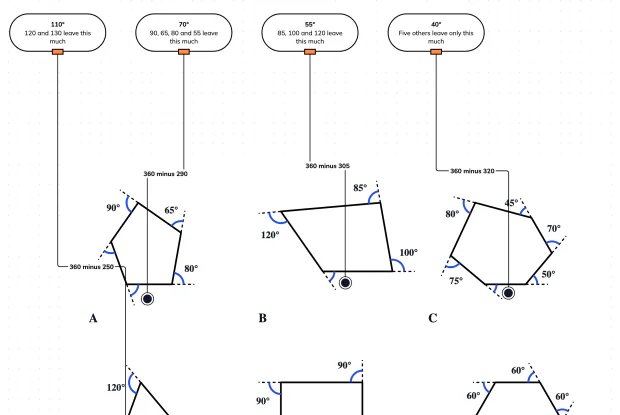
The interior angles of a polygon grow with every side you add. The exterior angles do not: they total 360° for a triangle, a hexagon and a hundred-sided shape alike. Walking round the outline shows why in one sentence. Find the missing exterior angle in an interactive playground.
What Is Each Angle in a Regular Polygon?
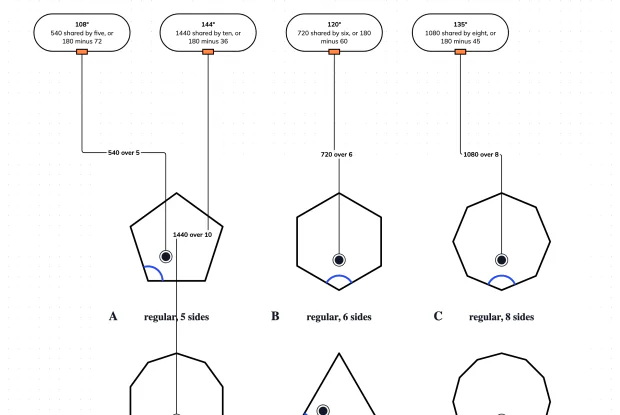
In a regular polygon every angle is the same, so one number describes the whole shape. You can find it by sharing out the angle sum, or far faster by going through the exterior angle. Compare the two routes on six regular polygons in an interactive playground.