What Does Pythagoras' Theorem Actually Say?
Root Concept
The square on the hypotenuse has the same area as the squares on the other two sides put together.
CodePLU Goal
Upgrading Human Mental Models
Learn how to think in Workflows

Concept Development By codeplu.com
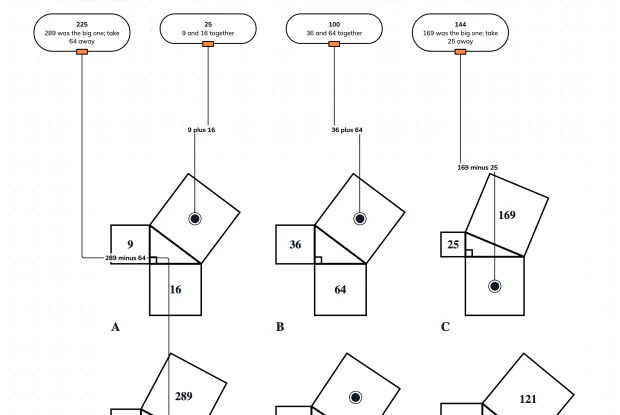
The biggest square always sits on the side opposite the right angle. Add the two smaller areas to find it, or subtract to find a smaller one.
Why Squares Rather Than Lengths?
Pythagoras' theorem is normally introduced as a formula with letters in it, which makes it look like a rule to be memorised and applied. It is really a statement about area, and it is much easier to believe once you have seen it that way. Take any right-angled triangle and draw a square outwards on each of its three sides. The square on the longest side holds exactly as much area as the other two squares put together.
That is the entire theorem. Nothing about it is obvious — there is no reason you would guess that squares built on the sides of a triangle should balance like that, and it is not true for triangles without a right angle. The right angle is what makes it work, and the result has been known for well over two thousand years.
The formula everyone learns is just this sentence written in symbols. Call the two shorter sides a and b and the longest one c, and the areas of the squares are a², b² and c², so the sentence becomes a² + b² = c². In the playground below you work with the areas directly, which is the same arithmetic without the symbols getting in the way.
Reading the Theorem Off a Diagram
Which Side Gets the Biggest Square?
Always the one opposite the right angle, which is called the hypotenuse. That side is the longest side of a right-angled triangle, and it is longest for a reason worth knowing: the right angle is the biggest angle in the triangle, since the other two must share the remaining 90°, and in any triangle the longest side sits opposite the largest angle. Because the hypotenuse is longest, the square built on it is the biggest of the three, which is exactly what the theorem needs — it has to hold both of the others. Identifying the hypotenuse correctly is the single most common place beginners go wrong, and the reliable test is never which side looks longest on the page but which one is opposite the little square marking the right angle.
How Do You Use It Both Ways?
The relationship works in whichever direction you need. If the two small squares are known and the big one is not, add them: squares of 9 and 16 give a square of 25 on the hypotenuse. If the big square and one small one are known, subtract: a hypotenuse square of 169 with a small square of 25 leaves 144 for the other. The arithmetic is trivial; the decision is not. Look at which square is blank first. If it is the one on the hypotenuse you add, and if it is one of the others you subtract, taking the small known area away from the big one rather than the other way round. Subtracting in the wrong order gives a negative area, which is a useful sign that the hypotenuse has been misidentified.
Why Is the Right Angle Essential?
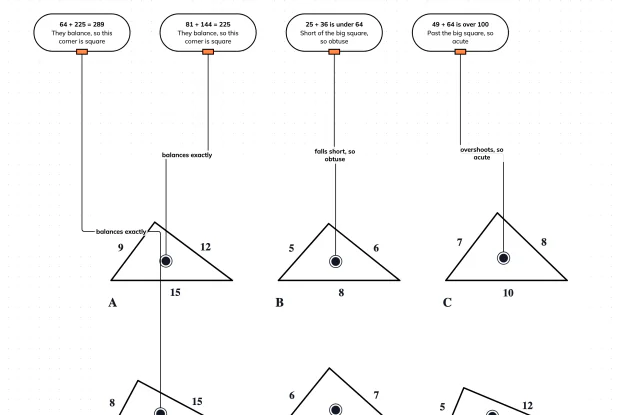
Because without it the balance simply does not hold. Take a triangle with sides 4, 5 and 6 and no right angle: the squares are 16, 25 and 36, and 16 + 25 = 41, which is not 36. The relationship fails, and it fails in an informative direction. When the largest angle is less than 90° the two small squares overshoot the big one; when it is more than 90° they fall short. Only at exactly 90° do they balance. So the theorem is not a general fact about triangles that happens to be easiest to state for right angles — it is a property of the right angle itself, which is why the converse in the last tutorial of this track can use it as a test for right angles.
Where Does the Theorem Come From?
There are hundreds of proofs, and the most persuasive ones are rearrangements rather than algebra. Take four copies of the same right-angled triangle and fit them inside a large square in two different ways. In the first arrangement the uncovered space is a single square built on the hypotenuse; in the second it is two squares, one on each of the shorter sides. The four triangles cover the same amount either way and the big square is the same size both times, so the leftover areas must be equal — which is the theorem. The result predates Pythagoras himself; Babylonian tablets list the triple 3, 4, 5 more than a thousand years earlier. His name stuck because his school is credited with the first general proof.
Real World Example
How Does a Builder Check a Foundation Is Square?
A right angle is the one thing a builder cannot afford to get wrong, and the theorem turns checking it into three measurements with a tape.
Two walls from a corner
3 m and 4 m marked
A builder setting out a foundation needs the corner to be a true right angle; a few degrees out at the corner becomes centimetres out at the far end of the wall, and every door and window suffers for it. A set square is useless at this scale. Instead the builder measures 3 metres along one wall line from the corner and marks it, then 4 metres along the other and marks that. These are the two shorter sides of a triangle, and their squares are 9 and 16 square metres — the two small squares in the diagrams you have been working with.
The measurement across
Exactly 5 m
Now the builder measures the distance directly between the two marks. If the corner is a true right angle, the square on that diagonal must equal 9 + 16 = 25, so the diagonal is the square root of 25, which is 5 metres exactly. If the tape reads 5 metres the corner is square. If it reads 5.1 the corner is too open, and if it reads 4.9 it is too tight, and in both cases the walls can be swung until the tape reads right. This is the 3-4-5 method, and it is used on building sites every day, usually by people who have never thought of it as geometry.
Why those three numbers
9 + 16 = 25
There is nothing magic about 3, 4 and 5 except that they are small whole numbers whose squares balance, which makes the check easy to do in the head and easy to measure accurately. Any multiple works just as well and is often better on a large site: 6, 8 and 10 metres give the same right angle with a longer baseline, so an error in the tape matters proportionally less. Other whole-number sets exist too, such as 5, 12, 13, and they are called Pythagorean triples. Builders tend to know one of them by heart without knowing it has a name.
FAQs
Final Words
Pythagoras' theorem says that on a right-angled triangle, the square drawn on the longest side holds exactly as much area as the squares on the other two put together. Written with letters that becomes a² + b² = c², but the sentence about areas is the thing worth carrying, because it tells you to add when the biggest square is missing and to subtract when it is not.
Working with areas is where the understanding lives; working with lengths is where the questions live. The next two tutorials make that step — taking a square root at the end to turn an area back into a side. They split into finding the hypotenuse, where you add, and finding a shorter side, where you subtract, because that single choice is where nearly every mistake in this topic is made.
Continue This Track
This concept is part 1 of Pythagoras' Theorem.
What Does Pythagoras' Theorem Actually Say?
Pythagoras' theorem is usually met as a formula, which hides what it means. Draw a square on each side of a right-angled triangle and the big one holds exactly as much as the two small ones together. Work with the squares themselves in an interactive playground before the formula appears.
How Do You Find the Hypotenuse?
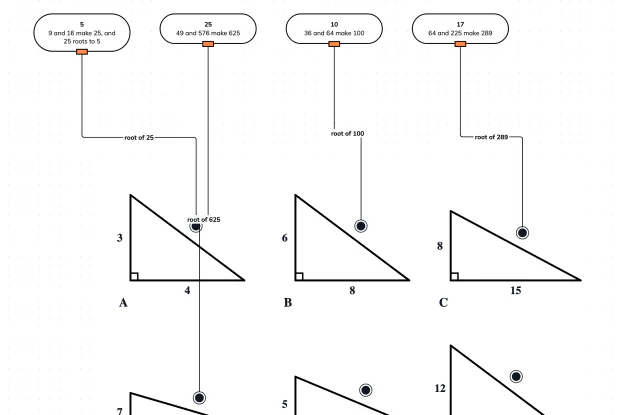
When both short sides of a right-angled triangle are known, the longest side comes from three steps: square each, add, take the square root. The adding is what marks this case out from the next one. Work through six triangles in an interactive playground.
How Do You Find a Shorter Side?
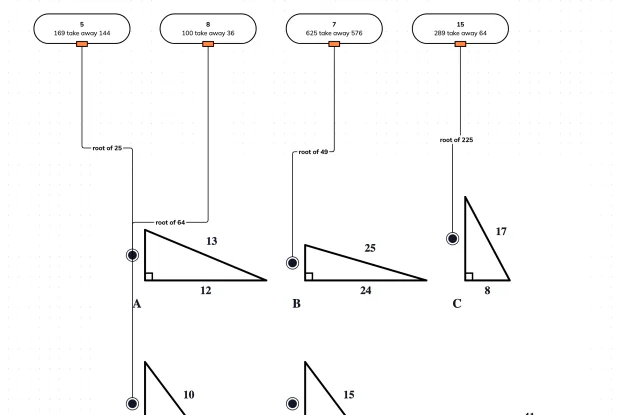
When the longest side is known and a shorter one is not, Pythagoras' theorem runs backwards: subtract instead of adding. The trap is the order — the big square always goes first. Practise the direction most often got wrong in an interactive playground.
Is This Triangle Right-Angled?
Pythagoras' theorem works in reverse. If the two shorter sides squared and added come to exactly the longest side squared, the triangle must contain a right angle — no protractor needed. And when they do not balance, the direction of the miss tells you what kind of triangle it is. Test six in an interactive playground.