Pythagoras' Theorem
Pythagoras' theorem is usually met as a formula, which hides what it is actually saying. This track starts with the picture instead: draw a square outwards on each side of a right-angled triangle and the square on the longest side holds exactly as much as the other two put together. Only once that has been worked with directly does the formula appear, and it turns out to be the same sentence written in symbols. The next two tutorials split the calculation along the line where nearly every mistake is made — adding when the longest side is missing, subtracting when it is not, with the square on the hypotenuse always going first. The last one runs the whole thing backwards: given three lengths and no diagram, the same comparison decides whether the triangle is right-angled at all, and the direction of any mismatch says whether its largest angle is obtuse or acute. That final test is the version builders and joiners actually use, because a length can be measured accurately with a tape and an angle cannot.
CodePLU Goal
Upgrading Human Mental Models
Learn how to think in Workflows
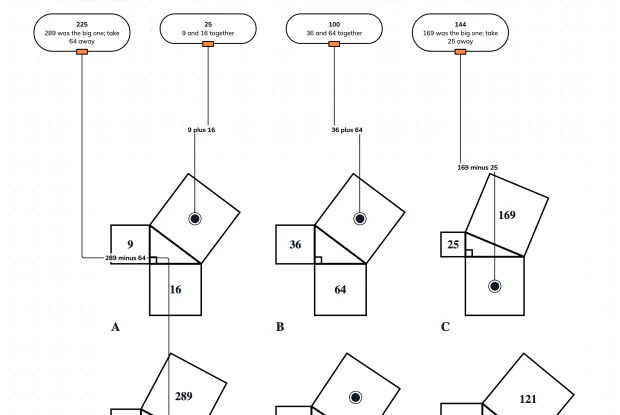
What Does Pythagoras' Theorem Actually Say?
Pythagoras' theorem is usually met as a formula, which hides what it means. Draw a square on each side of a right-angled triangle and the big one holds exactly as much as the two small ones together. Work with the squares themselves in an interactive playground before the formula appears.
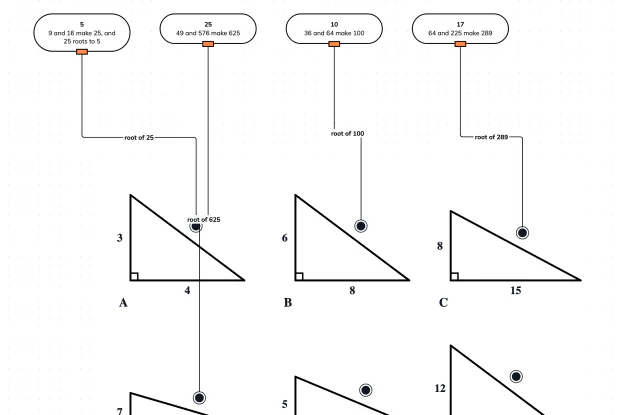
How Do You Find the Hypotenuse?
When both short sides of a right-angled triangle are known, the longest side comes from three steps: square each, add, take the square root. The adding is what marks this case out from the next one. Work through six triangles in an interactive playground.
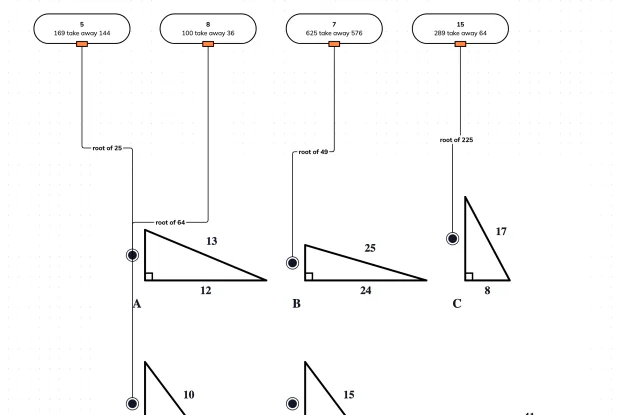
How Do You Find a Shorter Side?
When the longest side is known and a shorter one is not, Pythagoras' theorem runs backwards: subtract instead of adding. The trap is the order — the big square always goes first. Practise the direction most often got wrong in an interactive playground.
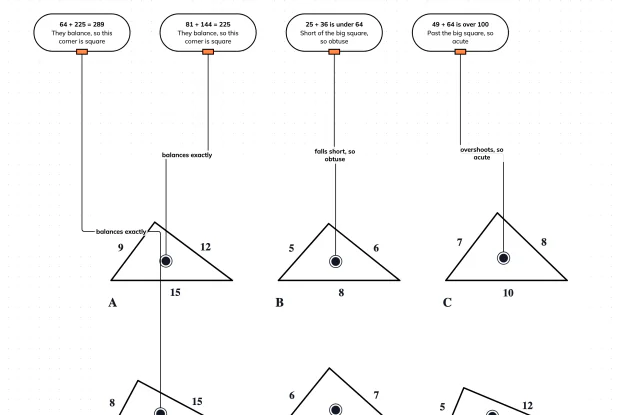
Is This Triangle Right-Angled?
Pythagoras' theorem works in reverse. If the two shorter sides squared and added come to exactly the longest side squared, the triangle must contain a right angle — no protractor needed. And when they do not balance, the direction of the miss tells you what kind of triangle it is. Test six in an interactive playground.