How Do You Find a Shorter Side?
Root Concept
A shorter side is the square root of the hypotenuse squared minus the other short side squared, in that order.
CodePLU Goal
Upgrading Human Mental Models
Learn how to think in Workflows

Concept Development By codeplu.com
The largest number on each triangle is the hypotenuse, and its square is always the one you subtract from.
What Changes When the Missing Side Is a Short One?
The theorem itself does not change at all. The square on the hypotenuse still holds as much area as the other two together. What changes is which square you are looking for. Last time the big square was unknown, so the two small ones were added to find it. This time the big square is known along with one of the small ones, so the known small square is taken away from the big one to leave the other.
So the three steps become square, subtract, root. And the subtraction brings in something the addition never had: an order. The big square must come first. Taking 169 from 144 rather than 144 from 169 gives a negative number, and there is no such thing as a negative area or a negative length, so a negative result is always a sign that the subtraction was done the wrong way round or the hypotenuse was misidentified.
That is why this is the harder of the two directions, and why every triangle in the playground is this case rather than the last. In each one the longest side is given, so each one needs a subtraction, and the practice is as much about spotting which number is the hypotenuse as about the arithmetic.
Getting the Subtraction the Right Way Round
What Are the Three Steps?
Square, subtract, root — with the hypotenuse's square as the thing you subtract from. Take a triangle with a hypotenuse of 13 and one short side of 12. Squaring gives 169 and 144. The square on the hypotenuse is 169, and it holds the other two, so the missing square is 169 − 144 = 25. Taking the square root gives 5, which is the missing side. In symbols this is a² = c² − b² and then a = √(c² − b²), where c is always the hypotenuse. The order inside the bracket is the whole difficulty. Say the sentence to yourself as the big square minus the small one, rather than trying to remember which letter goes where, and the arrangement on the page stops mattering.
How Do You Spot the Hypotenuse in a Question?
Two ways, and it is worth having both. On a diagram, find the small square marking the right angle and take the side that does not touch it. In a worded question with no diagram, the hypotenuse is simply the longest of the three lengths, so if you are given two numbers, the bigger one must be the hypotenuse whenever the missing side is a short one. That second test is quick and reliable: a right-angled triangle cannot have a side longer than its hypotenuse. If a question gives you a hypotenuse of 10 and a short side of 12, the question is faulty rather than difficult, because no such triangle exists. Noticing that is itself worth marks in some exams.
Why Does a Negative Result Mean Something Went Wrong?
Because you have subtracted the larger square from the smaller one, which can only happen if you treated a short side as the hypotenuse. The squares in this relationship are areas, and an area cannot be negative, so the calculation is telling you the arrangement was impossible rather than that the answer is unusual. If you ever write down something like 144 − 169 = −25 and then try to take the square root, stop and re-read which side is opposite the right angle. This is the most valuable error signal in the topic, because it is loud: the wrong-way-round subtraction announces itself, whereas a quietly wrong addition does not.
How Do You Check the Answer Is Sensible?
The missing short side must be smaller than the hypotenuse, always, because the hypotenuse is the longest side of the triangle. It must also be more than the difference between the hypotenuse and the other short side, by the triangle inequality. So with a hypotenuse of 17 and a short side of 8, the answer has to be less than 17 and more than 9, and 15 fits. That range takes a moment to work out and rules out most slips, including the commonest one of all — adding when you should have subtracted, which here would have given √353, about 18.8, immediately too big to be a short side of a triangle whose longest side is 17.
Real World Example
How Far Up a Wall Does a Ladder Reach?
The ladder length and the distance out are both known, and the height reached is the side nobody can measure from the ground.
What is fixed
A 13 m ladder, 5 m out
A ladder is 13 metres long, and safety guidance puts its foot roughly a quarter of its length away from the wall, so it is set 5 metres out. Both of those are known before anyone climbs: the ladder's length is stamped on it and the distance out is measured along the ground with a tape. The wall is vertical and the ground horizontal, so the right angle is at the foot of the wall, and the ladder itself is the hypotenuse — which it has to be, since it is the longest of the three and is opposite that right angle.
The subtraction
169 − 25 = 144
Square the two known lengths: the ladder gives 169 and the distance out gives 25. Because the ladder is the hypotenuse, its square is the one that holds both of the others, so the square on the wall height is 169 − 25 = 144. Doing this the other way round would give 25 − 169 = −144, which is the signal that the ladder and the ground distance have been swapped. Here the mistake would be obvious from the picture, but in a worded question with no diagram the negative result is often the first hint that something is wrong.
The height reached
12 m up the wall
The square root of 144 is 12, so the ladder reaches 12 metres up the wall. Check it: 12 is less than the 13-metre ladder, as any side must be, and more than 13 − 5 = 8, so it sits in the range the triangle inequality allows. This is the calculation behind every decision about whether a ladder is long enough for a job, and it is why moving the foot out for safety costs height — setting the same ladder 6 metres out instead of 5 leaves 169 − 36 = 133, and a reach of about 11.5 metres.
FAQs
Final Words
Finding a shorter side uses the same theorem in reverse: square the two known lengths, subtract the smaller from the square on the hypotenuse, then take the square root. The only new difficulty is the order, and it announces itself when you get it wrong — a negative result means a short side was mistaken for the hypotenuse.
Both directions of the calculation are now covered, and both assumed from the start that the triangle really does contain a right angle. The last tutorial in this track turns that assumption into a question: given three lengths and no diagram, the same relationship can be used to decide whether the triangle is right-angled at all.
Continue This Track
This concept is part 3 of Pythagoras' Theorem.
What Does Pythagoras' Theorem Actually Say?
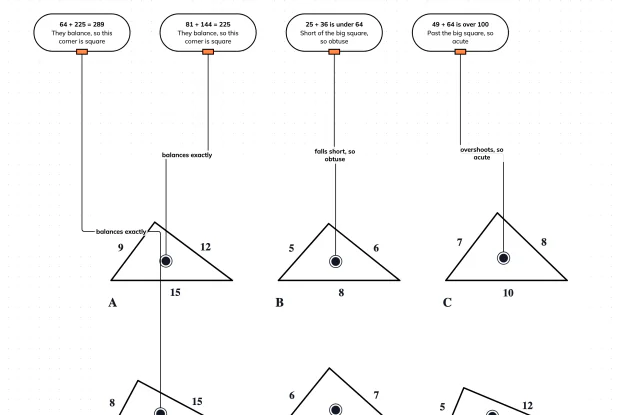
Pythagoras' theorem is usually met as a formula, which hides what it means. Draw a square on each side of a right-angled triangle and the big one holds exactly as much as the two small ones together. Work with the squares themselves in an interactive playground before the formula appears.
How Do You Find the Hypotenuse?
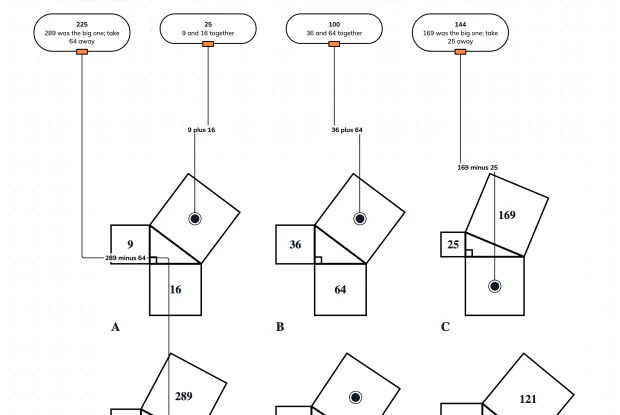
When both short sides of a right-angled triangle are known, the longest side comes from three steps: square each, add, take the square root. The adding is what marks this case out from the next one. Work through six triangles in an interactive playground.
How Do You Find a Shorter Side?
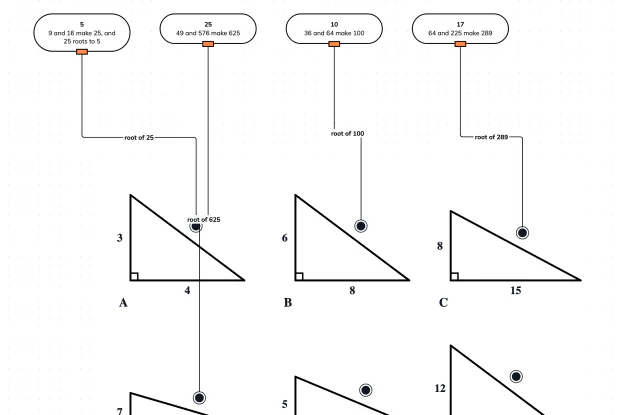
When the longest side is known and a shorter one is not, Pythagoras' theorem runs backwards: subtract instead of adding. The trap is the order — the big square always goes first. Practise the direction most often got wrong in an interactive playground.
Is This Triangle Right-Angled?
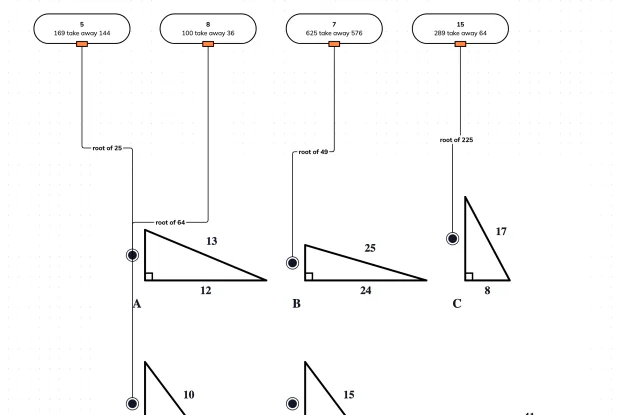
Pythagoras' theorem works in reverse. If the two shorter sides squared and added come to exactly the longest side squared, the triangle must contain a right angle — no protractor needed. And when they do not balance, the direction of the miss tells you what kind of triangle it is. Test six in an interactive playground.