Is This Triangle Right-Angled?
Root Concept
If the two shorter sides squared add to the longest squared, the triangle has a right angle — and the direction of any mismatch names the triangle.
CodePLU Goal
Upgrading Human Mental Models
Learn how to think in Workflows

Concept Development By codeplu.com
Compare the two small squares added together with the big one: equal, under, or over, and each answer names a different kind of triangle.
Can Lengths Alone Tell You About an Angle?
Everything so far in this track has started from a triangle already known to be right-angled and used that to find a missing length. This tutorial runs the reasoning the other way. Given three lengths and no diagram, no protractor and no promise of a right angle anywhere, you can still say with certainty whether the triangle contains one.
The test is the theorem read backwards, and it is called the converse. Square the two shorter sides, add them, and compare with the square of the longest. If the two sides are exactly equal, the triangle is right-angled, with the right angle opposite the longest side. It is a genuine proof rather than a strong hint: only a right-angled triangle can make those numbers balance.
What makes the test more useful still is what happens when the numbers do not balance, because the direction of the miss is informative. If the two small squares come to less than the big one, the largest angle is obtuse; if they come to more, every angle is acute. So three lengths classify the triangle completely, and the playground below has all three outcomes mixed together.
Running the Test and Reading the Result
How Do You Run the Test?
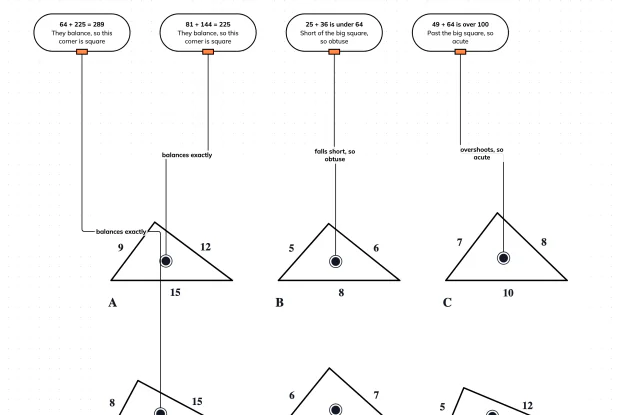
Identify the longest side first, because everything is compared against it. Square the other two, add them, and square the longest. Then compare the two numbers. For sides 9, 12 and 15, the longest is 15: the two small squares are 81 and 144, which total 225, and 15 squared is also 225, so the triangle is right-angled. For sides 5, 6 and 8 the longest is 8: 25 + 36 = 61 while 64 is the square of 8, so they do not balance. The order of the two shorter sides never matters, since they are being added, but picking the wrong side as the longest breaks everything, so it is worth writing the three lengths in order before starting.
What Does It Mean If They Do Not Balance?
The gap tells you which way the largest angle has moved. When the two small squares total less than the big square, the longest side is longer than a right angle would allow, so the angle opposite it has opened past 90° and the triangle is obtuse — that is the case with 5, 6 and 8, where 61 falls short of 64. When they total more, the longest side is shorter than a right angle would give, so that angle is under 90° and, since it is the largest, every angle is acute; that is 7, 8 and 10, where 113 overshoots 100. Picture the longest side as a hinge opening: squeeze it and the small squares overshoot, stretch it and they fall short.
Why Is the Converse Actually True?
It is not the same statement as the theorem and does need its own argument, though a short one. Suppose three lengths satisfy the relationship. Build a genuine right-angled triangle using the two shorter lengths as its legs; by the theorem its hypotenuse must be exactly the third length. So you now have two triangles with all three sides the same, which by the SSS congruence rule from the last track makes them identical. The original triangle therefore has the same angles as one you deliberately built with a right angle, so it has a right angle too. This is a good example of congruence being used to prove something rather than merely to compare two shapes.
Where Does This Get Used?
Anywhere a right angle has to be confirmed rather than assumed, and where the angle itself is awkward to measure. Builders check the corners of foundations with the 3-4-5 method, which is exactly this test run in advance. Carpenters square up a frame by measuring its two diagonals, a related check. Surveyors and machinists use it to verify setups where a protractor would be too coarse, because measuring lengths accurately is far easier than measuring angles accurately. The underlying reason is that a small error in an angle becomes while a length can be checked straight off a tape. The same reasoning is why the test is run over the largest triangle that will fit: a longer baseline makes any given measuring error a smaller fraction of the whole.
Real World Example
How Does a Joiner Check a Door Frame Is Square?
A frame that is out of square binds the door, and the fault is easier to measure with a tape than with any square that fits in a toolbox.
The two sides
900 mm and 2000 mm
A joiner fitting a door frame measures 900 mm along the head of the frame from the corner, and 2000 mm down the jamb from the same corner, marking both. These two measurements are along the frame itself, so they are quick and reliable. A carpenter's square would only check the first 200 mm of the corner and would miss a gentle bow further along, which is exactly the fault that stops a door closing. The two marks define a triangle whose third side is the diagonal between them, and that diagonal is what carries the information.
The diagonal it should have
2193 mm if square
If the corner is a true right angle, the diagonal must satisfy the relationship: 900 squared is 810,000 and 2000 squared is 4,000,000, which total 4,810,000. The square root of that is about 2193 mm. So the joiner stretches the tape between the two marks and looks for 2193. Note what has happened here: an angle that would need a large and expensive square to measure directly has been converted into a single length that any tape can read to the nearest millimetre. The awkward decimal is no obstacle either, because the joiner never has to calculate with it — only to check whether the tape agrees.
Reading the error
Too long means too open
If the tape reads 2200 rather than 2193, the diagonal is longer than a right angle allows, so the two small squares fall short of the big one and the corner has opened past 90°. If it reads 2185 the corner is tight. In both cases the joiner knows not just that the frame is out but which way, and by roughly how much, which is what turns a measurement into an instruction. This is the same reading of the mismatch that separates the obtuse and acute cases in the playground, applied to a job where being seven millimetres out is the difference between a door that swings and one that sticks.
FAQs
Final Words
Three lengths are enough to classify a triangle. Square the two shorter ones, add them, and compare with the square of the longest: equal means a right angle, less means the largest angle is obtuse, and more means every angle is acute. No protractor is involved anywhere, which is precisely why builders, joiners and surveyors use it.
That closes this track. You can now find either kind of missing side in a right-angled triangle, and decide whether a triangle is right-angled in the first place — and the proof of that last step leaned on the congruence rules from the previous track, which is a good sign that the chapter is starting to hold together rather than being a list of separate facts.
Continue This Track
This concept is part 4 of Pythagoras' Theorem.
What Does Pythagoras' Theorem Actually Say?
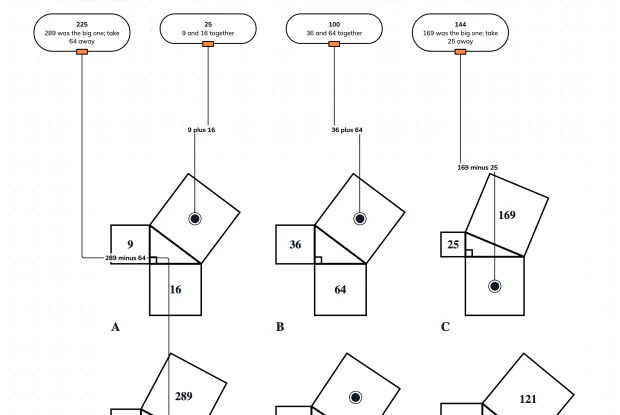
Pythagoras' theorem is usually met as a formula, which hides what it means. Draw a square on each side of a right-angled triangle and the big one holds exactly as much as the two small ones together. Work with the squares themselves in an interactive playground before the formula appears.
How Do You Find the Hypotenuse?
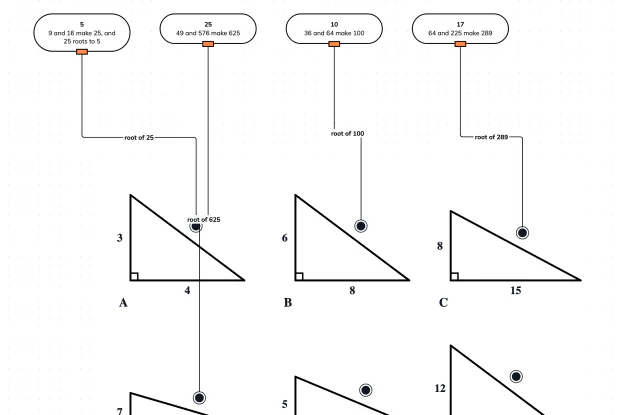
When both short sides of a right-angled triangle are known, the longest side comes from three steps: square each, add, take the square root. The adding is what marks this case out from the next one. Work through six triangles in an interactive playground.
How Do You Find a Shorter Side?
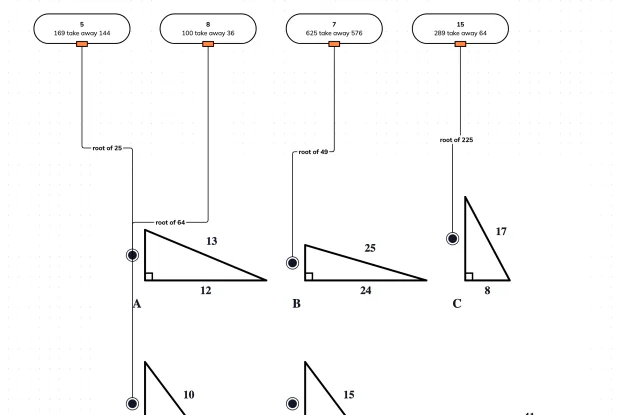
When the longest side is known and a shorter one is not, Pythagoras' theorem runs backwards: subtract instead of adding. The trap is the order — the big square always goes first. Practise the direction most often got wrong in an interactive playground.
Is This Triangle Right-Angled?
Pythagoras' theorem works in reverse. If the two shorter sides squared and added come to exactly the longest side squared, the triangle must contain a right angle — no protractor needed. And when they do not balance, the direction of the miss tells you what kind of triangle it is. Test six in an interactive playground.