How Do You Find the Hypotenuse?
Root Concept
The hypotenuse is the square root of the two shorter sides squared and added.
CodePLU Goal
Upgrading Human Mental Models
Learn how to think in Workflows

Concept Development By codeplu.com
The missing side is opposite the right angle in every one of these, so every one of them adds rather than subtracts.
Why Is This the Easier of the Two Cases?
The last tutorial worked entirely in areas: the square on the longest side holds as much as the other two together. Questions, though, ask about lengths, so there is one more step to make — turning an area back into a side by taking a square root. That step is what this tutorial adds.
This is the easier of the two directions because you are adding. Both short sides are known, so you square each one to get the two small square areas, add them to get the big square area, and take the square root to get back to a length. Three steps, always in that order, and no decisions to make along the way.
The one thing worth checking before you start is which side is actually missing. If the missing side is opposite the right angle, you are in this tutorial and you add. If it is one of the sides touching the right angle, you are in the next one and you subtract. Getting that backwards is the single most common error in the whole topic, and every triangle in the playground below is deliberately the adding case so the method can be practised cleanly first.
The Method, Step by Step
What Are the Three Steps?
Square, add, root. Take a triangle with short sides of 3 and 4. Squaring gives 9 and 16, which are the areas of the squares on those sides. Adding gives 25, which is the area of the square on the hypotenuse. Taking the square root of 25 gives 5, which is the length of the hypotenuse itself. Written in symbols that is c² = a² + b², then c = √(a² + b²), but the three words are easier to hold on to than the formula. The most common slip is stopping after the addition and writing 25 as the answer. 25 is an area, not a length, and forgetting the root is the mistake to watch for — a useful guard is that the answer should look like a sensible side length, not a much larger number.
How Do You Know the Answer Is Reasonable?
Two checks take seconds and catch almost everything. First, the hypotenuse must be longer than either of the other two sides, because it is opposite the largest angle. If your answer comes out smaller than one of the given sides, something has gone wrong, and it is usually that you subtracted when you should have added. Second, the hypotenuse must be shorter than the two short sides added together, because of the triangle inequality from earlier in this chapter. So for sides of 3 and 4 the answer has to lie between 4 and 7, and 5 sits comfortably inside that. Getting into the habit of glancing at that range before and after the calculation is worth more than checking the arithmetic twice.
What If the Answer Is Not a Whole Number?
Most of the time it will not be, and that is perfectly normal. Sides of 3 and 5 give 9 + 25 = 34, and √34 is about 5.83, which does not simplify to anything neat. Textbook questions lean on Pythagorean triples such as 3-4-5 and 5-12-13 because whole numbers are easier to check, but real measurements rarely cooperate. When the root is not exact, either leave it as √34 if the question asks for an exact answer, or round sensibly and say what you rounded to — usually one or two decimal places, and never more precision than the measurements you were given. An answer of 5.8309518948 from sides measured to the nearest centimetre is claiming an accuracy that does not exist.
Does the Triangle Have to Be Drawn a Particular Way Up?
No, and diagrams are often rotated deliberately to test exactly that. The hypotenuse is defined by its relationship to the right angle, not by its position on the page: it is the side that does not touch the right angle. A right-angled triangle standing on its hypotenuse, with the right angle at the top, is still an ordinary right-angled triangle and the method is unchanged. Before starting any calculation, find the small square that marks the right angle and identify which side is opposite it. Doing that first costs a second and removes the main source of error, which is treating whichever side looks longest, or whichever is drawn along the bottom, as the hypotenuse.
Real World Example
How Long a Cable Does a Mast Need?
The mast stands vertical and the ground runs horizontal, so the cable between them is the hypotenuse of a right-angled triangle.
The two known distances
24 m up, 7 m out
A radio mast is to be held steady by a guy cable running from a point 24 metres up the mast to an anchor in the ground 7 metres out from its base. Both of these are easy to measure: the height is read off the mast itself and the distance along the ground with a tape. What nobody can measure directly is the cable, because it does not exist yet — that is the quantity being ordered. The mast is vertical and the ground horizontal, so the angle between them is a right angle, which is what makes the calculation available at all.
Squaring and adding
49 + 576 = 625
Square the two known lengths: 7 squared is 49 and 24 squared is 576. Adding them gives 625, which is the area of the square on the cable. It is worth noticing how much bigger that number is than either input, and how meaningless it would be as an answer — nobody orders 625 metres of cable for a 24-metre mast. This is the step where the units change from metres to square metres and back again, and it is exactly where a rushed calculation goes wrong by stopping one step early. Keeping the units in mind is the guard: square metres are not something you can order on a drum.
Back to a length
25 m of cable
Taking the square root of 625 gives 25, so the cable is 25 metres long. Run the sanity check: it must be longer than 24 and shorter than 7 + 24 = 31, and 25 sits inside that range. In practice the rigger would order rather more than 25 metres to allow for the fixings at both ends and for tensioning, but the geometry gives the number everything else is measured from. The same calculation, with different numbers, sizes every diagonal brace, stay wire and ladder pitch on a site, which is why riggers reach for these three steps far more often than for a tape long enough to measure the diagonal itself.
FAQs
Final Words
Finding the hypotenuse is three steps in a fixed order: square both short sides, add them, take the square root. The addition is what identifies this case, and the square root is the step most often forgotten — the number you get from adding is an area and has to be converted back into a length before it answers the question.
Two quick checks make the answer trustworthy without redoing the arithmetic: the hypotenuse must be longer than either short side and shorter than the two of them added together. The next tutorial takes the other direction, where the hypotenuse is known and a shorter side is not, and there the order of the subtraction matters as much as the subtraction itself.
Continue This Track
This concept is part 2 of Pythagoras' Theorem.
What Does Pythagoras' Theorem Actually Say?
Pythagoras' theorem is usually met as a formula, which hides what it means. Draw a square on each side of a right-angled triangle and the big one holds exactly as much as the two small ones together. Work with the squares themselves in an interactive playground before the formula appears.
How Do You Find the Hypotenuse?
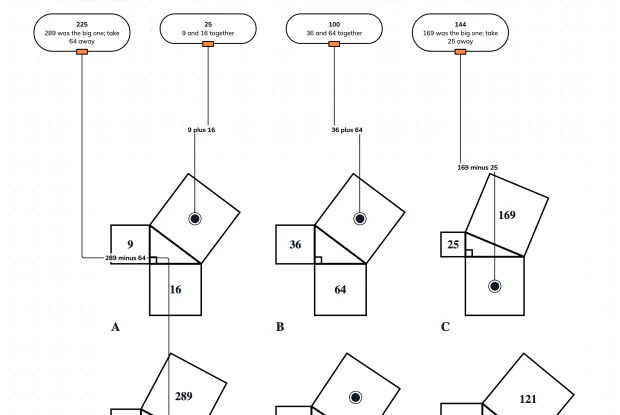
When both short sides of a right-angled triangle are known, the longest side comes from three steps: square each, add, take the square root. The adding is what marks this case out from the next one. Work through six triangles in an interactive playground.
How Do You Find a Shorter Side?
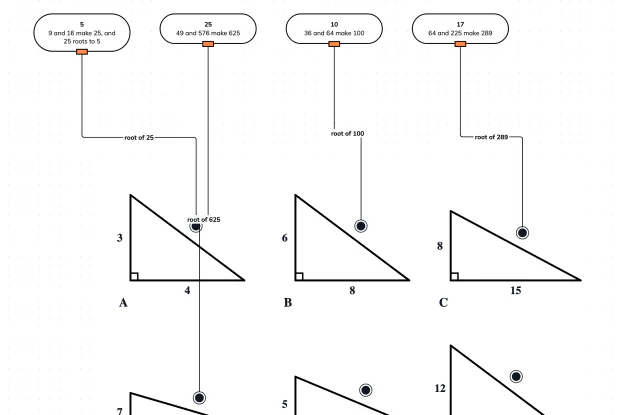
When the longest side is known and a shorter one is not, Pythagoras' theorem runs backwards: subtract instead of adding. The trap is the order — the big square always goes first. Practise the direction most often got wrong in an interactive playground.
Is This Triangle Right-Angled?
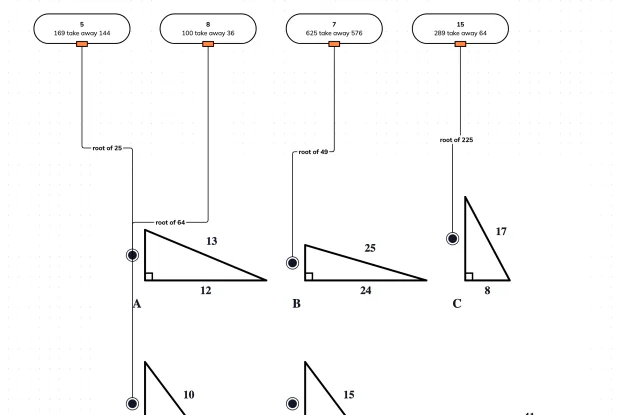
Pythagoras' theorem works in reverse. If the two shorter sides squared and added come to exactly the longest side squared, the triangle must contain a right angle — no protractor needed. And when they do not balance, the direction of the miss tells you what kind of triangle it is. Test six in an interactive playground.