How Do You Find a Missing Side in Similar Triangles?
Root Concept
One complete pair of matching sides gives the scale factor, and the scale factor gives every other side.
CodePLU Goal
Upgrading Human Mental Models
Learn how to think in Workflows

Concept Development By codeplu.com
Match the sides up by their position in the triangle before dividing. The longest goes with the longest, not whichever is written first.
Why Is One Pair Enough?
Similar triangles have all their matching sides in the same ratio. That single number covers the whole shape, so it can be found from any one pair of matching sides and then used on every other pair. A triangle with sides 6 and 8 enlarged so that the 6 becomes 9 has a scale factor of 1.5, and the 8 must therefore become 12.
Two steps, then. Find the scale factor by dividing the pair you have both members of, then multiply the side you know by that factor to get the one you want. Nothing about the shape or the angles is needed; the factor carries all of it.
The step before both of those is the one that goes wrong: matching the sides up correctly. The sides have to be paired by their position in the triangle, not by the order they are written or where they sit on the page, and a rotated or flipped diagram is a favourite way of testing whether you are doing that. In the playground the triangles are all the same way up, which keeps the practice on the arithmetic.
Matching, Dividing, Multiplying
How Do You Match the Sides Up?
By position in the triangle rather than by appearance on the page. The longest side of one triangle corresponds to the longest of the other, the shortest to the shortest, and the side opposite a particular angle corresponds to the side opposite the matching angle. That last version is the reliable one, because it survives any rotation or reflection of the diagram. A quick way to organise it is to write the two triangles' sides in size order and pair them off in those lists rather than working from the picture. Exam questions rotate one triangle on purpose, and a surprising number of wrong answers come from correct arithmetic done on the wrong pairing.
What Are the Two Steps?
Divide, then multiply. Take the pair you know both sides of and divide the new by the old to get the scale factor: 9 against 6 gives 1.5. Then multiply the remaining known side by that factor: 8 × 1.5 = 12. Where the missing side is on the smaller triangle rather than the larger, divide instead of multiplying, or equivalently work out the factor the other way round from the start. Some courses set it up as an equation of two fractions instead, matching 9/6 to x/8 and cross-multiplying, which gets the same answer by the same reasoning. The two-step version is easier to keep straight because the scale factor is a number you can sanity-check on its own.
How Do You Check the Answer?
Ask whether it should be bigger or smaller, and whether it is. If the triangle is being enlarged, every side of the new triangle must be longer than its match, so an answer that comes out smaller means the factor was applied the wrong way round. It is also worth checking the proportions look right: in a triangle whose sides were 6 and 8, the second side is about a third longer than the first, and that should still be true of 9 and 12. This catches a mispairing, which pure arithmetic checking never will, because a mispairing catches a mispairing, which pure arithmetic checking never will, because a mispairing produces a perfectly consistent calculation carried out on the wrong pair of numbers.
How Are Similar Triangles Spotted in the Wild?
Usually by their angles, since equal angles alone make triangles similar. The classic arrangement is two triangles sharing an angle with a line drawn parallel to one side, which creates equal corresponding angles and so two similar triangles nested inside each other. Another is two triangles meeting at a point, where vertically opposite angles do the work. Both patterns appear constantly in exam questions and in real measurement problems, and recognising them is what turns an unpromising diagram into a straightforward two-step calculation. Once the triangles are identified as similar, everything in this tutorial calculation. Once the triangles are identified as similar, everything in this tutorial applies unchanged, which is why spotting the pattern is usually the whole difficulty in a question rather than the arithmetic that follows it.
Real World Example
How Do You Measure a Tree Without Climbing It?
The sun is far enough away that its rays arrive parallel, which is what makes the two shadows belong to similar triangles.
What you can measure
A 1 m rule casting 0.8 m
Stand a metre rule upright on flat ground on a sunny day and measure its shadow: suppose it comes to 0.8 metres. Both of those numbers are taken with a tape at ground level and need no skill at all. The rule and its shadow form a right-angled triangle, with the sunlight as the hypotenuse. Nearby, a tree casts its own shadow, and because the sun is so far away its rays arrive effectively parallel, so the tree's triangle has exactly the same angles as the rays arrive effectively parallel, so the tree's triangle has exactly the same angles as the rule's — and equal angles are all two triangles need to be similar.
The measurement you want
A 9.6 m shadow
Measure the tree's shadow along the ground: 9.6 metres. That is the side matching the rule's 0.8-metre shadow, so the scale factor is 9.6 ÷ 0.8 = 12. The tree's triangle is twelve times the rule's in every direction. Applying that factor to the rule's height gives the tree: 1 × 12 = 12 metres. Two tape measurements on the ground and one division have produced a height nobody could reach, and the whole thing rests on the two triangles have produced a height nobody could reach with a tape, and the whole thing rests on the two triangles being the same shape rather than on any measurement of the tree itself.
What can go wrong
Sloping ground
The method fails in exactly the ways the similarity conditions fail. If the ground under the tree slopes while the ground under the rule is level, the two triangles no longer have matching angles and the factor is wrong. The same happens if the measurements are taken minutes apart, since the sun moves and the shadows change length. Foresters who use this method take both shadows within moments of each other and on comparable ground, which is not superstition but the practical form of the condition that the two triangles must be similar before any of the arithmetic means anything.
FAQs
Final Words
Similar triangles share one scale factor across every pair of matching sides, so one complete pair unlocks the rest. Divide to find the factor, multiply to apply it, and do the matching up before either — by position in the triangle rather than by where a side happens to sit on the page.
This is the result behind measuring anything too big or too awkward to reach, from a tree's height to a river's width. Every length in the enlarged triangle is the old length times the factor. The last tutorial in this track asks what happens to the space inside, where the answer is not the factor at all.
Continue This Track
This concept is part 3 of Similar Shapes and Scale.
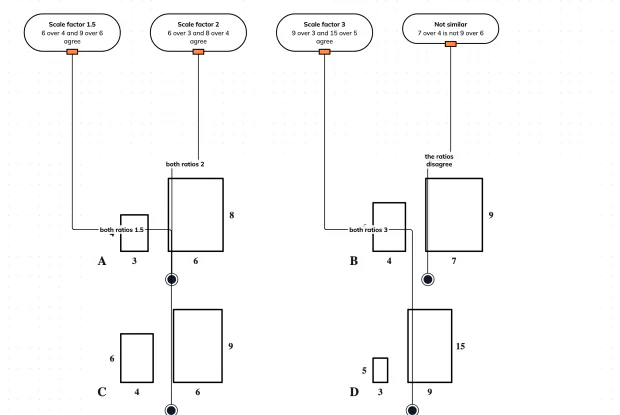
When Are Two Shapes Similar?
Similar shapes have equal angles and sides in the same ratio: one is an exact enlargement of the other. Two rectangles can look very alike and fail the test outright. Sort the genuine enlargements from the near-misses in an interactive playground.
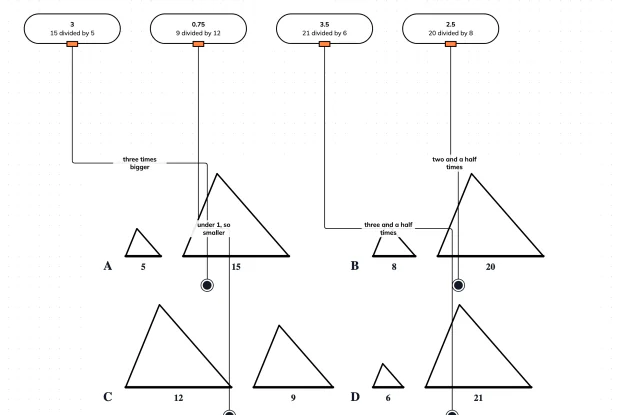
How Do You Find a Scale Factor?
The scale factor is the number every length is multiplied by when a shape is enlarged. Find it by dividing a new length by the matching old one — and expect an answer below 1 when the shape has shrunk. Practise both directions in an interactive playground.
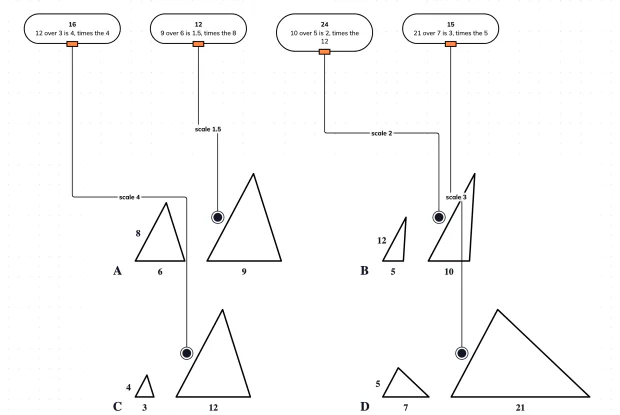
How Do You Find a Missing Side in Similar Triangles?
Similar triangles share one scale factor across every pair of matching sides, so one complete pair is enough to find any other length. Work out the factor, then multiply. Practise the two steps — and the matching up that comes before them — in an interactive playground.
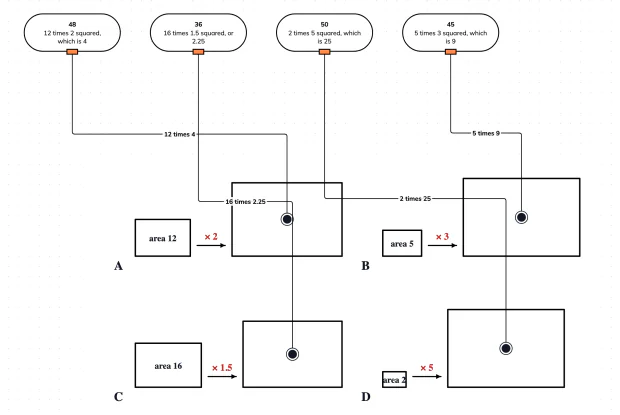
What Happens to Area When a Shape Is Enlarged?
Enlarging a shape by a scale factor multiplies every length by that factor — but the area goes up by the factor squared. Double a shape and it holds four times as much. See why, and why it explains a great deal about pizza and paint, in an interactive playground.