What Happens to Area When a Shape Is Enlarged?
Root Concept
Lengths are multiplied by the scale factor; areas are multiplied by the scale factor squared.
CodePLU Goal
Upgrading Human Mental Models
Learn how to think in Workflows

Concept Development By codeplu.com
Area is a length times a length, so both of them get multiplied by the scale factor — which is why the factor appears twice.
Does Doubling a Shape Double Its Area?
It does not, and the gap between what people expect and what happens is large enough to be worth a tutorial of its own. Double every length of a shape and it holds four times as much, not twice as much. Treble the lengths and the area goes up nine times.
The reason is one line. Area is always a length multiplied by a length — base times height for a rectangle, half base times height for a triangle, π times radius times radius for a circle. Enlarging multiplies each of those lengths by the scale factor, so the factor appears twice in the answer. Multiplying by the factor twice is the same as multiplying by its square.
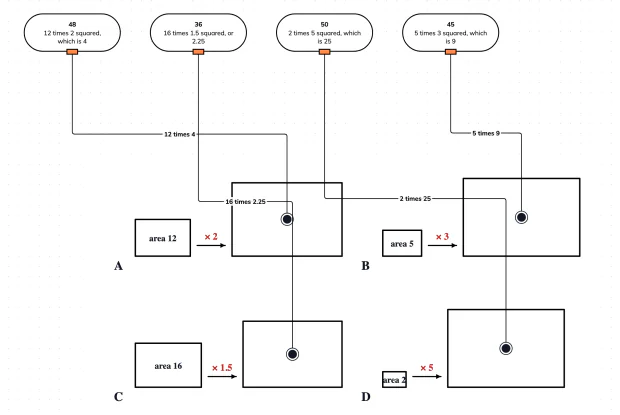
So the rule is: lengths go up by the scale factor, areas go up by the factor squared. A shape of area 12 enlarged by a factor of 2 has an area of 12 × 4 = 48. The playground makes the same mistake available on every board, because multiplying the area by the factor itself is what almost everyone does first.
Why the Factor Appears Twice
Why Is It the Square?
Follow a rectangle through an enlargement. Its area is base × height. Enlarge by a factor of 3 and the base becomes 3 × base while the height becomes 3 × height, so the new area is 3 × base × 3 × height, which is 9 × base × height. The two threes multiply together into a nine. Nothing about that argument is specific to rectangles: every area formula is built from lengths multiplied together in pairs, so every one of them picks up the factor twice. A circle of radius r has area πr², and trebling r gives π(3r)² = 9πr². The square in the area rule comes from the square in the word area itself: square units.
How Do You Use It?
Square the factor first, then multiply. A shape of area 16 enlarged by 1.5 becomes 16 × 1.5² = 16 × 2.25 = 36. Doing the squaring before the multiplying keeps it clear that the square belongs to the factor and not to the area. Running it backwards is just as common in questions: if an area goes from 5 to 45, the area factor is 9, so the length factor is √9 = 3. That square root step is the one people miss, and the symptom is an answer far too large — concluding that lengths were multiplied by 9 when they were only trebled. Whenever a question mixes lengths and areas, write down which factor you are holding.
What About Volume?
It follows the same logic one step further. A volume is three lengths multiplied together, so enlarging by a factor multiplies volume by the factor cubed. Double every dimension of a solid and it holds eight times as much, while its surface area goes up four times. That mismatch between four and eight is one of the most consequential facts in nature: it is why large animals need proportionally thicker legs, why small creatures lose heat so much faster than large ones, and why a scale model of a bridge cannot simply be built bigger and expected to behave the same way. The pattern is that lengths take the power one, areas the power two, volumes the power three.
Where Does This Catch People Out?
Anywhere something is priced by area but described by length. A pizza sold as sixteen inches across is not a third bigger than a twelve-inch one, it is nearly twice the pizza, because the area factor is (16/12)² = 1.78. Paint covering a wall twice as tall and twice as wide needs four times as much, not twice. A garden twice the size on the plan takes four times the turf. In each case the instinct is to scale the price or the quantity in step with the length, and in each case that is wrong by the factor again. Getting used to asking whether a quantity is a length or an area is most of the defence.
Real World Example
Which Pizza Is Better Value?
The number on the menu is a length, but what you are buying is an area, and the two do not scale together.
What the sizes mean
12 inches and 16 inches
Pizzas are sold by diameter, which is a length across the middle. A 16-inch pizza is described by a number a third larger than a 12-inch one — 16 ÷ 12 is about 1.33 — and that is the figure most people have in mind when they compare the prices. It is the scale factor for lengths, and it is the right number for the diameter, the radius and the distance round the crust. It is the wrong number entirely for the thing being eaten, It is the wrong number entirely for the thing actually being eaten, which is the area of the top.
What you actually get
Nearly twice as much
The area goes up by the square of the scale factor: 1.33² is about 1.78. So the 16-inch pizza carries roughly seventy-eight per cent more topping than the 12-inch one, not thirty-three per cent more. Checking it directly gives the same answer — areas of π × 6² = 113 and π × 8² = 201 square inches, and 201 ÷ 113 is 1.78. The larger pizza is therefore better value at any price up to 1.78 times the smaller one, which is a good deal more than most menus charge for the step up in size.
The same trap elsewhere
Paint, turf, screens
The pattern repeats wherever a product is named by a length and sold by an area. A television described as 55 inches is measured across its diagonal, so a 55-inch screen has about a third more area than a 48-inch one rather than fifteen per cent more. A wall twice as high and twice as wide needs four tins of paint, not two. In every case the instinct to scale in step with the length understates the answer, and the fix is the same one sentence: understates the answer, sometimes badly, and the fix is the same single sentence every time: areas take the square of the factor.
FAQs
Final Words
Enlarging a shape multiplies its lengths by the scale factor and its area by the factor squared, because an area is always a length times a length and both of them grow. Double a shape and it holds four times as much; treble it and it holds nine times. Running the rule backwards needs a square root, which is the step most often left out.
That completes this track. Similar shapes are exact enlargements, the scale factor is the single number describing one, it finds any missing length in similar triangles — and it has to be squared before it says anything about area, or cubed before it says anything about volume.
Continue This Track
This concept is part 4 of Similar Shapes and Scale.
When Are Two Shapes Similar?
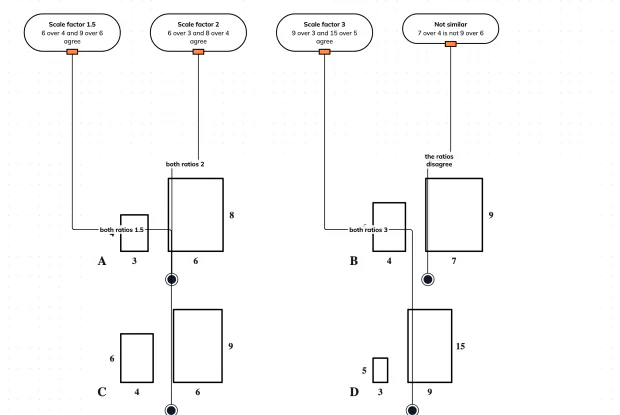
Similar shapes have equal angles and sides in the same ratio: one is an exact enlargement of the other. Two rectangles can look very alike and fail the test outright. Sort the genuine enlargements from the near-misses in an interactive playground.
How Do You Find a Scale Factor?
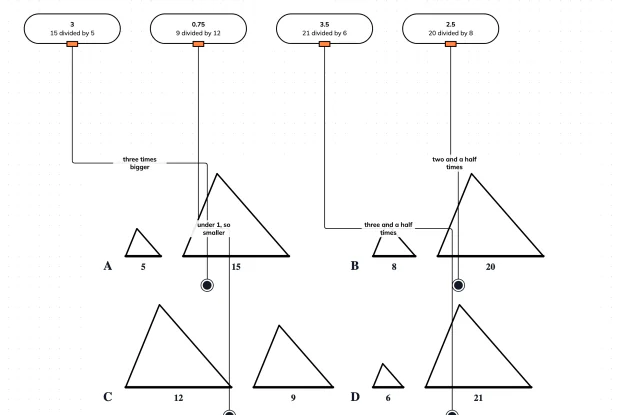
The scale factor is the number every length is multiplied by when a shape is enlarged. Find it by dividing a new length by the matching old one — and expect an answer below 1 when the shape has shrunk. Practise both directions in an interactive playground.
How Do You Find a Missing Side in Similar Triangles?
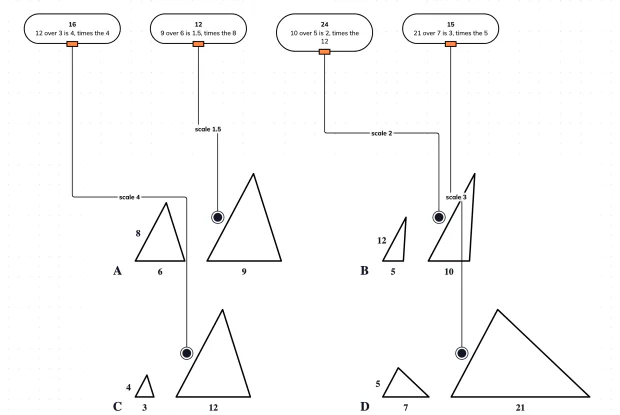
Similar triangles share one scale factor across every pair of matching sides, so one complete pair is enough to find any other length. Work out the factor, then multiply. Practise the two steps — and the matching up that comes before them — in an interactive playground.
What Happens to Area When a Shape Is Enlarged?
Enlarging a shape by a scale factor multiplies every length by that factor — but the area goes up by the factor squared. Double a shape and it holds four times as much. See why, and why it explains a great deal about pizza and paint, in an interactive playground.