When Are Two Shapes Similar?
Root Concept
Similar means one shape is an exact enlargement of the other: equal angles and every pair of matching sides in the same ratio.
CodePLU Goal
Upgrading Human Mental Models
Learn how to think in Workflows

Concept Development By codeplu.com
Divide each side of the larger shape by its match on the smaller one. Similar means every division gives the same answer.
What Does Similar Mean in Geometry?
In everyday English similar means roughly alike. In geometry it means something exact: one shape is an enlargement of the other, the same shape at a different size. Photocopy a triangle at 150 per cent and the copy is similar to the original; stretch it sideways only and it is not.
Two conditions have to hold together. All the matching angles must be equal, and all the matching sides must be in the same ratio. For triangles, equal angles alone is enough, because a triangle's shape is fixed by its angles — which is the AAA result from the congruence track, answering a different question. For every other shape you need both.
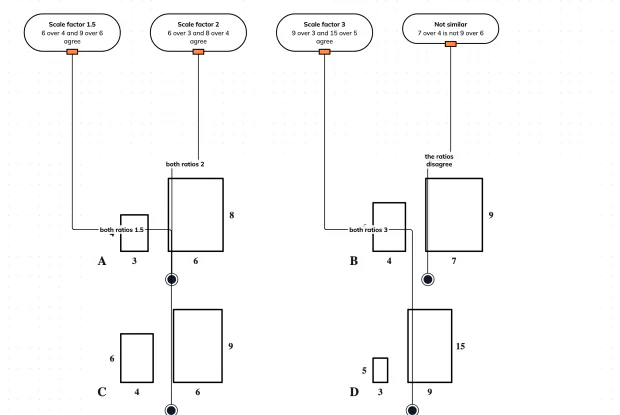
That is why the playground uses rectangles. Every rectangle has four right angles, so all rectangles pass the angle test and the sides do all the work. A 4 by 6 rectangle and a 7 by 9 one look perfectly similar at a glance, and they are not: 7 ÷ 4 is 1.75 while 9 ÷ 6 is 1.5. Looking alike is not the test.
Testing for Similarity
How Do You Run the Test?
Pair up the matching sides and divide. Take each side of the larger shape and divide it by the corresponding side of the smaller one, and check that every division gives the same answer. For a 3 by 4 rectangle and a 6 by 8 one, that is 6 ÷ 3 = 2 and 8 ÷ 4 = 2, so they are similar with a scale factor of 2. The word corresponding is doing real work here: the sides have to be matched up properly, shortest with shortest and longest with longest, not simply taken in the order they happen to be written. A 3 by 4 and a 8 by 6 rectangle are similar, even though dividing them in the given order suggests otherwise.
Why Do the Angles Matter Too?
Because equal ratios on their own are not enough for a general shape. Imagine a square and a rhombus with sides twice as long: every pair of matching sides is in the ratio 2, and the shapes are obviously not the same shape, because one has been pushed over. The angles are what stop that happening. For rectangles the angle condition comes free, since all four corners are right angles in both, which is why the playground can decide everything from the sides. For triangles the reverse shortcut applies and the angles alone are enough. the sides. For triangles the reverse shortcut applies and the angles alone are enough. Everything in between — pentagons, kites, any shape with more freedom than a triangle and less than a rectangle — needs both conditions checked.
Is Similar the Same as Congruent?
No, and the relationship between them is worth being clear about. Congruent means identical: same shape and same size. Similar means same shape, any size. So every congruent pair is also similar, with a scale factor of exactly 1, but most similar pairs are not congruent. The direction matters, exactly as it did with squares and rectangles in the quadrilateral track. A useful way to hold it: congruence is what you get from a photocopier set to 100 per cent, and similarity is what you get from any setting at all. Questions often ask which per cent, and similarity is what you get from any setting at all. Questions often ask which of the two a pair of shapes satisfies, and the answer can legitimately be both, which is worth saying rather than choosing one.
Where Does Similarity Get Used?
Everywhere something is drawn or built at a different size from the real thing. A map, an architect's plan, a scale model, a photograph, the image on a cinema screen: all of them are similar to what they represent, which is exactly what makes them useful, since every measurement can be scaled back. It is also the foundation of a great deal of practical measurement. Finding the height of a tree from the length of its shadow works because the tree and a metre rule beside it form two similar triangles, and that idea is the subject of the third tutorial in this track. Every scale drawing ever made rests on the same definition, which is why getting it exactly right matters more than it first appears.
Real World Example
Why Do Photographs Get Cropped on a Phone Screen?
A photo fills a screen exactly only when the two rectangles are similar, and most of the time they are not.
Two rectangles
3 by 2 and 16 by 9
A camera sensor is commonly a 3 by 2 rectangle, a proportion inherited from 35 mm film. A phone screen is usually something like 16 by 9, which came from television. Both are rectangles, both have four right angles, and at a glance they look like the same sort of thing. They are not similar, and the test settles it in one line: 16 ÷ 3 is about 5.33 while 9 ÷ 2 is 4.5. The two divisions disagree, so no enlargement of the photo 5.33 while 9 ÷ 2 is 4.5. The two divisions disagree, so no enlargement of the photo will ever match the screen exactly, however the picture is scaled.
What the software does
Crop or letterbox
Because the shapes are not similar, something has to give, and there are only two honest options. Either the picture is enlarged until it covers the screen and the parts that hang over the edges are cut off, which is cropping, or it is shrunk until it fits entirely and black bars fill the gap, which is letterboxing. Every photo app chooses one or offers both. What no software can do is fill the screen with the whole picture, because that would need the two rectangles to be similar, and no amount of cleverness makes them so.
The option that is not offered
Stretching
There is a third thing software could do and almost never does: stretch the photo differently in the two directions until it fits. That fills the screen with the whole picture, and it produces a result nobody wants, because faces come out wide and circles come out as ovals. Stretching by different amounts is precisely what similarity forbids, and the reason it looks wrong is that human vision is extremely good at detecting it. That is a fair summary of why similarity is worth defining so strictly: the eye notices immediately when a shape has not been enlarged evenly.
FAQs
Final Words
Similar means one shape is an exact enlargement of the other: matching angles equal and every pair of matching sides in the same ratio. Both conditions are needed in general, though rectangles get the angles free and triangles get the sides free, which is why those two shapes behave so differently in similarity questions.
The test produces a number as a by-product — the ratio that every pair of matching sides shares. That number is the scale factor, and it is the whole subject of the next tutorial, including what it means when it comes out smaller than one.
Continue This Track
This concept is part 1 of Similar Shapes and Scale.
When Are Two Shapes Similar?
Similar shapes have equal angles and sides in the same ratio: one is an exact enlargement of the other. Two rectangles can look very alike and fail the test outright. Sort the genuine enlargements from the near-misses in an interactive playground.
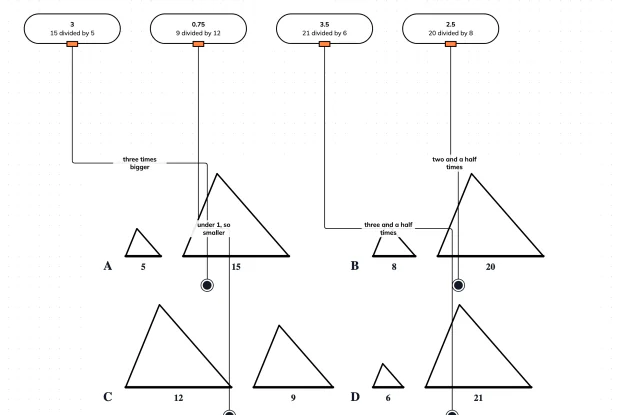
How Do You Find a Scale Factor?
The scale factor is the number every length is multiplied by when a shape is enlarged. Find it by dividing a new length by the matching old one — and expect an answer below 1 when the shape has shrunk. Practise both directions in an interactive playground.
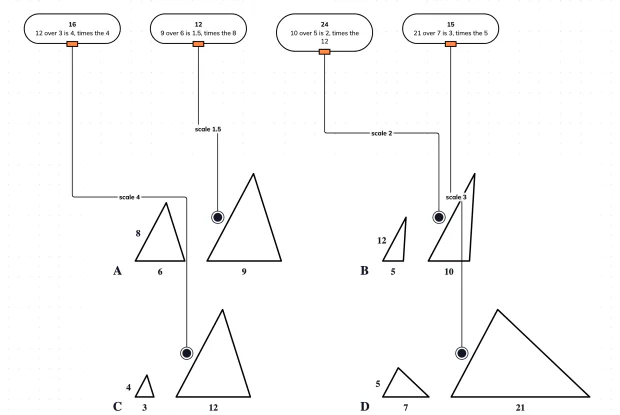
How Do You Find a Missing Side in Similar Triangles?
Similar triangles share one scale factor across every pair of matching sides, so one complete pair is enough to find any other length. Work out the factor, then multiply. Practise the two steps — and the matching up that comes before them — in an interactive playground.
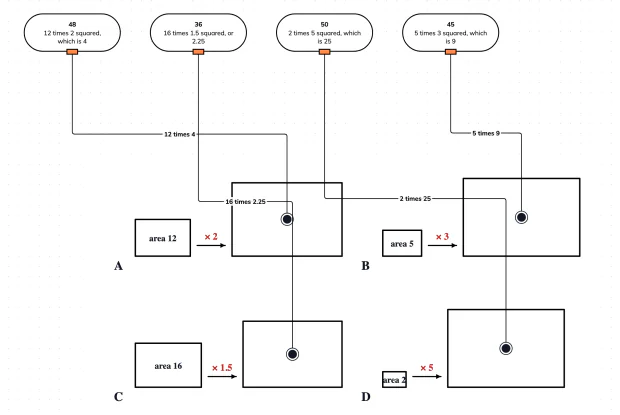
What Happens to Area When a Shape Is Enlarged?
Enlarging a shape by a scale factor multiplies every length by that factor — but the area goes up by the factor squared. Double a shape and it holds four times as much. See why, and why it explains a great deal about pizza and paint, in an interactive playground.