How Do You Find a Scale Factor?
Root Concept
The scale factor is new length divided by old length, and a value under 1 is a reduction rather than an error.
CodePLU Goal
Upgrading Human Mental Models
Learn how to think in Workflows

Concept Development By codeplu.com
New over old. The same factor multiplies every length in the shape, so any matching pair of sides gives the same answer.
What Exactly Is a Scale Factor?
When one shape is an enlargement of another, every length is multiplied by the same number. That number is the scale factor. A scale factor of 3 means every side of the new shape is three times the matching side of the old one — not three units longer, three times as long, which is the distinction that matters.
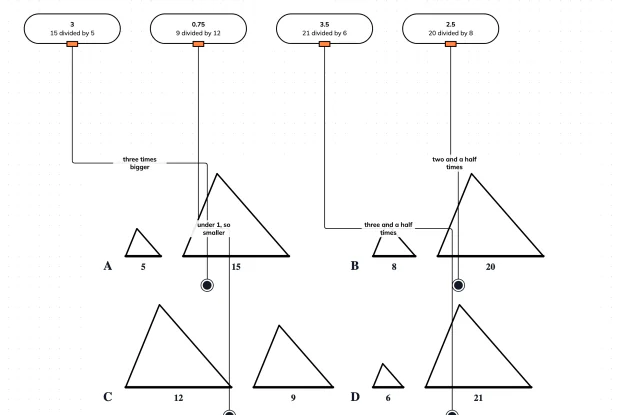
Finding it takes one division: a new length divided by the matching old length. If a side of 5 becomes a side of 15, the scale factor is 15 ÷ 5 = 3. Because every pair of matching sides shares the same factor, any pair will do, which also gives a free check when a shape has more than one labelled side.
Two things trip people up. The first is the order: it is new over old, and dividing the other way gives the factor for going back rather than forward. The second is that a scale factor can be less than 1, which means the shape has shrunk. That is a perfectly ordinary enlargement with a fractional factor, not an error, and two of the pairs in the playground are exactly that case.
Getting the Division Right
Which Way Round Does the Division Go?
New over old, when you want the factor that takes the first shape to the second. A side of 6 becoming a side of 21 gives 21 ÷ 6 = 3.5. Doing it the other way, 6 ÷ 21, gives about 0.286, and that is not wrong so much as the answer to a different question: it is the scale factor that takes the big shape back to the small one. The two are reciprocals of each other, and both are genuine scale factors depending on which direction you are travelling. Questions usually say which shape is being enlarged into which, and if a diagram shows an arrow, it points the way the factor runs. When in doubt, sanity-check the size: a factor over 1 must produce a bigger shape.
What Does a Factor Less Than 1 Mean?
That the shape got smaller. A scale factor of 0.75 takes a side of 12 to a side of 9, and a factor of 0.4 takes 20 to 8. Mathematically these are still called enlargements, which sounds odd in English but keeps one word for the whole operation rather than needing separate rules for growing and shrinking. Everything works identically: multiply every length by the factor, and the angles are untouched. Scale factors between 0 and 1 are exactly as common in practice as those above 1, since every map, plan and photograph of something large is a reduction. A 1:50 scale drawing has a scale factor of 0.02, and nothing about the arithmetic changes because of it.
How Do You Use the Factor Once You Have It?
Multiply to go forwards and divide to come back. With a factor of 3, a side of 7 on the original becomes 21 on the enlargement, and a side of 24 on the enlargement came from 8 on the original. That is the whole of what a scale factor does for lengths, and it is why one number is enough to describe an entire enlargement however complicated the shape. The important limit is that it applies to lengths only. Angles do not change at all under enlargement, and areas change by a different amount, which is the subject of the last tutorial in this track and a place where applying the length factor gives a badly wrong answer.
What Do Map Scales Mean?
They are scale factors written as ratios. A map marked 1:25,000 means one unit on the map stands for 25,000 of the same units on the ground, so the scale factor from ground to map is 1 ÷ 25,000 = 0.00004. In practice nobody uses that decimal; the ratio form is easier to work with, because 4 cm on the map means 4 × 25,000 = 100,000 cm on the ground, which is 1 km. Model railways, architectural drawings and scale models all use the same notation, and reading it correctly is simply a matter of remembering that the first number is always the drawing and the second is always the real thing.
Real World Example
How Big Should a Model Aircraft's Wings Be?
One number on the box decides every dimension of the model, and getting it the right way round decides whether the model is tiny or enormous.
What the box says
1:72
A plastic kit is marked 1:72, which means one unit on the model stands for 72 of the same units on the real aircraft. As a scale factor going from the real thing to the model that is 1 ÷ 72, about 0.0139 — comfortably less than 1, because the model is a reduction. Nobody writes it as a decimal, because the ratio is easier to divide by, but it is worth seeing that a fractional scale factor is what a model kit actually is. Every dimension of the model comes from that single number.
Working out a wing
11.7 metres becomes 16 cm
A Spitfire's wingspan is about 11.7 metres, which is 1170 centimetres. Dividing by 72 gives about 16.25 centimetres, so the model's wings must span a little over 16 cm. Every other measurement follows the same way: the fuselage, the propeller, the height of the tail. That is why kits at the same scale can be displayed together and look right beside each other, and why a 1:48 model of the same aircraft will not sit convincingly next to a 1:72 one — the two have been reduced by different factors and the smaller scale looks wrong beside the larger one.
Getting it backwards
A 14-metre model
Multiplying by 72 instead of dividing would turn 11.7 metres into 842 metres, which is obviously absurd and so gets caught immediately. The dangerous version of the error is subtler: working out a real dimension from a measurement taken off the model and dividing when you should multiply. A 16 cm wing divided by 72 gives 0.22 cm rather than 11.7 metres, and on a drawing full of numbers that mistake is easy to miss. The habit worth building is to ask before every calculation whether the answer should come out bigger or smaller, and then check that it did.
FAQs
Final Words
A scale factor is the number every length is multiplied by, and finding it is one division: new length over matching old length. Dividing the other way answers the opposite question and gives the reciprocal, so check that a factor over 1 has produced a bigger shape and one under 1 a smaller one.
Factors below 1 are reductions and are entirely ordinary — every map and model is one. The next tutorial puts the factor to work on triangles, where a single known pair of sides unlocks every other length, and after that comes the one thing a scale factor does not do to area.
Continue This Track
This concept is part 2 of Similar Shapes and Scale.
When Are Two Shapes Similar?
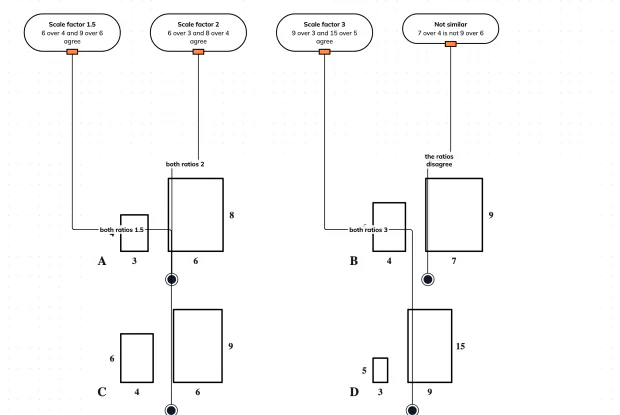
Similar shapes have equal angles and sides in the same ratio: one is an exact enlargement of the other. Two rectangles can look very alike and fail the test outright. Sort the genuine enlargements from the near-misses in an interactive playground.
How Do You Find a Scale Factor?
The scale factor is the number every length is multiplied by when a shape is enlarged. Find it by dividing a new length by the matching old one — and expect an answer below 1 when the shape has shrunk. Practise both directions in an interactive playground.
How Do You Find a Missing Side in Similar Triangles?
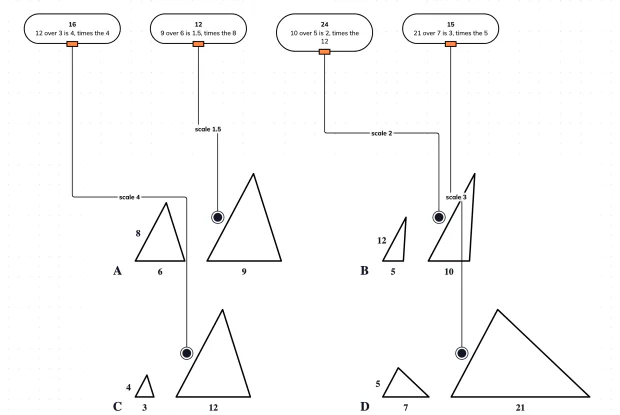
Similar triangles share one scale factor across every pair of matching sides, so one complete pair is enough to find any other length. Work out the factor, then multiply. Practise the two steps — and the matching up that comes before them — in an interactive playground.
What Happens to Area When a Shape Is Enlarged?
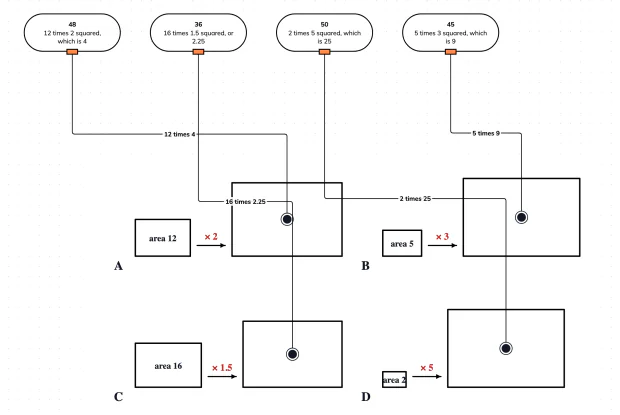
Enlarging a shape by a scale factor multiplies every length by that factor — but the area goes up by the factor squared. Double a shape and it holds four times as much. See why, and why it explains a great deal about pizza and paint, in an interactive playground.