Why Does Blood Go Round Twice?
Root Concept
Lungs are too delicate to take the pressure the body needs, so blood returns to the heart between the two trips and is re-pressurised for each — one pump doing two different jobs.
CodePLU Goal
Upgrading Human Mental Models
Learn how to think in Workflows

Concept Development By codeplu.com
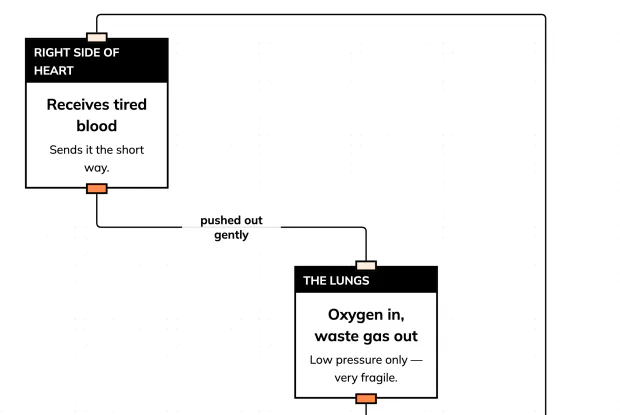
The double circuit as one closed loop, with the pressure each leg requires
Why Not Just Send Blood Round Once?
The obvious design would be a single lap. Blood leaves the heart, calls at the lungs to collect oxygen, continues to the body to deliver it, and comes back. One trip, one pump, no repetition. Fish do approximately this, and it works for them. Yet in you and every other mammal and bird, blood returns to the heart in the middle of its journey and gets pushed out a second time. That looks like waste until you ask what pressure each destination can survive.
The body needs to be reached under real force. Blood has to travel down to your feet, up to your brain, and through kilometres of vessels narrow enough that pushing anything through them takes effort. That demands a strong shove. Lungs, meanwhile, are built for the opposite priority: gas has to cross between air and blood, so the barrier is made as thin as physically possible — thin enough that high pressure would force fluid across it and flood the very spaces air needs to occupy.
So there is no single pressure that suits both. A one-lap system has to compromise, and any compromise means either weak delivery to the body or dangerous pressure in the lungs. The two-circuit design refuses to compromise: it drops the pressure for the lungs, brings the blood back, and re-pressurises it for the body. That is why one heart has two sides with visibly different wall thicknesses, and why this is a loop rather than a line.
The Two Circuits and the Pressure Problem
What are the two loops, exactly?
The short one runs heart to lungs and back — often called the pulmonary circuit — and its entire job is to swap gases. The long one runs heart to everything else and back, the systemic circuit, and its job is delivery and collection everywhere. They are joined end to end through the heart, so blood alternates: short loop, long loop, short loop, and so on. The heart sits between them as a double pump, its right side serving the short circuit and its left side the long one. Both sides beat at the same time, so the two circuits run simultaneously rather than taking turns.
Why can the lungs only take gentle pressure?
Because their function requires fragility. Oxygen has to cross from air into blood by diffusion, and diffusion across a thick barrier is far too slow to keep a mammal alive — so the barrier is reduced to about as thin as living tissue can be, a wall roughly a single cell thick on each side. That thinness is exactly what cannot resist pressure. Push blood into the lungs at the force used for the body and fluid leaks out of the vessels into the air spaces, which is a real medical emergency rather than a hypothetical: it is what happens when the left side of the heart fails and pressure backs up.
Why does the body need so much more force?
Distance, height and resistance. Blood must reach the toes and climb to the brain, and most of the journey is through vessels so narrow that friction dominates. Pushing fluid through a narrow tube takes pressure proportional to how narrow it is, and the smallest vessels are narrow enough that red cells pass almost single file. That is where most resistance lives, and overcoming it is why the left ventricle's wall is several times thicker than the right's. If you have ever seen a heart in cross-section, that asymmetry is the pressure problem made visible.
Why does the blood have to come back to the heart in between?
Because pressure is lost on every trip and something has to restore it. By the time blood has squeezed through the lungs it has very little push left — spent on the journey — so it could not possibly continue round the body. Returning to the heart is a re-pressurisation stop. This is also why the answer to "how many times does blood pass through the heart per circuit?" is twice, and why the loop in the playground has no terminal node: there is no end to arrive at, only the same four stops in order, about once a minute at rest.
What does this explain about hearts in general?
Fish have a two-chambered heart and a single circuit, which suits them: water supports their weight, they need less oxygen per kilogram, and their gills sit right next to the heart. Birds and mammals, which are warm-blooded and use oxygen at a much higher rate, all have four chambers and two circuits. The pattern is consistent enough to be a good example of structure following requirement — the demanding metabolism came with the design that can supply it, and neither works well without the other.
Real World Example
What Blood Pressure Readings Are Actually Measuring
A reading like 120 over 80 is taken on the arm, which means it is describing the long circuit only. Here is what each part means:
The upper number
The push during a beat
The pressure in the systemic arteries at the moment the left ventricle contracts. This is the force being generated to reach your whole body, and it is the number the thick-walled left side exists to produce.
The lower number
The pressure between beats
The arteries do not empty between beats — they stay pressurised, which keeps flow continuous rather than coming in gushes. That resting pressure is the second number.
What is not being measured
The lung circuit
Pressure in the pulmonary circuit is far lower — roughly a fifth of these numbers — and no arm cuff can read it. Measuring it takes a catheter, which is why lung-circuit problems are harder to spot.
Why high readings damage things
Pressure wears vessels out
Sustained high pressure in the long circuit strains the vessel walls and forces the left ventricle to thicken further to keep up. The organs with the finest vessels — kidneys, eyes, brain — tend to show the damage first.
FAQs
Final Words
Double circulation is a solution to a conflict rather than an accident of anatomy. Reaching a whole body takes force; exchanging gas takes a barrier too thin to survive force. Rather than compromise, the design separates the jobs: gentle push to the lungs, back to the heart, hard push to the body, back again — one closed loop with the heart appearing twice in it.
That conflict is also written into the organ. The left side is thick because of what it has to overcome and the right side is thin because it must not overcome very much, which is why a blood-pressure cuff is describing only half the system. The last part of this track keeps the loop running and asks what actually makes you breathe harder when you run — where the answer is not the one most people give.
Continue This Track
This concept is part 2 of How Your Body Keeps You Going.
How Does Food Become Fuel?
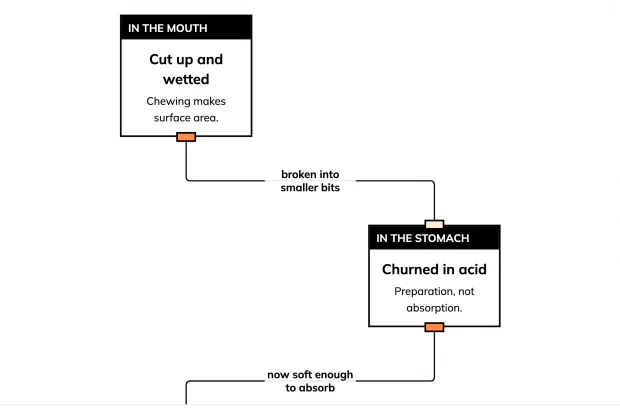
Digestion is often pictured as the stomach doing the work. It is not — the stomach prepares, and absorption happens further down. Follow the five stages from mouthful to working cell and build the sequence yourself in an interactive playground.
Why Does Blood Go Round Twice?
Blood does not do one lap of the body. It does a short loop to the lungs and a long loop to everywhere else, passing through the heart between them. Learn why that costs less than it seems and close the loop yourself in an interactive playground.
Why Do You Breathe Faster When You Run?
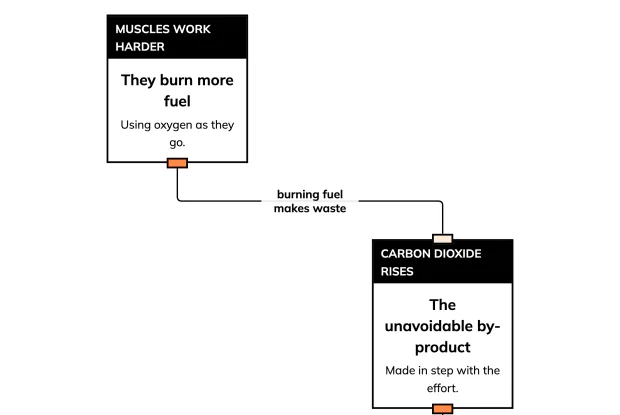
The obvious answer is that running uses oxygen so your body asks for more. That is not what triggers it. Follow the actual causal chain from working muscle to gasping breath, and build it yourself in an interactive playground.