How Does Food Become Fuel?
Root Concept
Food is not inside your body until it crosses the gut wall into the blood, so the stomach only prepares it and the small intestine is where eating actually pays off.
CodePLU Goal
Upgrading Human Mental Models
Learn how to think in Workflows

Concept Development By codeplu.com
Five stages from a mouthful to a cell, each connection giving what had to happen first
Is Food in Your Body as Soon as You Swallow?
It feels like it is. You swallow, it disappears, and the sensible conclusion is that the food is now inside you. But there is a stricter way to look at it that makes the whole of digestion easier to follow: your gut is a tube running through you, open at both ends. Something sitting in that tube is no more inside your body than a letter inside a postbox is inside the post office. It is in a container that passes through.
Food is genuinely inside you at the moment it crosses the gut wall and enters your blood. That single reframe rearranges what the organs are for. The mouth and the stomach are not where you absorb anything — they are preparation, breaking food into pieces small enough and soft enough to cross a wall. The crossing itself happens almost entirely in the small intestine, which is why that organ is metres long and folded into a surface area far larger than its size suggests.
This matters beyond passing a test. It explains why the stomach can be removed and a person can still be nourished, why the small intestine cannot, and why fibre — which never crosses the wall — still does something useful on its way past. Follow the five stages and ask at each one whether the food has entered the body yet. The answer is no until stage three, which is not where most people would put it.
The Five Stages, and What Each Is Actually For
Why does chewing matter more than it seems to?
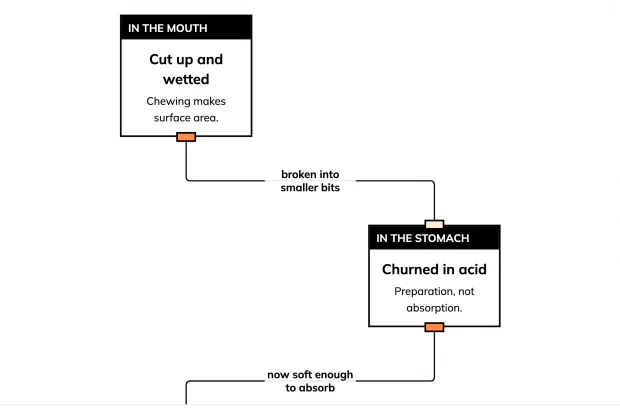
Because digestion is a surface problem. The chemicals that break food down can only work where they touch it, so a single large lump exposes very little of itself. Cutting it into many smaller pieces multiplies the exposed surface enormously without changing the amount of food at all. Saliva adds water, which the later chemistry needs, and it begins on starch immediately — the faint sweetness that appears if you hold plain bread in your mouth is starch being cut into sugars before you have even swallowed. Chewing is not politeness, it is the first mechanical step.
If the stomach is not where food is absorbed, what is it doing?
Three jobs, all preparatory. It stores a meal so you can eat in minutes and digest over hours. It churns, mixing food into a semi-liquid — mechanical work rather than chemical. And it produces acid strong enough to kill most of what arrives alive and to help split proteins apart. What it does almost none of is absorption: apart from water, alcohol and a few drugs, things do not cross the stomach wall. Picturing the stomach as a preparation room rather than a destination is the single most useful correction most people can make here.
Why is the small intestine the place where food actually enters?
Because it is built for crossing and nothing else. It is several metres long, its inner surface is folded, the folds carry finger-like projections, and those carry projections of their own — a nesting that turns a modest tube into a surface area often compared to a room's floor. Every one of those projections is wrapped in blood vessels waiting on the other side of a very thin wall. Enzymes from the pancreas and bile from the liver arrive here too, finishing the breakdown. Small molecules cross; anything still too large does not, which is why the earlier stages had to do their work.
What happens once it is in the blood?
It goes to the liver first, and that detail is worth knowing. Blood leaving the intestine does not head straight for the body; it runs through the liver, which checks the delivery — storing surplus sugar, processing fats, and neutralising various toxins before they reach anywhere delicate. Only then does the cargo join the general circulation, which the next tutorial follows. So the liver acts as a customs post between your gut and the rest of you, which is a large part of why it takes such damage from what people ingest.
And what about everything that never crosses?
It continues into the large intestine, where water is reclaimed and the remainder is compacted for disposal. Fibre is the main resident: it does not cross the wall and provides no fuel, yet removing it from a diet causes problems, because it gives the gut bulk to push against and feeds bacteria that live there. So the last stretch is not merely a waste pipe — and this is a good illustration of the general rule that in the body, structures usually turn out to be doing several jobs at once rather than the single one their name suggests.
Real World Example
Where Does a Slice of Bread Actually Go?
Bread is mostly starch — long chains of sugar molecules, far too large to cross any wall. Follow it:
In the mouth
Chains start being cut
Chewing multiplies the surface and saliva begins splitting starch into shorter sugars. Hold bread on your tongue for a minute and you can taste this happening.
In the stomach
Churned, barely digested
Stomach acid works mainly on protein, so the bread is being mixed and softened rather than broken down much further. It is also not being absorbed here at all.
In the small intestine
Cut to single sugars and crossed
Pancreatic enzymes finish cutting the chains into glucose, which is small enough to pass through the wall into the blood. This is the moment the bread stops being in a tube and becomes part of you.
Afterwards
Liver, then cells — and the rest passes on
Glucose goes to the liver, which stores what is not needed now, then out to cells to be burned. The bran and fibre never cross at all and continue to the large intestine.
FAQs
Final Words
Digestion makes sense once you stop treating the gut as the inside of your body. It is a tube running through you, and everything before the small intestine exists to prepare food for one event: crossing the wall. The mouth makes surface area, the stomach stores and softens and sterilises, the small intestine absorbs, the liver inspects, and cells finally burn what arrives.
That reframe also tells you where the fragility is. Lose your stomach and preparation can be worked around; lose the small intestine and the crossing has nowhere to happen. The next tutorial picks up exactly where this one ends, following what happens to a cargo of fuel once it is in the blood — and why it goes around twice rather than once.
Continue This Track
This concept is part 1 of How Your Body Keeps You Going.
How Does Food Become Fuel?
Digestion is often pictured as the stomach doing the work. It is not — the stomach prepares, and absorption happens further down. Follow the five stages from mouthful to working cell and build the sequence yourself in an interactive playground.
Why Does Blood Go Round Twice?
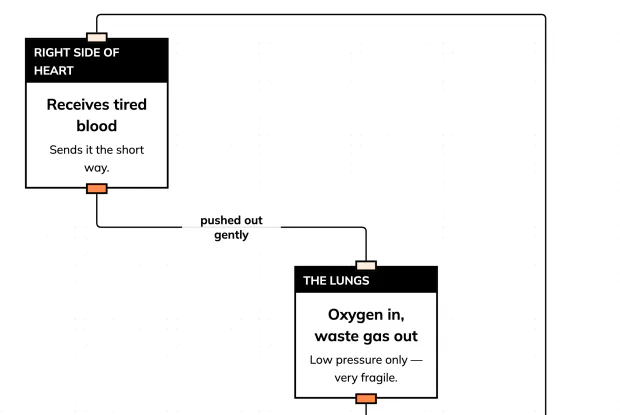
Blood does not do one lap of the body. It does a short loop to the lungs and a long loop to everywhere else, passing through the heart between them. Learn why that costs less than it seems and close the loop yourself in an interactive playground.
Why Do You Breathe Faster When You Run?
The obvious answer is that running uses oxygen so your body asks for more. That is not what triggers it. Follow the actual causal chain from working muscle to gasping breath, and build it yourself in an interactive playground.