Why Do You Breathe Faster When You Run?
Root Concept
Your body monitors carbon dioxide rather than oxygen, so faster breathing is triggered by waste building up — not by fuel running short.
CodePLU Goal
Upgrading Human Mental Models
Learn how to think in Workflows

Concept Development By codeplu.com
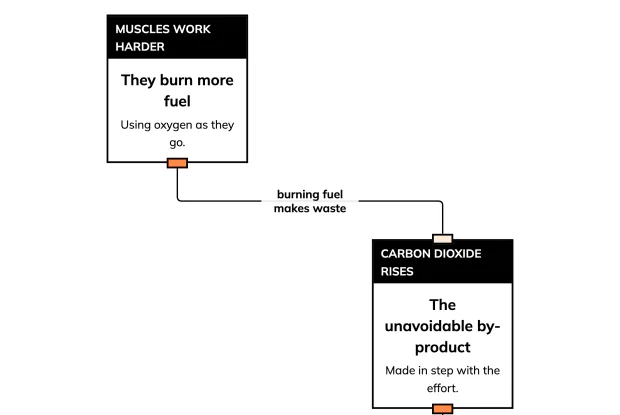
The causal chain from working muscle to faster breathing, with the detection step made explicit
What Is Your Body Actually Measuring?
Ask why you pant after running and almost everyone gives the same answer: your muscles used up oxygen, so your body needs more, so you breathe faster. It sounds obviously right, it gets the outcome right, and it is wrong about the mechanism — which matters, because the mechanism explains several things the popular version cannot.
Your body does not primarily monitor how much oxygen you have. It monitors carbon dioxide, the waste gas produced whenever fuel is burned. Sensors in your brainstem and in a couple of major arteries respond to the acidity that dissolved carbon dioxide creates in your blood, and it is that acidity — not a shortage of oxygen — that drives the urge to breathe. Faster breathing clears the waste, and more oxygen coming in is a very welcome side effect rather than the thing being requested.
Once you know which variable is being watched, some odd facts click into place. Why you can hold your breath longer after deliberately over-breathing, and why that is dangerous. Why the urge to breathe when holding your breath becomes unbearable long before you are actually running low on oxygen. And why a person can suffocate in a room full of an inert gas without ever feeling distressed — because the alarm system they are relying on is not measuring the thing that is missing.
The Chain, and Where the Popular Version Goes Wrong
Why is carbon dioxide unavoidable?
Because of what burning fuel means chemically. Cells combine fuel from food with oxygen to release energy, and what comes out the other side is water and carbon dioxide. That is not a design flaw or an inefficiency — it is the reaction. Work harder and you run the reaction faster, so carbon dioxide is produced faster, in almost exact proportion to the effort. This proportionality is precisely what makes it such a good thing to monitor: the amount of waste in your blood is a live readout of how hard you are working.
How does a gas make blood acidic?
Carbon dioxide dissolves in water and some of it reacts to form an acid. Blood is mostly water, so more carbon dioxide dissolved means measurably more acid and a lower pH. This conversion is the hinge of the whole system, because it turns an invisible gas concentration into a chemical property that sensors can respond to directly. The reverse also holds — blow off carbon dioxide by breathing hard and the blood becomes slightly more alkaline, which is why over-breathing produces tingling and light-headedness.
Where are the sensors, and what do they respond to?
The main ones sit in the brainstem, in the region that sets your breathing rhythm, and they respond to acidity in the fluid around them. A second set sits in the walls of two large arteries and can also detect a genuinely low oxygen level. The division of labour matters: the acidity sensors are exquisitely sensitive and handle ordinary minute-to-minute regulation, while the oxygen sensors are a backup that only speak up when oxygen falls a long way. Under everyday conditions, the acid signal is doing essentially all the work.
So why does the oxygen explanation feel so convincing?
Because oxygen and carbon dioxide move together in almost every ordinary situation. Exercise consumes oxygen and produces carbon dioxide at the same time, so watching either would give the same instruction. The only way to tell which is being measured is to separate them — and it turns out you can. Breathe rapidly for a while and you blow off carbon dioxide without changing your oxygen much; the urge to breathe vanishes even though nothing has been added. That is a direct demonstration that the alarm is wired to the waste, not to the fuel.
Why is that separation dangerous to play with?
Because it disables a warning without removing the danger. Divers who deliberately over-breathe before a breath-hold dive can suppress the urge to breathe long past the point at which oxygen is running genuinely low, and can lose consciousness underwater without ever feeling desperate for air. The same logic explains deaths in spaces filled with nitrogen or helium: a person breathes normally, clears carbon dioxide normally, feels perfectly fine, and passes out from lack of oxygen with no distress at all. The sensation of needing to breathe is not a fuel gauge, and treating it as one has killed people.
Real World Example
The Breath-Hold Experiment You Can Reason Through
Hold your breath normally, then try again after breathing quickly for thirty seconds. Do not actually do the second version — but follow what happens:
Attempt one: an ordinary breath-hold
Urge arrives quickly
Within perhaps thirty to sixty seconds the need to breathe becomes strong. At that moment your blood oxygen has barely fallen — what has risen is carbon dioxide, and that is what you are feeling.
Attempt two: after over-breathing
The urge is delayed
Rapid breathing has cleared carbon dioxide below its usual level, so the acid signal takes much longer to build. Oxygen was never the limiting factor for the sensation, so the urge is postponed.
Why that is not a superpower
The oxygen clock kept running
Nothing extra was stored. Oxygen still declines at the same rate, so the safety margin between "uncomfortable" and "unconscious" has been removed rather than extended. This is the mechanism behind drownings in strong swimmers.
The conclusion the experiment forces
The alarm watches waste
Two attempts, same oxygen behaviour, completely different sensations — which can only be explained if the sensation is driven by carbon dioxide. That is the whole argument of this tutorial in one comparison.
FAQs
Final Words
The chain runs: muscles burn fuel, carbon dioxide is produced in proportion, it dissolves in blood and forms acid, sensors detect that acidity, and breathing speeds up. Oxygen arriving faster is a consequence of that response rather than its cause. Your body watches the waste because waste production is a reliable live measure of how hard you are working.
This is a good example of why mechanism is worth more than outcome. Both explanations predict panting after a run, but only the correct one tells you why the urge to breathe can be switched off without making you any safer — which is knowledge that has practical consequences in water. That closes this track: food crossing into the blood, blood going round twice, and the signal that decides how fast you breathe while it happens.
Continue This Track
This concept is part 3 of How Your Body Keeps You Going.
How Does Food Become Fuel?
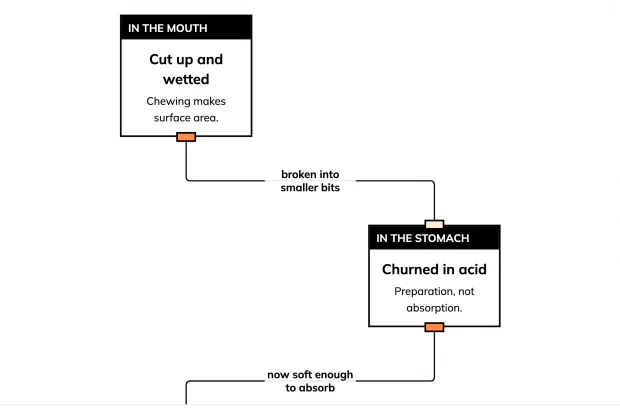
Digestion is often pictured as the stomach doing the work. It is not — the stomach prepares, and absorption happens further down. Follow the five stages from mouthful to working cell and build the sequence yourself in an interactive playground.
Why Does Blood Go Round Twice?
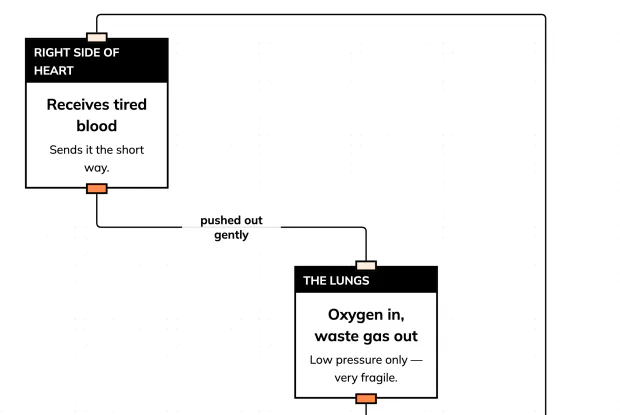
Blood does not do one lap of the body. It does a short loop to the lungs and a long loop to everywhere else, passing through the heart between them. Learn why that costs less than it seems and close the loop yourself in an interactive playground.
Why Do You Breathe Faster When You Run?
The obvious answer is that running uses oxygen so your body asks for more. That is not what triggers it. Follow the actual causal chain from working muscle to gasping breath, and build it yourself in an interactive playground.