Why Do Two Words That Mean the Same Feel Different?
Root Concept
Two words can point at the same fact and carry opposite attitudes, so choosing between them argues a case without adding any evidence.
CodePLU Goal
Upgrading Human Mental Models
Learn how to think in Workflows

Concept Development By codeplu.com
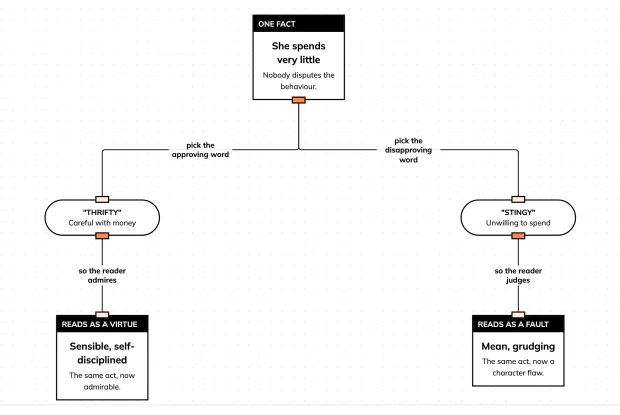
One undisputed fact described two ways, forking on the attitude the word carries
Can Two Words Be Accurate and Opposite at Once?
Someone buys the cheapest option every time, never eats out, and keeps a coat for fifteen years. Call them thrifty and you have paid them a compliment. Call them stingy and you have insulted them. Neither word is factually wrong — both describe exactly the behaviour just listed — and yet the two sentences would start different arguments at a dinner table.
This is the difference between what a word states and what it implies. The stated part, the bit a dictionary can pin down, is called denotation: thrifty and stingy denote the same thing, spending very little. The implied part is connotation: the attitude, warmth or judgement the word carries alongside its meaning. Thrifty approves. Stingy disapproves. The fact is identical and the verdict is opposite.
It is worth understanding this properly, because connotation does persuasive work while looking like description. A writer who calls a group freedom fighters and another who calls them rebels have reported the same actions and taken different sides, without offering a single piece of evidence for either view. Once you can see the mechanism you can both use it deliberately in your own writing and notice when it is being used on you — which is one of the more practical things grammar has to offer.
How the Two Layers Work
What exactly is denotation?
The part of a word's meaning that can be checked. If a word denotes a person who spends very little, then applying it to a lavish spender is simply an error, and anybody can see that it is. Denotation is what makes translation and definition possible, and it is what dictionaries are mostly recording. Two words with the same denotation are what people loosely call synonyms — and the reason true synonyms are rare is that words which share a denotation almost always differ in the second layer.
And connotation?
Everything the word brings with it besides its denotation: approval or disapproval, formality, warmth, age, social setting. Slim, slender, skinny and scrawny all denote low body weight, and they range from complimentary to insulting with no change in the underlying fact. Connotation is learned through use rather than definition, which is why it is one of the last things a language learner acquires and why a technically correct word can still land badly. It also shifts over time and between communities, so it is genuinely harder to pin down than denotation — but it is not vague, as anyone who has been called scrawny can confirm.
How does this get used to persuade?
By presenting a judgement as a description. Consider a company that reduces its workforce: it can be downsizing, restructuring, letting people go, or sacking staff. Every one of those denotes the same event. The first two are cool and procedural, the third is soft and slightly evasive, the fourth is blunt. A reader who accepts the writer's word has quietly accepted the writer's framing, and no argument was made for it. The word did the work an argument would otherwise have had to do.
Is loaded language always a trick?
No, and it would be a mistake to conclude that neutral words are always the honest choice. Sometimes the connotation is the accurate part: describing a cruel act in cool procedural language misrepresents it just as badly as overstating a small one. Good writing chooses words whose implications match the writer's actual assessment, and the fault is not having implications — it is smuggling them in where the reader cannot see them, or choosing a warm word for something you know to be ugly.
How do you test a word before using it?
Two questions. First, is the denotation right — does it actually describe the facts? If not, no amount of good feeling rescues it. Second, would I be comfortable if the reader noticed the attitude I have attached? If you would rather they did not notice, that is the signal you are relying on connotation to carry a claim you cannot defend. The same test works in reverse when reading: find the loaded words, substitute a neutral alternative, and see whether the passage still supports its conclusion. Often it does not.
Real World Example
The Same Decision, Four Ways
A firm ends the employment of two hundred people. Every version below denotes that event correctly:
"The company is restructuring."
Procedural, agentless
Technically accurate and it barely mentions the people. It frames the event as organisational design, which invites the reader to think about the company rather than the two hundred.
"The company is letting staff go."
Softened, almost gentle
Letting go suggests release rather than removal, and it implies reluctance the sentence does not have to prove. Same event, warmer lighting.
"The company is cutting two hundred jobs."
Neutral and specific
It names the number and uses a plain verb. This is close to the reference version — the one a reader can compare the others against.
"The company is sacking two hundred people."
Blunt, and about people
People rather than jobs, and a hard verb. Nothing false, and the emphasis has moved entirely onto those affected. Which of the four is honest depends on what actually happened — that is exactly the writer's responsibility.
FAQs
Final Words
Words carry two layers. Denotation is what a word points at and can be checked; connotation is the attitude it brings along. Thrifty and stingy denote identical behaviour and deliver opposite verdicts, which is why so few true synonyms exist — words that share a denotation almost always disagree about how to feel.
The practical value is symmetrical. Writing: choose words whose implications match what you actually think, and be suspicious of any word you would rather the reader did not examine. Reading: swap the loaded words for plain ones and see whether the argument survives. That closes this track — inside a word, across a family of words, and now the part of a word's meaning that its parts cannot explain.
Continue This Track
This concept is part 3 of Where a Word's Meaning Comes From.
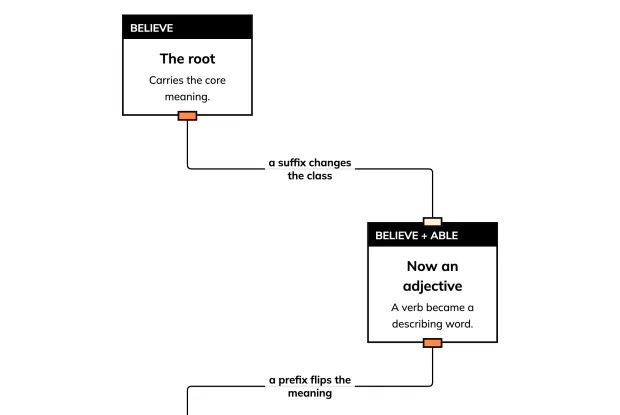
How Are Words Built From Parts?
Long words are not memorised one at a time — they are assembled from pieces that repeat across thousands of words. Learn the two jobs those pieces do, and build one word up from its root in an interactive playground.
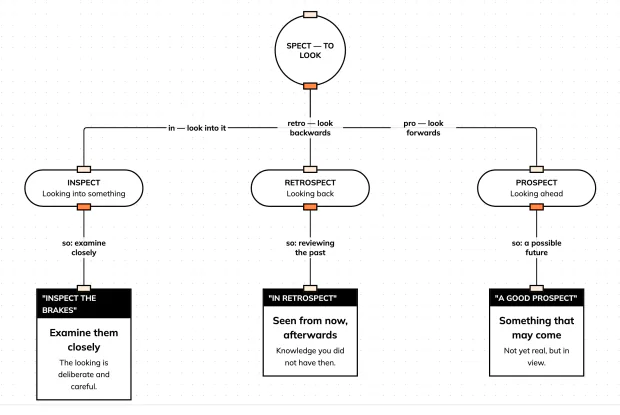
How Does One Root Spread Across Many Words?
Some roots never appear as words on their own, yet turn up inside dozens that do. Learn how one such root behaves, then trace it out to the words it built in an interactive playground.
Why Do Two Words That Mean the Same Feel Different?
Some pairs of words point at exactly the same fact and carry opposite attitudes towards it. Learn the difference between what a word states and what it implies, and build both branches in an interactive playground.