How Are Words Built From Parts?
Root Concept
A prefix usually changes what a word means while a suffix usually changes what kind of word it is, so an unfamiliar word can be read by splitting it rather than guessing at it.
CodePLU Goal
Upgrading Human Mental Models
Learn how to think in Workflows

Concept Development By codeplu.com
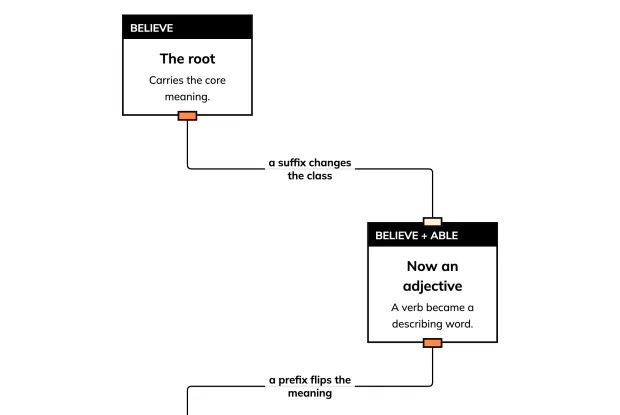
One word assembled from its root, each connection naming what the added piece did
Is a Long Word Really One Thing to Learn?
Look at unbelievably. Twelve letters, and it feels like a single item to be memorised. It is not — it is four pieces stacked in order: un, believe, able, ly. Every one of those pieces appears in hundreds of other words, and each does a specific and predictable job. Once you can see the seams, a long word stops being a thing to recognise and becomes a thing to read.
The two jobs are worth separating clearly, because this is the part that turns into a usable skill. A prefix goes on the front and normally changes what the word means, without changing what kind of word it is: believable and unbelievable are both adjectives, and they mean opposite things. A suffix goes on the end and normally changes what kind of word it is: believe is a verb, believable is an adjective, and the meaning has barely moved. Front changes meaning, back changes class.
That single generalisation does most of the work. Meet a word you have never seen — say demystification — and you can take it apart rather than guess: de reverses, mystify makes mysterious, ation turns an action into a thing. So it is the process of making something no longer mysterious. You did not need to have met the word before. You needed to have met its pieces, and you almost certainly had.
The Pieces and Their Jobs
What is a root, exactly?
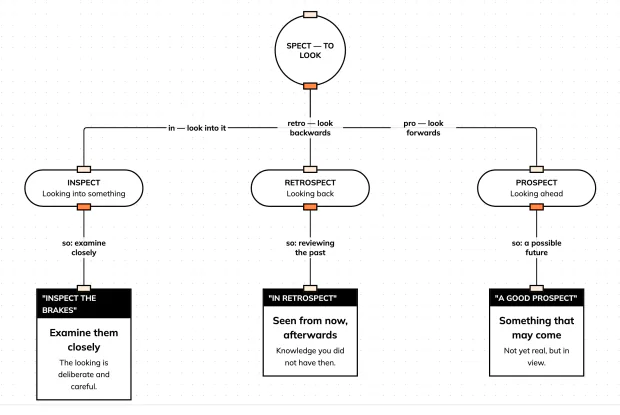
The part carrying the core meaning, and the part that survives when you strip the additions. In unbelievably the root is believe; in demystification it is mystery. Roots are sometimes complete English words on their own and sometimes not — spect, from Latin for look, is a root that never appears alone but turns up in inspect, spectator and prospect. That second kind is the more interesting, because it is where a small amount of knowledge unlocks a large number of words, which is exactly what the next tutorial is about.
Why do prefixes change meaning rather than class?
Because of what they do semantically: they negate, reverse, repeat, or position. Un and in negate — happy becomes unhappy, both adjectives. Re repeats — build becomes rebuild, both verbs. Pre and post position in time, sub and super in space. In each case the word keeps doing the same kind of job in a sentence, and only its content shifts. This is a strong tendency rather than an absolute law, and knowing it as a tendency is what lets you use it: if adding a front piece seems to have changed the word class, look again, because you have probably mis-split the word.
Why do suffixes change class?
Because that is largely what they are for — converting a word from one job to another so it can be used in a different slot. Add ness to an adjective and you get a noun: happy, happiness. Add ly to an adjective and you get an adverb: quick, quickly. Add able to a verb and you get an adjective: believe, believable. Add ation to a verb and you get a noun naming the process. Recognising these endings is the fastest way to work out how an unfamiliar word can be used in a sentence, even before you are sure what it means.
In what order do the pieces go on?
Outward from the root, and the order is not arbitrary. Unbelievably was built believe, then believable, then unbelievable, then unbelievably. You cannot form unbelieve and then add able, because unbelieve is not a word — so the sequence tells you something real about how the word was made. This is why building it up is the right exercise: the intermediate stages either exist or they do not, and that constraint is the reason this is a derivation rather than a list of parts.
Where does this method break down?
In three places worth knowing. Some words only look assembled: understand is not under plus stand in any useful sense, and a confident split gives you nonsense. Spelling shifts at the joins — happy becomes happiness with a letter change, and able sometimes drops a silent e. And meaning drifts over centuries, so a word's parts explain where it came from rather than always what it means now: awful once meant full of awe. So treat splitting as a strong first hypothesis to be checked, not as a decoder ring.
Real World Example
Reading a Word You Have Never Met
Suppose you meet counterproductively in a report and have never seen it before. Rather than guessing from context, split it:
Find the root
produce
Strip the additions and what remains carries the core meaning — to make or bring about. Everything else is doing something to that meaning or to its grammatical job.
Read the front
counter = against
A prefix, so expect a change of meaning rather than class. Counter reverses direction — working against producing, rather than producing.
Read the back
ive, then ly
Ive makes an adjective — productive. Ly makes it an adverb — describing how something is done. So the word must be describing the manner of an action.
Assemble the reading
In a way that works against the goal
You have arrived at the meaning without a dictionary, and — just as usefully — you know it modifies a verb, so you know where it can sit in a sentence.
FAQs
Final Words
A long word is a stack, not a single item. The root carries the core meaning, prefixes on the front change that meaning while leaving the word class alone, and suffixes on the end change the class while keeping the meaning close. Assembling one from the root outward shows why the order is not arbitrary: every intermediate stage has to be a real word.
The payoff is that unfamiliar words stop needing to be guessed at. Split, read the front, read the back, assemble — and treat the result as a strong hypothesis rather than a certainty, because meanings drift and some words only look assembled. The next tutorial takes one root that never appears alone and follows it across a whole family of words, which is where this method pays off most.
Continue This Track
This concept is part 1 of Where a Word's Meaning Comes From.
How Are Words Built From Parts?
Long words are not memorised one at a time — they are assembled from pieces that repeat across thousands of words. Learn the two jobs those pieces do, and build one word up from its root in an interactive playground.
How Does One Root Spread Across Many Words?
Some roots never appear as words on their own, yet turn up inside dozens that do. Learn how one such root behaves, then trace it out to the words it built in an interactive playground.
Why Do Two Words That Mean the Same Feel Different?
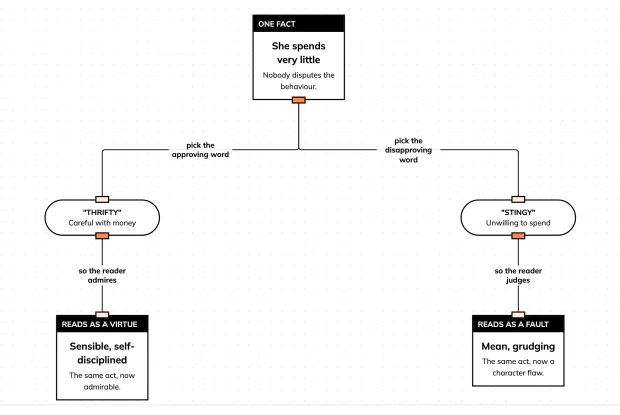
Some pairs of words point at exactly the same fact and carry opposite attitudes towards it. Learn the difference between what a word states and what it implies, and build both branches in an interactive playground.