Where a Word's Meaning Comes From
A vocabulary strand that runs alongside the two grammar tracks and assumes nothing from them. It works outward from a single word to the impression a word leaves. The first part takes a long word apart and finds the rule underneath: a prefix on the front changes what a word means, a suffix on the end changes what kind of word it is, so an unfamiliar word can be read rather than guessed at. The second part follows one root that is never an English word by itself across the family it built, which is where a little knowledge pays out most — twenty roots and twenty prefixes cover a great deal of formal English between them. The third part deals with what the parts cannot explain: why thrifty and stingy describe identical behaviour and take opposite sides, and how that difference lets word choice argue a case without offering any evidence.
CodePLU Goal
Upgrading Human Mental Models
Learn how to think in Workflows
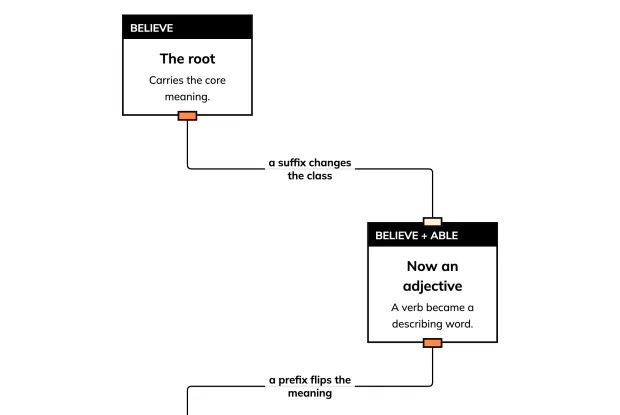
How Are Words Built From Parts?
Long words are not memorised one at a time — they are assembled from pieces that repeat across thousands of words. Learn the two jobs those pieces do, and build one word up from its root in an interactive playground.
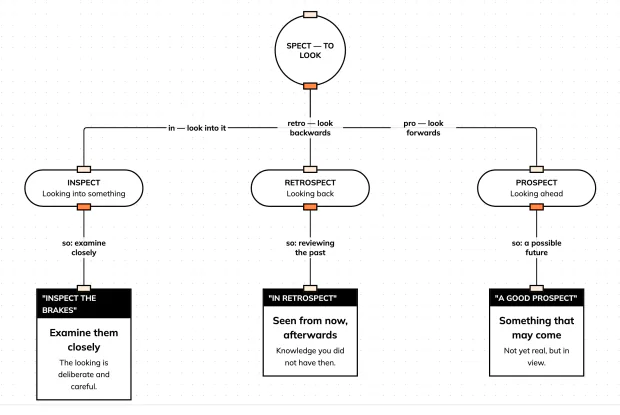
How Does One Root Spread Across Many Words?
Some roots never appear as words on their own, yet turn up inside dozens that do. Learn how one such root behaves, then trace it out to the words it built in an interactive playground.
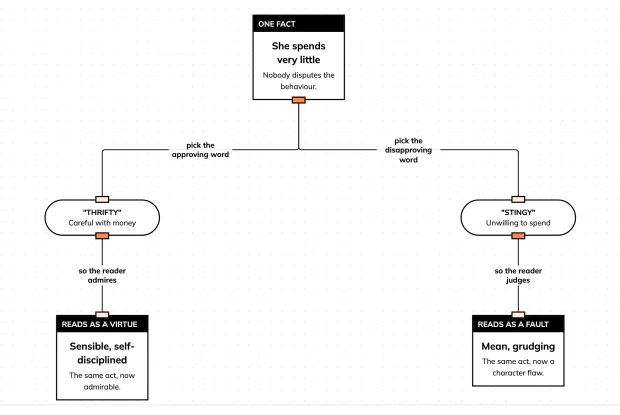
Why Do Two Words That Mean the Same Feel Different?
Some pairs of words point at exactly the same fact and carry opposite attitudes towards it. Learn the difference between what a word states and what it implies, and build both branches in an interactive playground.