How Does One Root Spread Across Many Words?
Root Concept
A buried root supplies one core idea to every word it appears in, and the prefix on the front decides which direction that idea points.
CodePLU Goal
Upgrading Human Mental Models
Learn how to think in Workflows

Concept Development By codeplu.com
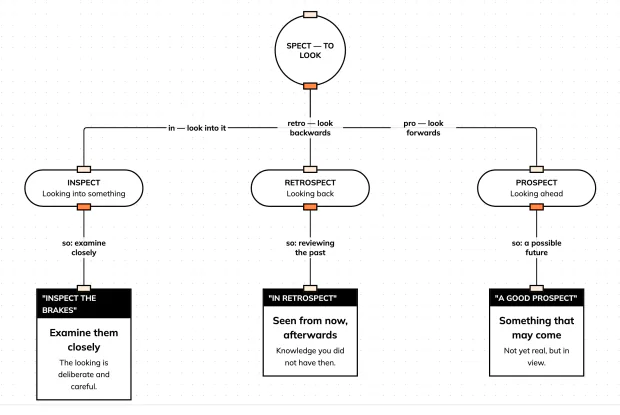
One buried root, three prefixes pointing it in different directions, and what each word means today
Why Do Inspect, Retrospect and Prospect Feel Related?
Say them together and something obvious is going on, even if you have never thought about why. Inspect, retrospect, prospect, spectator, spectacles, spectacular, suspect. Seven words that share four letters and share something in their meaning too — all of them are about looking. That shared piece is spect, from the Latin for look, and it is a root that is never an English word by itself.
That is what makes buried roots such good value. A root you can already see, like believe inside unbelievable, teaches you little you did not know. A root you cannot see is different: learning that spect means look does not just explain one word, it partly explains every word containing it, including ones you meet for the first time in ten years. English is full of these, because it absorbed enormous numbers of Latin and Greek words, and the roots came with them.
The previous tutorial showed prefixes changing meaning. This one shows what they change it into, which is often a direction. In means into, retro means backwards, pro means forwards, sus means from below. Put those in front of look and you get looking into, looking back, looking forward, looking up from underneath — and those turn out to be very close to what inspect, retrospect, prospect and suspect actually mean.
How a Root Family Works
Why does English have so many roots you cannot see?
Because of how it acquired its vocabulary. English is Germanic in structure but borrowed heavily from Latin and French, and later took technical vocabulary directly from Latin and Greek. Borrowed words arrived already assembled, so their parts were never English words in their own right — spect, dict, port, ject and duct all behave this way. The practical consequence is a split in the vocabulary: everyday words tend to be short and Germanic, while formal and technical words tend to be Latin-built and therefore decodable by exactly the method in this track.
What does the prefix contribute?
Usually a direction or a relation, and it is remarkably consistent across families. Take dict, meaning say: predict is say beforehand, contradict is say against, dictate is say authoritatively. Now take the same prefixes onto a different root: pre appears in prevent and prepare, contra in contravene. Once you have met a prefix in three families you effectively know it, and that is why the pieces compound — twenty roots and twenty prefixes cover a very large amount of formal English between them.
How far can you trust the literal reading?
Far enough to be useful, not far enough to stop checking. Prospect literally reads as forward-look, and its modern meaning — a possibility that may come about — is clearly descended from that but is not identical to it. Suspect literally reads as look from underneath, which explains the sense of looking sideways at someone without quite explaining today's meaning. Meanings drift as they are used, so the root gives you a strong direction of travel and the current dictionary meaning is the destination.
Where does the drift go furthest?
In words that have been in heavy everyday use longest, because use is what wears meanings away from their origins. Spectacles are literally things for looking, which still fits. Spectacular has drifted from worth looking at to impressive, which fits loosely. But consider dilapidated — literally from Latin for stones falling apart — now used freely of a wooden shed, where no stone is involved at all. So the more ordinary a word has become, the less its root constrains it, and the more technical the word, the more reliable the split.
How do you use this deliberately?
Not by memorising lists of roots, which is dull and does not stick. The efficient habit is to notice families when you meet them: when a new word feels related to one you know, look for the shared piece and say what it seems to mean. You are building the map from words you already have rather than from a table. And when the split explains the word, the connection is remembered because you made it — which is the same reason this platform asks you to build the graph rather than read it.
Real World Example
One Prefix Across Three Different Roots
The prefix pre means before. Watch it behave identically on three unrelated roots, which is why the pieces compound rather than adding up:
pre + dict (say)
predict
To say beforehand. The literal reading and the modern meaning are essentially the same, which is typical of relatively technical vocabulary.
pre + view (see)
preview
To see beforehand. Same prefix, same job, different root — and the meaning is again almost exactly the sum of the parts.
pre + caution (care)
precaution
Care taken beforehand. Now the reading needs a little interpretation, because the noun names the thing done rather than the doing.
Why this compounds
Pieces multiply, they do not add
Knowing pre helps with every root you meet, and knowing dict helps with every prefix. Twenty of each covers far more than forty words — which is the whole argument for learning the pieces rather than the words.
FAQs
Final Words
One root can sit inside a dozen words without ever being a word itself. Spect supplies looking to inspect, retrospect, prospect and suspect, and the prefix decides the direction — into, backwards, forwards, from underneath. That is why the words feel related, and why learning the buried piece is worth more than learning any single word containing it.
Two cautions keep the method honest: the literal reading is a strong hint rather than a definition, and the more everyday a word has become the further it has drifted from its parts. The last tutorial in this track moves from what a word means to something the parts cannot tell you — why two words with the same meaning can leave completely different impressions.
Continue This Track
This concept is part 2 of Where a Word's Meaning Comes From.
How Are Words Built From Parts?
Long words are not memorised one at a time — they are assembled from pieces that repeat across thousands of words. Learn the two jobs those pieces do, and build one word up from its root in an interactive playground.
How Does One Root Spread Across Many Words?
Some roots never appear as words on their own, yet turn up inside dozens that do. Learn how one such root behaves, then trace it out to the words it built in an interactive playground.
Why Do Two Words That Mean the Same Feel Different?
Some pairs of words point at exactly the same fact and carry opposite attitudes towards it. Learn the difference between what a word states and what it implies, and build both branches in an interactive playground.