What Job Does Each Word in a Sentence Do?
Root Concept
A word's class is a description of the job it is doing in this sentence, so the reliable way to identify one is to remove it and see what breaks.
CodePLU Goal
Upgrading Human Mental Models
Learn how to think in Workflows

Concept Development By codeplu.com
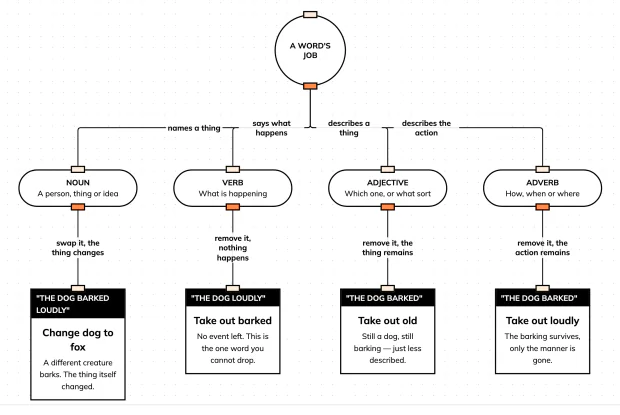
Four word jobs, each connected to what breaks when that word is removed
Why Do the Definitions Stop Working Exactly When You Need Them?
Almost everyone is taught that a noun is a person, place or thing. It works for dog and table and Karachi, and then it meets the word running in "running is good for you" — which is a thing you do, sitting exactly where a noun sits, doing exactly what a noun does. At that point the definition has stopped helping, and a lot of people quietly conclude that grammar is arbitrary.
It is not arbitrary. The problem is that the definitions describe *meaning* while the classes are really about *job*. A word class is not a permanent property stamped on a word in the dictionary; it is a description of the work that word is doing in the sentence in front of you. The same letters can do different jobs on different days. Water is a thing in "the water is cold" and an action in "water the plants". Neither use is a trick question. They are two jobs.
Once you look at jobs instead of meanings, you get a test that actually works, and it is the test this tutorial is built around: take the word out and see what breaks. Remove a verb and the sentence stops describing an event at all. Remove an adjective and the thing is still there, merely less described. That difference is reliable in a way that "is it a thing?" never was.
The Four Jobs, and How to Tell Which Is Which
What is a noun actually doing?
It names something the sentence is going to talk about — a person, an object, a place, or an idea like honesty or distance. The reason the standard definition fails is that it lists the kinds of meaning a noun usually has instead of the position a noun usually occupies. Try a structural test instead: if you can put the or a in front of it and it still sounds like English, you are almost certainly looking at a noun. The running works. The barked does not. This test survives the abstract cases that break the meaning-based definition, which is precisely where beginners get stuck.
Why is the verb the one word you cannot delete?
Because the verb is what makes a string of words into a statement about something happening. "The old dog" is a description; it is not yet news. Add barked and it becomes an event you could agree or disagree with. That is why removing the verb does not merely weaken a sentence, it stops it being a sentence — and it is why the verb is the right place to start when you are unpicking anything complicated. Find the verb, then ask who did it. Everything else in the sentence hangs off that answer, which is the idea the next tutorial builds on directly.
How do adjectives and adverbs divide the work?
Both are describers, and they differ only in what they attach to. An adjective describes a thing: old dog, cold water, difficult question. An adverb describes an action, or sometimes a whole clause: barked loudly, ran yesterday, spoke carefully. So the test is not about the word's shape but about what it is modifying — remove it and ask what became less specific. If the thing lost detail, it was an adjective. If the action lost detail, it was an adverb. The -ly ending is a helpful hint and nothing more; friendly and lovely are adjectives, and fast is an adverb in "he ran fast" with no ending at all.
So what does the removal test give you?
A procedure instead of a memory. Take out the word, read what is left, and notice the specific thing that disappeared. If the whole event vanished, you removed the verb. If a participant vanished, you removed a noun. If the thing survived but got vaguer, an adjective. If the action survived but got vaguer, an adverb. This is worth practising because it keeps working on sentences far more tangled than the examples in any textbook — you are not trying to recall which box a word lives in, you are watching what its absence costs.
What about all the other word classes?
There are more — pronouns standing in for nouns, prepositions locating things in space and time, conjunctions joining parts together, determiners like the and some marking which one. They matter, and the removal test extends to them. This tutorial stays with four because these four carry the load in most sentences and because they are the four that beginners confuse with each other. Get the noun-verb-adjective-adverb distinction working as a test rather than a list, and the rest are much easier to add later.
Real World Example
One Word, Four Jobs, No Trickery
If word classes were properties of words, this could not happen. Watch the same four letters take a different job each time:
"Turn on the light."
Noun
It names a thing, and it takes the in front of it. Remove it and there is nothing left to turn on — a participant has vanished from the sentence.
"Light the candle."
Verb
Now it is the event. Remove it and the sentence stops reporting anything happening at all, which is the signature of a verb rather than of anything else.
"It is a light bag."
Adjective
Here it describes the bag. Remove it and the bag is still there, still being referred to, just no longer described — the adjective test exactly.
"Travel light."
Adverb
This time it describes how the travelling is done. Remove it and the travelling survives with its manner unspecified. Same spelling every time; four different jobs.
FAQs
Final Words
Word classes are jobs, not labels. That single shift explains why the familiar definitions keep failing at the edges: they describe what words usually mean instead of what they are doing here, in this sentence. Nouns name the participants, the verb supplies the event, adjectives add detail to things and adverbs add detail to actions — and the removal test tells you which is which by showing you exactly what disappears.
Notice which of the four turned out to be structural rather than decorative. The verb is the one you cannot delete, and that makes it the anchor of everything else. The next tutorial starts there: find the verb, then ask who is doing it and who it is being done to, and a sentence resolves into three parts you can point at.
Continue This Track
This concept is part 1 of Building a Sentence From Its Parts.
What Job Does Each Word in a Sentence Do?
Word classes are usually taught as definitions to memorise, which is why they slip. Learn the four main jobs a word can do, and the removal test that identifies each one, then match the jobs yourself in an interactive playground.
What Are the Parts of a Sentence?
A sentence is not a line of words with equal status — three of them do the structural work. Learn to find the verb, the subject and the object, then label a real sentence yourself in an interactive playground.
Active or Passive: Who Is Doing the Action?
Active and passive are not good and bad writing. They are two ways to report one event, and they differ in which part goes first — which is why one of them can leave out who did it. Build both versions yourself in an interactive playground.