What Are the Parts of a Sentence?
Root Concept
Find the verb first, because the subject and object are defined by their relationship to it — the subject does it and the object receives it.
CodePLU Goal
Upgrading Human Mental Models
Learn how to think in Workflows

Concept Development By codeplu.com
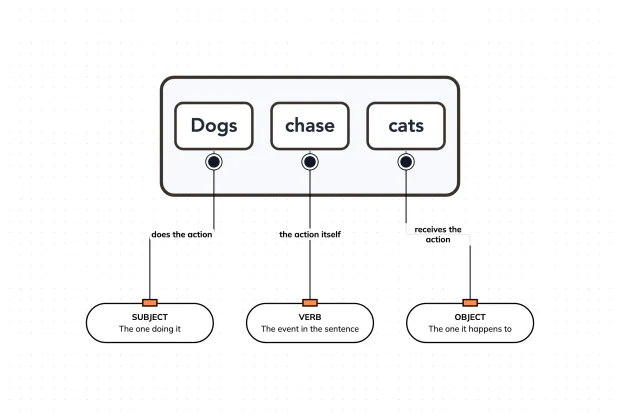
One sentence with its three structural parts labelled by the job each word performs
Why Does Word Order Change the Meaning So Completely?
"Dogs chase cats" and "Cats chase dogs" contain exactly the same three words. Every letter is identical. Yet they describe opposite situations, and no English speaker hesitates for a moment about which is which. Something other than the words is carrying that meaning, and in English that something is position.
The previous tutorial ended on the verb — the one word you cannot remove without the sentence stopping being a sentence. That is where this one starts, because the verb is also the anchor for everything else. Once you have found the event, two questions follow naturally: who is doing it, and who is having it done to them. The answer to the first is the subject. The answer to the second is the object. Those three parts are the skeleton, and most of the rest of a sentence hangs off them as detail.
This is worth doing as a labelling exercise rather than a reading exercise, because the skill is pointing at the right word under time pressure — which is what you are actually doing whenever you untangle a long sentence, check whether a verb agrees with its subject, or work out who a badly written email is accusing of what. Find the verb, then follow the arrows outward.
Finding the Three Parts, in the Right Order
Why start with the verb rather than the beginning of the sentence?
Because the other two parts are defined in terms of it. Subject and object are not positions on a line, they are roles in an event: the doer and the receiver. Until you know what the event is, you cannot ask who did it. Starting at the left-hand end feels natural and works on short sentences, then fails on anything with an introductory phrase — in "After the storm, the roof leaked", the first noun you meet is storm, which is doing nothing at all. Find leaked first and the question "what leaked?" answers itself immediately.
How do you find the subject reliably?
Ask the verb who or what. Leaked — what leaked? The roof. Chase — who chases? Dogs. The word that answers is the subject, and this works regardless of where in the sentence it appears. A second confirmation is agreement: change the subject from singular to plural and an English verb often changes with it. "The dog barks" becomes "the dogs bark". Nothing else in the sentence has that power over the verb, which is why subject-verb agreement errors are the most common thing to go wrong in a long sentence — the writer loses track of which noun the verb belongs to.
And the object?
Ask the verb who or what receives the action. Dogs chase — chase what? Cats. If nothing answers that question, the sentence may simply not have an object, and that is normal rather than a mistake: "the roof leaked" is complete, and "she slept" is complete. Verbs that need an object to make sense are called transitive, and verbs that do not are intransitive. Some are both, depending on use — "she runs" and "she runs a business". So the object is optional in a way the subject and verb are not.
What about everything else in the sentence?
It attaches to one of the three. In "The old dog next door chased the neighbour's cat yesterday", the skeleton is still dog chased cat. Old and next door describe the dog. The neighbour's describes the cat. Yesterday describes the chasing. All of it is detail hung on the frame, and this is exactly why the frame is worth being able to see — a sentence that has become impossible to follow usually has a great deal of detail and a skeleton you have lost track of. Strip it back to three words and it becomes obvious what is being claimed.
Does the subject always come before the verb in English?
Usually, and that is why English relies so heavily on order — but not always. Questions invert it: "is the dog barking?" puts part of the verb first. Some emphatic and literary constructions move things around: "never have I seen such a thing". And the next tutorial is about the construction that deliberately promotes the receiver to the front of the sentence, which lets the doer be left out altogether. Knowing that the default is subject-verb-object is what makes those departures noticeable rather than confusing.
Real World Example
Untangling a Sentence That Has Gone Wrong
Consider this, of the kind that appears in reports everywhere: "The list of items that were requested by the department heads last quarter have been mislaid." Something is wrong. Finding the skeleton locates it exactly:
Find the verb of the main clause
have been mislaid
There are two verb groups competing for attention — were requested and have been mislaid. The second is the one making the sentence's actual claim, so that is the main event.
Ask the verb who or what
The list
What has been mislaid? The list. Not the items, and not the department heads — those belong to a phrase describing the list. The subject is a single list.
Check agreement against that subject
list ... has been mislaid
A singular subject needs has, not have. The writer's eye landed on the nearest plural noun, items, and matched the verb to that instead. This is the single most common error in long English sentences.
Why the skeleton fixes it instantly
list has been mislaid
Three words, and the error is impossible to miss. The technique generalises: when a sentence feels wrong and you cannot say why, delete the detail until only the frame is left, and check that the frame agrees with itself.
FAQs
Final Words
Three parts carry a sentence: the verb naming the event, the subject doing it, and the object having it done to them. The order to find them in matters more than any definition — verb first, then who, then whom — because the two roles only exist relative to the event. Everything else in the sentence, however long it gets, is detail attached to one of those three.
That skeleton is also a practical tool rather than a classroom exercise: it is how you catch a verb that has drifted away from its subject, and how you work out what a bloated sentence is actually claiming. The last part of this track uses it on a construction built specifically to move the receiver to the front — and, in doing so, to let the doer disappear entirely.
Continue This Track
This concept is part 2 of Building a Sentence From Its Parts.
What Job Does Each Word in a Sentence Do?
Word classes are usually taught as definitions to memorise, which is why they slip. Learn the four main jobs a word can do, and the removal test that identifies each one, then match the jobs yourself in an interactive playground.
What Are the Parts of a Sentence?
A sentence is not a line of words with equal status — three of them do the structural work. Learn to find the verb, the subject and the object, then label a real sentence yourself in an interactive playground.
Active or Passive: Who Is Doing the Action?
Active and passive are not good and bad writing. They are two ways to report one event, and they differ in which part goes first — which is why one of them can leave out who did it. Build both versions yourself in an interactive playground.