Active or Passive: Who Is Doing the Action?
Root Concept
Active and passive report the same event and differ only in which part comes first — and because the passive leads with the receiver, it can leave the doer out altogether.
CodePLU Goal
Upgrading Human Mental Models
Learn how to think in Workflows

Concept Development By codeplu.com
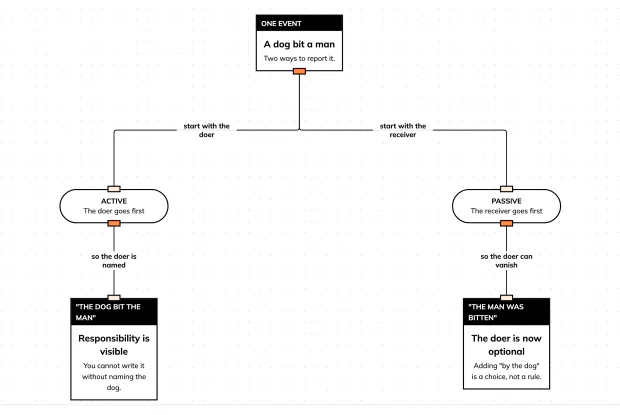
One event reported two ways, forking on which part is put first
Why Does One Version Let You Leave Out Who Did It?
Two sentences: "The dog bit the man" and "The man was bitten by the dog." Same event, same participants, same outcome. The only difference is which one you meet first. That sounds like a stylistic preference, and for the first few seconds it is — until you notice what the second version makes possible. You can stop it early. "The man was bitten" is a complete, grammatical English sentence, and the dog has vanished from it entirely.
There is no way to do that with the active version. "Bit the man" is not a sentence. Because the active form starts with the doer, it structurally requires you to say who acted. The passive starts with the receiver, so by the time the sentence is grammatically complete, the doer has become an optional extra you may or may not choose to add.
This is why active and passive are worth learning as a real choice rather than as a rule about good writing. You have probably been told to prefer the active voice, and often that is good advice — it is shorter and clearer. But the passive is the right choice more often than the advice admits, and it is also the single most effective device in English for making an agent disappear. Both of those are worth being able to see coming.
How the Two Forms Differ, and When Each Is Right
What actually changes between the two versions?
The receiver is promoted to the front, and the verb changes shape to match. "The dog bit the man" becomes "the man was bitten" — a form of to be plus a past participle. The old subject, if you keep it, moves to the end behind by. So three things move at once, which is why the passive feels longer and heavier: it is longer, by two or three words when the doer is kept. That length is the honest cost of the construction, and it is the reason blanket advice to avoid it exists at all.
When is the passive genuinely the better choice?
Whenever the receiver is what the sentence is about, or the doer is unknown, obvious, or irrelevant. "My bike was stolen" is the right sentence — you do not know who did it, and "someone stole my bike" makes the unknown thief the subject of your sentence for no reason. "The road was resurfaced last week" is right because nobody cares which crew. Scientific writing has traditionally used it for the same reason: "the samples were heated to 200°C" keeps the attention on the samples rather than on who was holding the tongs. In every one of these the passive is not a lapse, it is the accurate emphasis.
So when is it doing something you should be suspicious of?
When the doer is known, relevant, and quietly omitted. "Mistakes were made" is the famous example, and it is famous precisely because it is a grammatically flawless way of admitting an error without admitting who committed it. "The account was closed" — by whom? "It has been decided that your role is redundant" — decided by whom? Once you can see the construction, you can ask the question it is suppressing, and the reasonable next step is to rewrite it actively and see whether anyone objects. That single test tells you whether the passive was serving the reader or shielding the writer.
Why is the advice to avoid the passive so common if it is often right?
Because the failure mode is much more common than the good use. Inexperienced and defensive writing overuses the passive badly — it makes prose sound official, and sounding official is a temptation. Style guides respond with a blunt rule because a blunt rule is easier to follow than a judgement. But it is worth knowing that the rule is a heuristic standing in for the real question, which is: is the receiver what this sentence is about, and is the doer worth naming? Answer those and you never need the rule.
How do you spot a passive reliably?
Look for a form of to be — is, was, were, has been, will be — followed by a past participle, and then check whether you could add by somebody after it. "The window was broken" passes both tests: was plus broken, and "by the children" fits. Beware the lookalike: "the window was dirty" also has was, but dirty is an adjective and no by phrase fits, so it is not passive. The by test is the more reliable of the two, because that is precisely the slot where the missing doer would go.
Real World Example
The Same Announcement, Written Both Ways
An organisation has to tell customers about a data breach. Here is the same fact in both voices, and what each one does to the reader:
Passive, doer omitted
"Customer data was accessed without authorisation."
Complete, correct, and it names nobody. Not a single word is false — and yet the sentence cannot tell you whether an outsider broke in or an employee walked out with it. The slot where the doer would sit has simply been left empty.
Passive, doer restored
"Customer data was accessed by an unauthorised third party."
Still passive, still leading with the data — which is reasonable, because the data is what customers care about. But the by phrase is filled in, so the sentence now answers the question the first version dodged.
Active
"An unauthorised third party accessed customer data."
Shortest of the three and the most direct about agency. It puts the intruder in the spotlight, which may or may not be the emphasis the writer wants — but nobody can accuse it of hiding anything.
The test worth remembering
Try adding "by whom?"
When you meet a passive, ask who is missing. If the answer is unknown or genuinely unimportant, the passive is doing its job. If the answer is known and awkward, you have found out something about the writer rather than about the event.
FAQs
Final Words
Active and passive are one event reported two ways, and the fork is a single decision: which participant goes first. Lead with the doer and you have to name them. Lead with the receiver and the sentence is already complete before the doer comes up, which turns naming them into an option. The heavier verb form and the by phrase are consequences of that choice, not separate rules.
Which is why the useful skill here is not obeying a style rule but asking one question. When you meet a passive, ask by whom. If nobody knows, or nobody needs to, the sentence is doing its job well. If the answer is known and inconvenient, the construction has told you something the writer chose not to.
Continue This Track
This concept is part 3 of Building a Sentence From Its Parts.
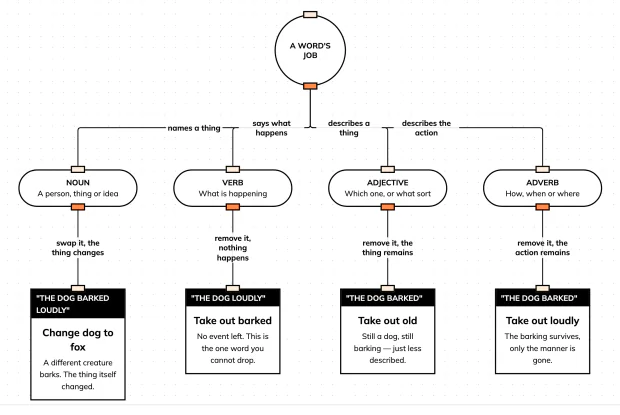
What Job Does Each Word in a Sentence Do?
Word classes are usually taught as definitions to memorise, which is why they slip. Learn the four main jobs a word can do, and the removal test that identifies each one, then match the jobs yourself in an interactive playground.
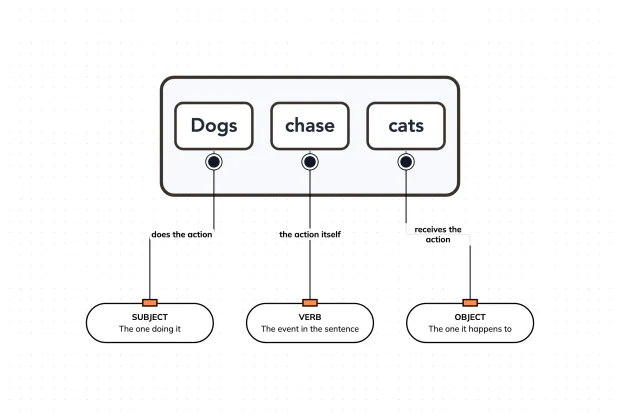
What Are the Parts of a Sentence?
A sentence is not a line of words with equal status — three of them do the structural work. Learn to find the verb, the subject and the object, then label a real sentence yourself in an interactive playground.
Active or Passive: Who Is Doing the Action?
Active and passive are not good and bad writing. They are two ways to report one event, and they differ in which part goes first — which is why one of them can leave out who did it. Build both versions yourself in an interactive playground.