What Is an Exponent?
Root Concept
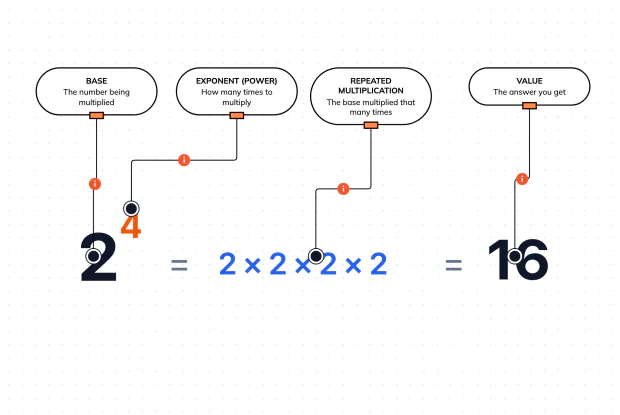
An exponent is a short way to write repeated multiplication. In a power like 2⁴, the big number is the base (the number being multiplied) and the small raised number is the exponent (how many times to multiply the base by itself). So 2⁴ means 2 × 2 × 2 × 2, which works out to the value 16.
CodePLU Goal
Upgrading Human Mental Models
Learn how to think in Workflows

Concept Development By codeplu.com
The power 2⁴ taken apart: the base and its exponent, the repeated multiplication they stand for, and the value it works out to
What Does the Little Number Floating Above Mean?
Sometimes in maths you see a number written with a smaller number sitting just above and to the right of it, like 2⁴ or 5². That little raised number is not a typing mistake, and it does not mean 'times' — it is called an exponent, and it is a clever shorthand for something you already know how to do: multiplying a number by itself, over and over.
A power like 2⁴ has two parts. The big number, 2, is the base — it is the number you are going to multiply. The small raised number, 4, is the exponent — it tells you how many times to multiply the base by itself. So 2⁴ means 'multiply 2 by itself 4 times': 2 × 2 × 2 × 2. Work that out step by step and you get 16, which is the value of the power. We read 2⁴ out loud as 'two to the power of four' or just 'two to the fourth'.
That is the whole idea, and it is worth getting exactly right, because exponents are a shorthand people often misread. In the playground you will take the power 2⁴, already written out in full as 2 × 2 × 2 × 2 = 16, and label each part: the base, the exponent, the repeated multiplication it stands for, and the value it comes to.
How Do Exponents Work?
What is an exponent?
An exponent is a small number written raised up after another number, and it counts how many times to multiply that number by itself. The number being multiplied is called the base, and the whole thing — base plus exponent — is called a power. In 2⁴, the base is 2 and the exponent is 4, so it means 2 multiplied by itself 4 times: 2 × 2 × 2 × 2. We say it as 'two to the power of four'. The exponent is really just a counter: 2³ means three 2s multiplied (2 × 2 × 2), 2⁵ means five 2s multiplied (2 × 2 × 2 × 2 × 2), and so on. Instead of writing out a long line of multiplication, the exponent lets you write it in a tiny, tidy way — that is the whole point of the notation.
Repeated multiplication, not ordinary multiplication
Here is the mistake almost everyone makes at first: they see 2⁴ and think it means 2 × 4 = 8. It does not. The exponent does not multiply the base by itself; it tells you how many copies of the base to multiply together. So 2⁴ is 2 × 2 × 2 × 2 = 16, not 8. To keep them straight, read the little number as 'how many times', never as 'times'. Try it with 3²: it means two 3s multiplied, 3 × 3 = 9 — not 3 × 2 = 6. And 5³ means three 5s multiplied, 5 × 5 × 5 = 125. The base tells you what number to use, and the exponent tells you how many of them to line up and multiply. Getting this one idea right is most of what learning exponents is about.
Why exponents make numbers grow so fast
Because each step multiplies instead of adds, powers grow astonishingly quickly. Look at the powers of 2: 2¹ = 2, 2² = 4, 2³ = 8, 2⁴ = 16, 2⁵ = 32, 2⁶ = 64, 2⁷ = 128. Every time the exponent goes up by just one, the value doubles — so the numbers race upward far faster than simple counting or adding ever could. By 2¹⁰ you are already past a thousand. This explosive growth is exactly why exponents are so useful: they let us write and work with gigantic numbers neatly, and they show up whenever something doubles again and again — like a rumour spreading, money earning interest, or a single cell splitting into millions. A small exponent can stand for a very big number.
Real World Example
Where Do Exponents Show Up in Real Life?
Exponents are not just classroom notation — they describe real things that grow or are measured by repeated multiplication. Here are three:
Folding a piece of paper
Each fold doubles the layers: 2 to the power of the folds
Take a sheet of paper and fold it in half: now there are 2 layers. Fold it again: 4 layers. Again: 8 layers. Each fold doubles the number of layers, so after 4 folds you have 2⁴ = 16 layers, and after 7 folds you have 2⁷ = 128 layers. This is repeated multiplication in your hands: the base is 2 (because each fold doubles) and the exponent is the number of folds. It also shows why you cannot fold paper very many times — the layers pile up so fast, thanks to the exponent, that after about seven folds the wad is too thick to bend. A tiny exponent, a surprisingly tall stack.
The area of a square
Why we say a number is 'squared'
Have you ever wondered why 5² is read as 'five squared'? It comes from area. A square that is 5 units along each side is filled by 5 rows of 5 little squares, which is 5 × 5 = 25 small squares in total — the area. Because you multiply the side by itself, the area of any square is its side to the power of 2, and that is exactly why raising a number to the exponent 2 got the everyday name 'squaring'. In the same way, the space inside a cube — 5 along each of three directions — is 5 × 5 × 5 = 5³, which is why the exponent 3 is called 'cubing'. The names 'squared' and 'cubed' are exponents borrowed straight from shapes.
Writing gigantic numbers
Powers of 10 keep huge numbers short
Scientists and computers deal with enormous numbers, and exponents keep them manageable. The powers of 10 are especially handy: 10² = 100, 10³ = 1000, 10⁶ = 1,000,000 (a million). The exponent simply tells you how many zeros follow the 1, so instead of writing a million as 1 with six zeros, you can write 10⁶. This is how distances in space, sizes of computer files, and populations are often written — as a small number times a power of 10. Without exponents, a single very large number could fill a whole line; with them, it fits in a couple of characters. That compactness is one of the most useful gifts exponents give us.
FAQs
Final Words
An exponent is a small raised number that is really an instruction: multiply the base by itself this many times. In 2⁴, the base 2 is the number being multiplied, the exponent 4 is how many copies to multiply, the repeated multiplication is 2 × 2 × 2 × 2, and the value that comes out is 16. The one trap to avoid is reading it as 2 × 4 — the exponent counts copies, it does not multiply.
Because every step multiplies rather than adds, powers shoot up in size astonishingly fast, which is why a tiny exponent can stand for a giant number and why exponents appear everywhere something doubles, squares or grows. Now that you can read a power and say exactly what it means, you are ready for the next questions: how do you work powers out quickly, and what happens when you multiply two powers together?
Continue This Track
This concept is part 1 of Powers and Roots.
What Is an Exponent?
An exponent is shorthand for repeated multiplication: 2⁴ means 2 × 2 × 2 × 2 = 16. Label the base, exponent, repeated multiplication and value on a worked power, in an interactive playground.
How Do You Work Out Powers of Whole Numbers?
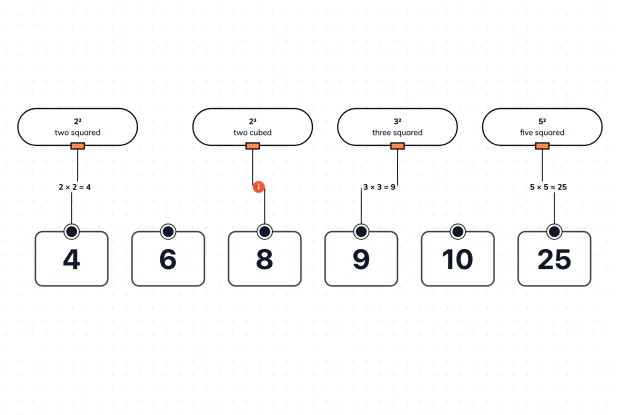
To work out a power of a whole number, multiply the base by itself as many times as the exponent says: 3²=9, 2³=8, 5²=25. Compute four powers and land each on its value in an interactive playground.
What Is a Square Root?
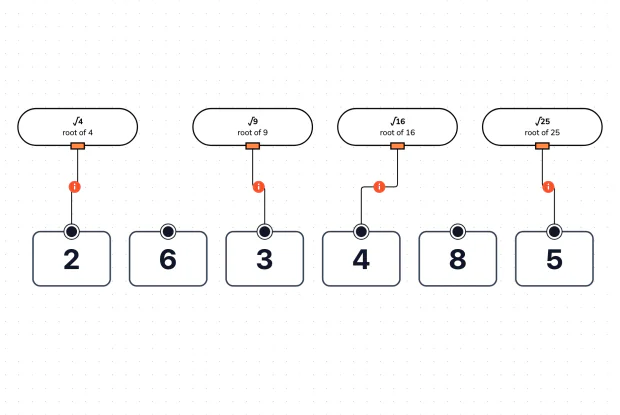
A square root undoes squaring: √9 = 3 because 3 × 3 = 9. Learn the radical sign and perfect squares, then work out four roots in an interactive playground.
How Do You Simplify a Square Root?
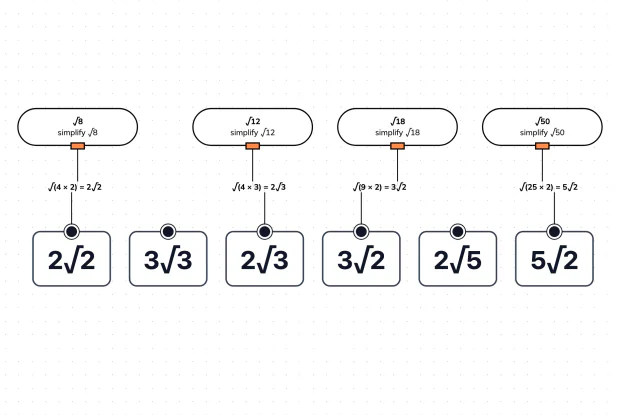
√12 isn't whole, but it hides a perfect square: √12 = 2√3. Learn to pull out the largest perfect-square factor and simplify four roots in an interactive playground.