How Do You Simplify a Square Root?
Root Concept
To simplify a square root, find the largest perfect-square factor of the number, split the root using √(a×b) = √a × √b, and take the square root of the perfect-square part outside the sign. So √12 = √(4×3) = √4 × √3 = 2√3.
CodePLU Goal
Upgrading Human Mental Models
Learn how to think in Workflows

Concept Development By codeplu.com
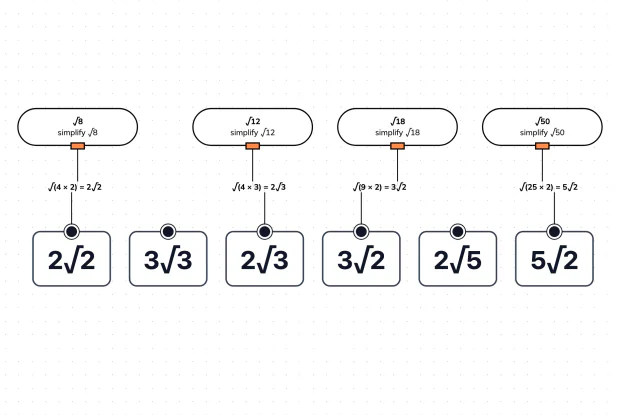
Each root simplified by pulling out its perfect square — √8 = 2√2, √12 = 2√3, √18 = 3√2, √50 = 5√2; the tiles 3√3 and 2√5 belong to other numbers
How Do You Tidy Up a Square Root That Isn't Whole?
Some square roots come out as neat whole numbers — √9 = 3, √16 = 4. But most do not. √12, for example, is not a whole number; it is a never-ending decimal, about 3.46. Rather than round it and lose accuracy, mathematicians tidy it into a simpler exact form. That is what simplifying a square root means: rewriting it in the neatest way, without changing its value.
The trick is that many numbers hide a perfect square inside them. 12 is 4 × 3, and 4 is a perfect square. So √12 can be split up: √12 = √(4 × 3) = √4 × √3 = 2√3. The perfect square, 4, comes out from under the radical sign as its root, 2, leaving the rest, √3, behind. The tidy answer 2√3 is exactly equal to √12 — just written more simply.
So the whole method is: find the largest perfect-square factor, take its root outside, and leave the rest under the sign. In the playground you will simplify four roots this way and connect each to its tidy form — while some tiles on the board are the simplified forms of different numbers, there to catch a careless match.
How Do You Simplify a Square Root?
Why some roots need simplifying
A square root is only 'finished' when it is as simple as it can be. If the number under the sign is a perfect square, you get a whole number and you are done: √16 = 4. But if it is not a perfect square, like √12, the exact value is an awkward never-ending decimal. Instead of rounding — which throws away accuracy — we look for a tidier exact way to write it. Many numbers are secretly a perfect square multiplied by something else: 12 = 4 × 3, 18 = 9 × 2, 50 = 25 × 2. Spotting that hidden perfect square is the key, because a perfect square can escape from under the radical sign as a plain whole number, making the whole expression simpler while keeping its value exactly the same.
The method: pull out the perfect square
Simplifying a square root uses one rule: a root of a product is the product of the roots, √(a × b) = √a × √b. The method has three steps. First, find the largest perfect-square factor of the number — for 12, that is 4 (since 12 = 4 × 3). Second, split the root using the rule: √12 = √(4 × 3) = √4 × √3. Third, take the root of the perfect-square part, which is a whole number, and write it in front: √4 = 2, so √12 = 2√3. The part that was not a perfect square, √3, stays under the sign. The result, 2√3, means '2 lots of √3' and is exactly equal to √12. Always pull out the LARGEST perfect square, or you will have to simplify again.
Worked examples
Try the same three steps on a few. √8: the largest perfect-square factor of 8 is 4 (8 = 4 × 2), so √8 = √4 × √2 = 2√2. √18: the largest perfect square in 18 is 9 (18 = 9 × 2), so √18 = √9 × √2 = 3√2. √50: the largest perfect square in 50 is 25 (50 = 25 × 2), so √50 = √25 × √2 = 5√2. Notice the pattern: you hunt for the biggest perfect-square factor (4, 9, 16, 25…), take its root out front, and leave the leftover under the sign. If a number has no perfect-square factor other than 1 — like 3, 5 or 7 — then its root is already simplified and cannot be tidied further. These are exactly the roots you will match in the playground.
Real World Example
Why Bother Simplifying Roots?
Simplifying is not busywork — it keeps answers exact and comparable. Here are three reasons it matters:
Keeping answers exact
2√3 is exact; 3.46 is only close
When you write √12 as the decimal 3.46, you have rounded — the true value goes on forever, so 3.46 is slightly wrong. But 2√3 is exactly equal to √12, with nothing lost. In maths and science, keeping answers exact matters, because small rounding errors can pile up over several steps and push a final answer off. Simplifying a root lets you carry the precise value all the way through a calculation and only turn it into a decimal at the very end, if you need one. So 2√3 is not just tidier than √12 — it is the honest, exact form, whereas any decimal you write is a rounded approximation of it.
Diagonals and distances
The diagonal of a square is a simplified root
Square roots turn up constantly in geometry, and they usually come out un-simplified. The diagonal across a square whose sides are 1 works out to √2; across a square with sides of 2 it is √8, which simplifies neatly to 2√2. Distances between points, the sides of right-angled triangles, and many measurements all land on square roots like these. Leaving a distance as 4√2 rather than the messy 5.657… keeps it exact and makes it easy to compare with other distances. So whenever you measure across shapes, the answer is often a square root that is far clearer once you have pulled out its perfect square.
Comparing and combining roots
Simplified form reveals which roots match
Simplifying makes hidden matches visible. Are √8 and √50 related? In that form it is hard to say — but simplified, √8 = 2√2 and √50 = 5√2, and now you can see they are both 'lots of √2', so they can be added or compared directly (2√2 + 5√2 = 7√2). Two roots that looked completely different turn out to share the same √2 once tidied. This is why simplifying is the first thing you do with roots before adding, subtracting or comparing them: it puts every root in a standard form, so matching parts line up and the ones that truly differ stand apart. Tidy form is what makes the rest of the arithmetic of roots possible.
FAQs
Final Words
Simplifying a square root means writing it in its tidiest exact form by pulling out the largest perfect-square factor. Use the rule √(a×b) = √a × √b: find the biggest perfect square inside the number, take its root out front, and leave the rest under the sign — so √12 = √(4×3) = 2√3, √18 = 3√2 and √50 = 5√2. If a number has no perfect-square factor but 1, like √7, it is already simplest.
A simplified root is exact, not rounded, which keeps answers precise through geometry and longer calculations, and it reveals which roots secretly match — √8 and √50 are both 'lots of √2' once tidied. That shared form is the doorway to the next step: adding, subtracting and comparing square roots, which only works once each root is in its simplest form.
Continue This Track
This concept is part 4 of Powers and Roots.
What Is an Exponent?
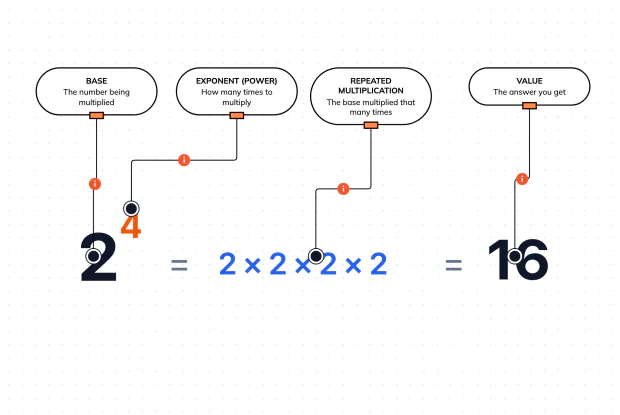
An exponent is shorthand for repeated multiplication: 2⁴ means 2 × 2 × 2 × 2 = 16. Label the base, exponent, repeated multiplication and value on a worked power, in an interactive playground.
How Do You Work Out Powers of Whole Numbers?
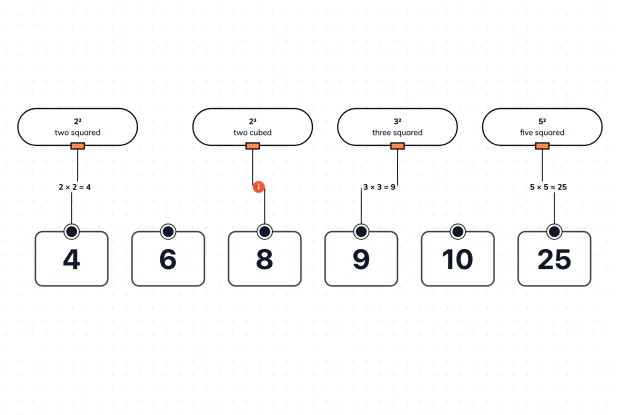
To work out a power of a whole number, multiply the base by itself as many times as the exponent says: 3²=9, 2³=8, 5²=25. Compute four powers and land each on its value in an interactive playground.
What Is a Square Root?
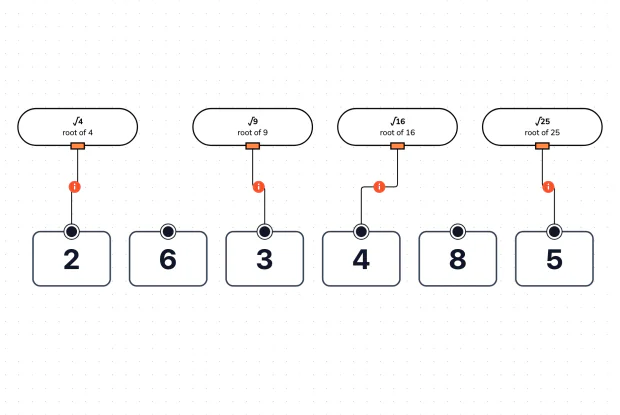
A square root undoes squaring: √9 = 3 because 3 × 3 = 9. Learn the radical sign and perfect squares, then work out four roots in an interactive playground.
How Do You Simplify a Square Root?
√12 isn't whole, but it hides a perfect square: √12 = 2√3. Learn to pull out the largest perfect-square factor and simplify four roots in an interactive playground.