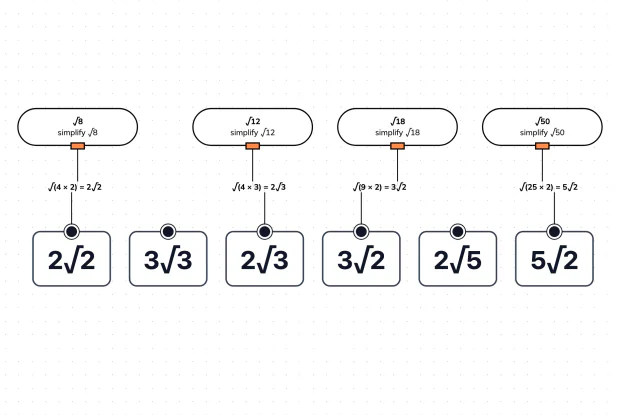
How Do You Work Out Powers of Whole Numbers?
Root Concept
To find the value of a power of a whole number, multiply the base by itself as many times as the exponent says. So 3² = 3 × 3 = 9 and 2³ = 2 × 2 × 2 = 8. The exponent counts how many copies of the base to multiply — it never means base times exponent.
CodePLU Goal
Upgrading Human Mental Models
Learn how to think in Workflows

Concept Development By codeplu.com
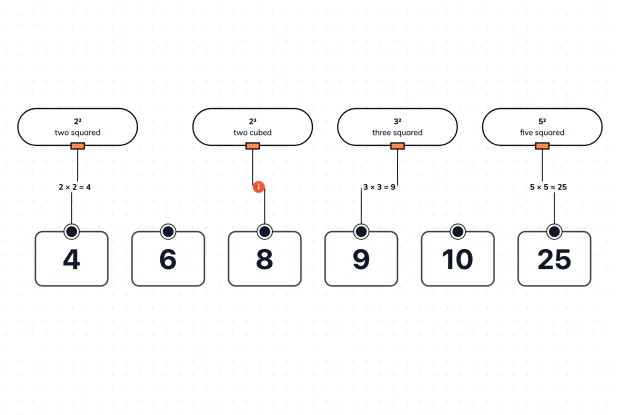
Each power worked out and landed on its value — 2² on 4, 2³ on 8, 3² on 9, 5² on 25; the tiles 6 and 10 are the wrong 'times' answers
How Do You Turn a Power Into a Number?
You already know that a power like 3² is a short way of writing repeated multiplication. This tutorial is about the next step: actually working it out — turning a power into its value. And the good news is there is only one method, and it never changes, no matter which whole number is the base.
To work out any power, you do exactly what the exponent tells you: multiply the base by itself that many times. For 3², the base is 3 and the exponent is 2, so you multiply two 3s: 3 × 3 = 9. For 2³, you multiply three 2s: 2 × 2 × 2 = 8. For 5², two 5s: 5 × 5 = 25. Write it out as a line of multiplication first if it helps, then multiply step by step until you reach a single number.
The one thing to stay alert to is the famous trap: the exponent is not something you multiply the base by. 2³ is not 2 × 3 = 6 — it is 2 × 2 × 2 = 8. In the playground you will work out four powers and land each on its correct value, and some of the tiles on the board are the wrong 'times' answers, put there on purpose so you have to compute carefully rather than guess.
How Do You Compute Powers of Whole Numbers?
The one method for any power
Every power of a whole number is worked out the same way: multiply the base by itself as many times as the exponent says. The safest approach is to write the power out in full first, then multiply. Take 4³: the base is 4 and the exponent is 3, so write 4 × 4 × 4, then work left to right — 4 × 4 = 16, then 16 × 4 = 64. So 4³ = 64. Doing it in steps, two numbers at a time, keeps big powers manageable and mistakes rare. The base can be any whole number — 2, 3, 7, 10, anything — and the method never changes. Once you can turn a power into a line of multiplication and multiply it out step by step, you can work out any power of any whole number.
Squares and cubes
Two exponents come up so often they have their own names. Raising to the power 2 is called squaring: 6² = 6 × 6 = 36, read as 'six squared'. Raising to the power 3 is called cubing: 2³ = 2 × 2 × 2 = 8, read as 'two cubed'. The results of squaring the counting numbers are so useful they are worth knowing by heart: 1, 4, 9, 16, 25, 36, 49, 64, 81, 100 — these are the perfect squares (1², 2², 3², … , 10²). The cubes grow faster: 1, 8, 27, 64, 125 (1³, 2³, 3³, 4³, 5³). Knowing a few squares and cubes by memory makes a lot of later maths quicker, because you will recognise these numbers instantly instead of working them out every time.
The mistake to avoid
There is one error that trips up almost everyone learning powers, and it is worth naming so you can dodge it: multiplying the base by the exponent instead of raising it. 2³ does NOT mean 2 × 3 = 6; it means 2 × 2 × 2 = 8. 5² does NOT mean 5 × 2 = 10; it means 5 × 5 = 25. The little number counts how many copies of the base to multiply together — it is never one of the things you multiply. A quick way to check yourself: read the power aloud as 'the base, multiplied by itself, this many times', and actually write out that many copies before you multiply. In the playground, the wrong 'times' answers (like 6 and 10) are sitting right there on the board as tempting tiles, so working each power out properly is the only way to land it correctly.
Real World Example
Where Do Powers of Whole Numbers Show Up?
Powers are not just sums to practise — they count real things that grow by multiplying. Here are three:
Squares on a chessboard
An 8 by 8 board holds 8² = 64 squares
A chessboard is 8 squares along each side. To count all its squares you do not have to count them one by one — you work out 8², because there are 8 rows of 8. 8 × 8 = 64, so a chessboard has 64 squares. This is squaring in action: whenever something is arranged in a square grid, the total is a side length raised to the power 2. A 10 by 10 grid has 10² = 100 cells; a 5 by 5 window has 5² = 25 panes. That is exactly why the power 2 is called 'squaring' — it counts the items in a square. Any square arrangement you meet is a perfect square number hiding in plain sight.
Cubes stacked in a box
A 3 by 3 by 3 stack is 3³ = 27 cubes
Now go from flat to solid. Imagine little cubes — sugar lumps or dice — packed into a box that is 3 along, 3 wide and 3 tall. How many fit? You multiply the three directions: 3 × 3 × 3 = 27, which is 3³. So a 3 by 3 by 3 stack holds 27 cubes. This is cubing, the power 3, and it is why raising to the power 3 got the name 'cubed': it counts the little cubes filling a cube-shaped space. A 4 by 4 by 4 box holds 4³ = 64. Because you multiply three times instead of two, cubes grow faster than squares — which is why even a small box can hold a surprising number of little cubes.
Powers of 10 and big numbers
10² = 100, 10³ = 1000 — the zeros count the power
The whole number 10 has especially friendly powers, and they are the backbone of how we write large numbers. 10² = 10 × 10 = 100, and 10³ = 10 × 10 × 10 = 1000. Notice the pattern: the exponent tells you how many zeros follow the 1. That is not a coincidence — it is because each extra factor of 10 shifts everything up one place, adding a zero. This is why a hundred, a thousand and a million can be written as 10², 10³ and 10⁶, and why powers of whole numbers are so useful for handling big amounts. Working out powers of 10 is the easiest place to see how quickly repeated multiplication builds a number up.
FAQs
Final Words
To work out any power of a whole number, you use one unchanging method: multiply the base by itself as many times as the exponent says. Write it out in full — 2³ = 2 × 2 × 2 — and multiply step by step to reach the value, 8. Squaring (power 2) and cubing (power 3) come up so often they have their own names, and the perfect squares 1, 4, 9, 16, 25… are worth knowing by heart. The one trap to avoid is multiplying the base by the exponent: 5² is 25, never 10.
With the method for computing powers in hand, you can turn any power into a number and recognise the squares and cubes hiding in chessboards, stacked cubes and the powers of 10. The next questions build straight on this: what happens to the value when the exponent grows, and what shortcuts appear when you multiply two powers of the same base together?
Continue This Track
This concept is part 2 of Powers and Roots.
What Is an Exponent?
An exponent is shorthand for repeated multiplication: 2⁴ means 2 × 2 × 2 × 2 = 16. Label the base, exponent, repeated multiplication and value on a worked power, in an interactive playground.
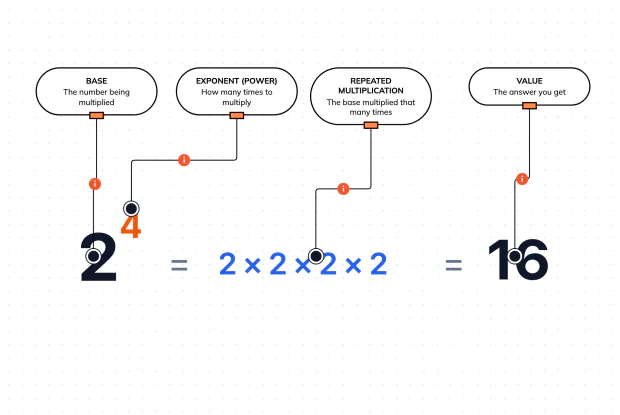
How Do You Work Out Powers of Whole Numbers?
To work out a power of a whole number, multiply the base by itself as many times as the exponent says: 3²=9, 2³=8, 5²=25. Compute four powers and land each on its value in an interactive playground.
What Is a Square Root?
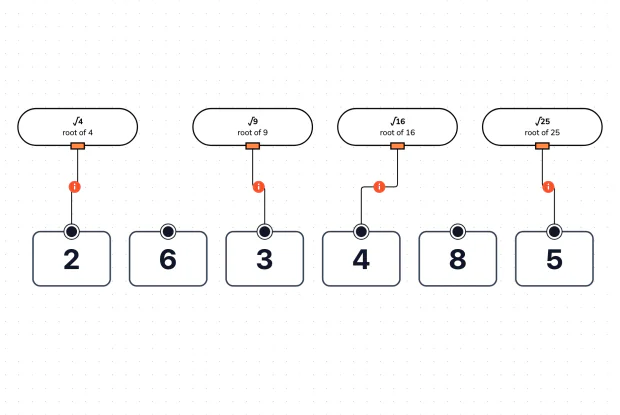
A square root undoes squaring: √9 = 3 because 3 × 3 = 9. Learn the radical sign and perfect squares, then work out four roots in an interactive playground.
How Do You Simplify a Square Root?
√12 isn't whole, but it hides a perfect square: √12 = 2√3. Learn to pull out the largest perfect-square factor and simplify four roots in an interactive playground.