What Is a Square Root?
Root Concept
The square root of a number is the value that, multiplied by itself, gives that number. It is written with the radical sign √, and it undoes squaring: √9 = 3 because 3 × 3 = 9. Numbers whose square roots are whole numbers, like 4, 9, 16 and 25, are called perfect squares.
CodePLU Goal
Upgrading Human Mental Models
Learn how to think in Workflows

Concept Development By codeplu.com
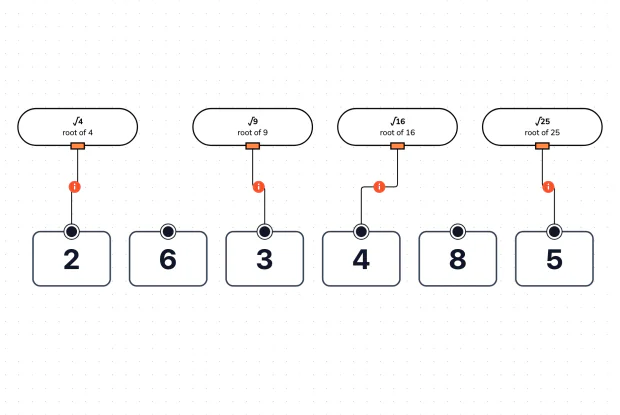
Each square root matched to the number that, times itself, makes it — √4 on 2, √9 on 3, √16 on 4, √25 on 5; the tiles 6 and 8 are wrong answers
What Number, Times Itself, Gives This?
You know that squaring a number means multiplying it by itself: 3² = 3 × 3 = 9. A square root asks the very same question backwards: 'what number, multiplied by itself, gives this?' The square root of 9 is 3, because 3 × 3 = 9. So a square root simply undoes a square.
Square roots have their own special sign, the radical: √. When you see √9, read it as 'the square root of 9', and it is asking you to find the number that squares to 9 — the answer is 3, so √9 = 3. In the same way √16 = 4 (because 4 × 4 = 16) and √25 = 5 (because 5 × 5 = 25).
Numbers like 4, 9, 16 and 25 are especially friendly, because their square roots come out as neat whole numbers. These are called perfect squares. In the playground you will take four square roots and, for each one, find the number that multiplied by itself gives it — then land it on the correct tile, avoiding the wrong answers placed there to catch a guess.
How Do Square Roots Work?
What is a square root?
A square root of a number is the value that, when multiplied by itself, gives that number. We write it with the radical sign √: '√9' means 'the square root of 9'. To find it, you ask a single question — 'what number times itself makes 9?' — and the answer, 3, is the square root, because 3 × 3 = 9. The number tucked under the radical sign is the one you are taking the root of. So √25 asks 'what times itself is 25?', and since 5 × 5 = 25, the answer is √25 = 5. That is the whole idea of a square root: it is a search for the number that was squared to produce the one you are looking at.
Square roots undo squares
Squaring and square-rooting are opposites — each one undoes the other, the way adding undoes subtracting. Start with 4 and square it: 4² = 16. Now take the square root of 16: √16 = 4, and you are back where you started. That round trip, 4 → 16 → 4, is what 'undoing' means. This is why square roots are so useful: whenever something has been squared and you want to get back to the original number, the square root is the tool that reverses it. If squaring answers 'what is this number times itself?', then the square root answers the reverse, 'what number was multiplied by itself to get this?' Knowing they are a matched pair — square and square root — makes both far easier to understand.
Perfect squares and their roots
Some numbers give a whole number when you take their square root, and these are called perfect squares. They are exactly the numbers you get by squaring the counting numbers: 1, 4, 9, 16, 25, 36, 49, 64, 81, 100. Their square roots are the counting numbers themselves — √1 = 1, √4 = 2, √9 = 3, √16 = 4, and so on up to √100 = 10. Learning these pairs by heart makes square roots quick, because you will recognise a perfect square instantly and know its root without working it out. Numbers that are not perfect squares, like 2, 3 or 12, still have square roots, but those roots are not whole numbers — √2 is about 1.41 — which is a story for another tutorial. Here, the focus is the friendly perfect squares.
Real World Example
Where Do Square Roots Come From?
Square roots are not an abstract invention; they answer real 'work backwards' questions. Here are three:
Finding the side of a square
Area 25 means a side of √25 = 5
This is where the name comes from. The area of a square is its side multiplied by itself — side squared. So if you know a square's area and want its side, you do the opposite: you take the square root. A square patch of garden with an area of 25 square metres must have sides of √25 = 5 metres, because 5 × 5 = 25. A square rug covering 16 square feet has sides of √16 = 4 feet. The square root literally finds the 'root' — the side — of a square from its area. That everyday geometry question, 'how long is each side?', is exactly what a square root answers, and it is why the operation is named after squares at all.
Doing perfect squares in your head
Knowing the pairs makes roots instant
Because the perfect squares come up so often, knowing them by heart turns square roots into instant recall rather than a puzzle. If someone asks for √49, you do not need to hunt — you remember that 7 × 7 = 49, so √49 = 7. Learn the ten pairs (1&1, 2&4, 3&9, 4&16, 5&25, 6&36, 7&49, 8&64, 9&81, 10&100) and a whole class of square-root questions becomes as quick as reciting a times table. This is exactly the skill the playground builds: for each root, you recall or work out which number, times itself, produces it — and the wrong tiles are there to make sure you really know, rather than guess.
When the root isn't a whole number
Most numbers have 'in-between' square roots
Not every number is a perfect square, and that is completely normal. The square root of 2, for example, is about 1.41, because 1.41 × 1.41 is very close to 2 — it sits between the whole numbers 1 and 2. Most numbers are like this: their square roots are decimals that go on forever, so we either round them or leave them written as √2. You can see roughly where a root lands by thinking of the nearest perfect squares: √10 must be a little more than 3, because 10 is just past 9 (whose root is 3) and before 16 (whose root is 4). Perfect squares are the neat anchor points; every other number's root falls somewhere between them.
FAQs
Final Words
A square root answers one backwards question: what number, multiplied by itself, gives this? Written with the radical sign √, it undoes squaring — √9 = 3 because 3 × 3 = 9, and squaring then rooting a number returns you to where you started. The friendliest numbers are the perfect squares (1, 4, 9, 16, 25…), whose roots are whole numbers worth knowing by heart.
The name is no accident: the square root finds the side of a square from its area, which is where the whole idea comes from. Perfect squares give tidy whole-number roots; every other number's root falls between them as a decimal. Once you can find these neat roots, the next question is what to do with roots that are not perfect squares — how to simplify a root like √12 into something tidier.
Continue This Track
This concept is part 3 of Powers and Roots.
What Is an Exponent?
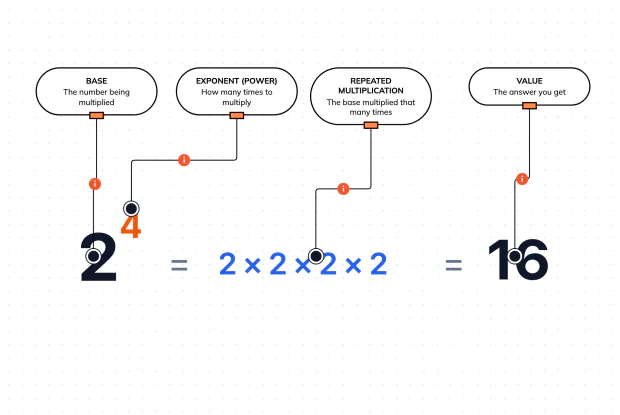
An exponent is shorthand for repeated multiplication: 2⁴ means 2 × 2 × 2 × 2 = 16. Label the base, exponent, repeated multiplication and value on a worked power, in an interactive playground.
How Do You Work Out Powers of Whole Numbers?
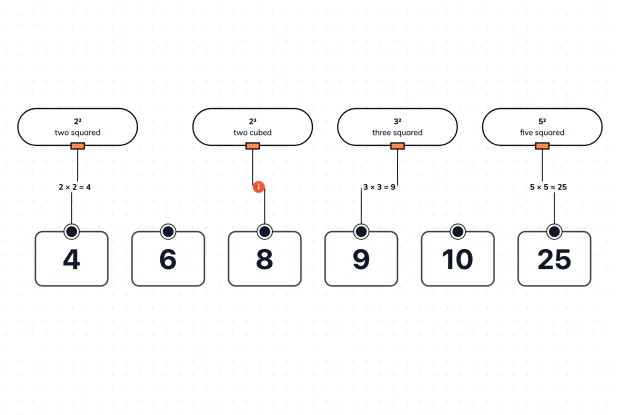
To work out a power of a whole number, multiply the base by itself as many times as the exponent says: 3²=9, 2³=8, 5²=25. Compute four powers and land each on its value in an interactive playground.
What Is a Square Root?
A square root undoes squaring: √9 = 3 because 3 × 3 = 9. Learn the radical sign and perfect squares, then work out four roots in an interactive playground.
How Do You Simplify a Square Root?
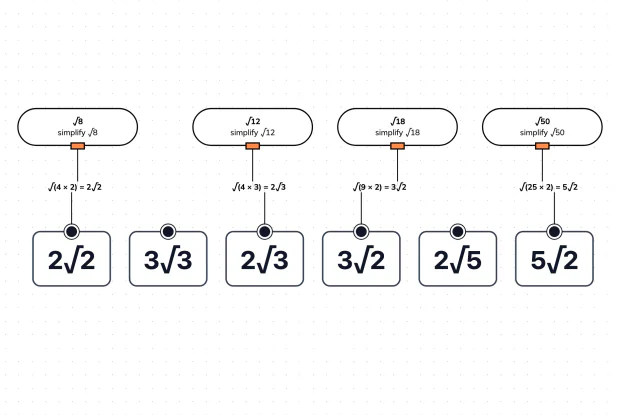
√12 isn't whole, but it hides a perfect square: √12 = 2√3. Learn to pull out the largest perfect-square factor and simplify four roots in an interactive playground.