What Is a Percentage Actually Measuring?
Root Concept
A percentage is a share out of a hundred, so it only becomes an amount once you know the base it is applied to.
CodePLU Goal
Upgrading Human Mental Models
Learn how to think in Workflows

Concept Development By codeplu.com
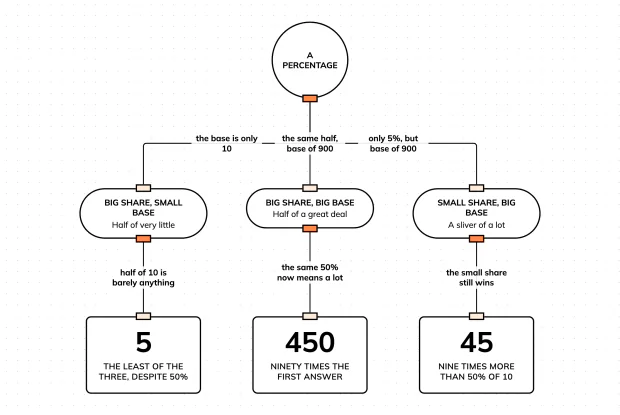
The same percentages producing very different amounts depending on the base
Why Does 5% Sometimes Beat 50%?
Here is a question that catches almost everyone the first time. Would you rather have 50% of one thing or 5% of another? Most people pick 50% instinctively, because it is the bigger number. But 50% of 10 is 5, while 5% of 900 is 45 — nine times more. The smaller percentage won comfortably, and nothing about the percentages explains why.
The reason is that a percentage is not an amount. It is an instruction: take this many parts out of every hundred. Until you know what it is being applied to, it has no size at all. That thing it is applied to is called the base, and the base does at least as much work as the percentage itself.
This is why percentages are so effective in advertising and so easy to mislead with. Fifty per cent off sounds enormous, and on a cheap item it is worth almost nothing. A two per cent fee sounds trivial, and on a house purchase it is thousands. In the playground below you will build a percentage down into three share-and-base cases and what each is worth, and watch the ranking come out in an order that the percentages alone would never predict.
How Do Percentages Actually Behave?
What does per cent literally mean?
Per cent means per hundred — cent is the same root as century and centimetre. So 30% means thirty out of every hundred, which is why writing it as the fraction 30/100 or the decimal 0.3 loses nothing. The reason we bother with a scale of a hundred is comparison. Hundredths are fine enough to describe most real differences without needing decimals, and putting everything on the same denominator makes ranking effortless: 37% against 41% needs no thought at all, whereas 3/8 against 5/12 needs actual work. That is the entire job percentages were invented for. They are not a more advanced kind of number, just a shared scale that makes unlike things comparable at a glance.
Why does a percentage mean nothing on its own?
Because it is a proportion, not a quantity. A percentage is always of something, and that something — the base — determines the actual amount. Fifty per cent of 10 is 5; fifty per cent of 900 is 450. Identical percentage, ninety times the result. So whenever you meet a percentage, the useful question is not how big is it but what is it a percentage of. This is where a lot of everyday confusion lives. A news headline saying cases doubled, a 100% rise, is frightening or trivial depending entirely on whether the base was two people or two million. Journalists sometimes report the percentage without the base for exactly that reason, and the number becomes unreadable without it.
Why doesn't a 20% rise followed by a 20% fall get you back?
This one surprises people even after they understand bases, and it follows directly from them. Take 100 and add 20%: you add 20 and reach 120. Now take 20% off that: 20% of 120 is 24, not 20, so you land on 96 rather than 100. You are four short. The percentages were the same but the bases were not — the rise was calculated on 100 and the fall on 120. A percentage change always uses whatever the amount is at that moment as its base. It is why a share price that drops 50% needs a 100% gain to recover, and why a 10% pay cut followed by a 10% rise leaves you worse off than before. Percentage changes do not cancel out, and treating them as if they do is one of the most expensive small errors in personal finance.
Real World Example
Which Sale Sign Is Worth Walking Across Town For?
Percentage sense is mostly the habit of asking what the base is before reacting to the number. One afternoon of shopping shows why:
The eye-catching sign
A shop advertises 50% off phone cases. The cases cost 12, so half off saves you 6. The sign is the biggest number in the street and the saving is the price of a coffee. Nothing is wrong with the maths — the base is simply small, so even a huge percentage cannot produce a large amount.
The sign nobody reads
The shop next door has 5% off laptops. That sounds barely worth noticing. But the laptop is 900, so 5% is 45 — more than seven times the saving from the dramatic 50% sign. The unimpressive percentage attached to a large base beats the impressive one attached to a small base, comfortably.
The one that actually costs you
Now the laptop shop offers 20% off today, then puts prices up 20% next week. If you bought at 900 minus 20%, you paid 720. Next week's 20% rise is calculated on 720, adding 144 to reach 864 — not back to 900. The two 20% changes did not cancel, because the second one used a smaller base. Whenever a percentage is applied twice, check what each one was applied to.
FAQs
Final Words
A percentage is an instruction, not an amount: take this many parts out of every hundred. It only becomes a quantity once you know the base, which is why 5% of a large number can crush 50% of a small one, and why the first question to ask about any percentage is what it is a percentage of.
Carry two habits away from this. Convert to a common scale before comparing anything, and check the base every time a percentage is applied more than once — because a rise and an equal fall use different bases and never cancel out. That single check is worth more in real life than any amount of mental arithmetic speed.
Continue This Track
This concept is part 4 of Three Ways to Write the Same Number.
What Does a Fraction Actually Mean?
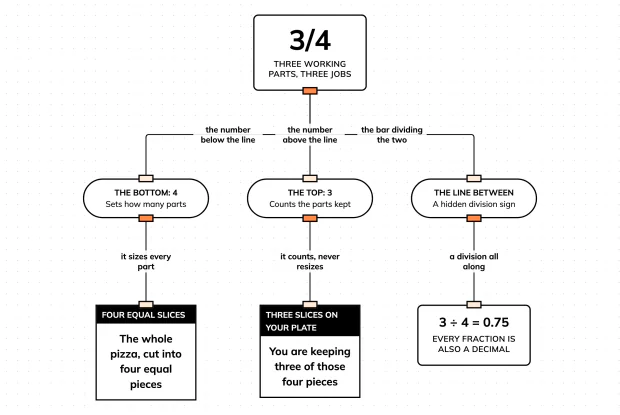
A fraction is not one number but two doing different jobs. Learn what the top and bottom each tell you, and build 3/4 down into its three working parts in an interactive playground.
How Can Two Different Fractions Be Equal?
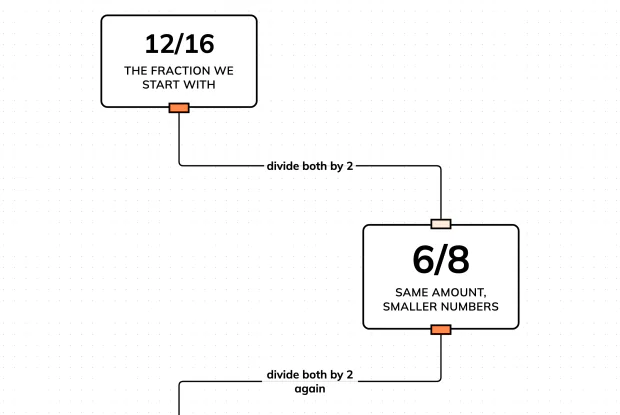
1/2, 2/4 and 8/16 are the same amount written three ways. Learn why multiplying or dividing both parts changes nothing.
How Do You Convert Between Fractions, Decimals and Percentages?
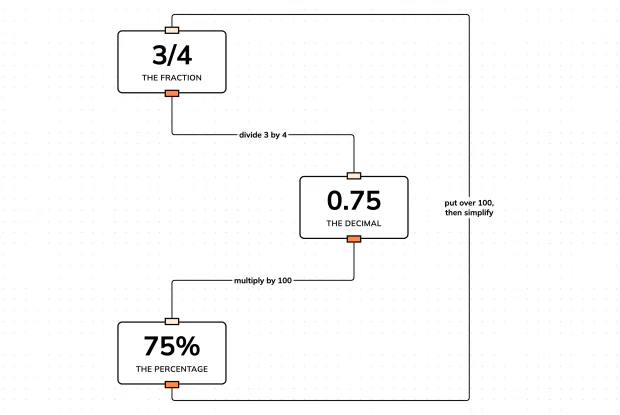
3/4, 0.75 and 75% are one value in three notations. Learn the move between each pair, then close the conversion loop yourself.
What Is a Percentage Actually Measuring?
A percentage on its own tells you almost nothing — it needs something to be a percentage of. Learn why the base decides everything, in an interactive playground.