How Do You Convert Between Fractions, Decimals and Percentages?
Root Concept
Fractions, decimals and percentages are three notations for one value — divide to get a decimal, multiply by 100 for a percentage, and put over 100 to get back to a fraction.
CodePLU Goal
Upgrading Human Mental Models
Learn how to think in Workflows

Concept Development By codeplu.com
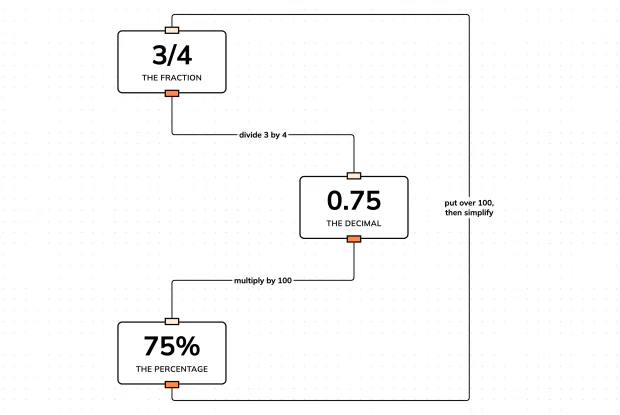
One value moving through all three notations and back to the start
Why Does One Number Need Three Different Notations?
3/4, 0.75 and 75% look like three different things. They are one amount written three ways, and nothing about the value changes as you move between them. A shop offering 3/4 off, 0.75 off and 75% off is offering exactly the same discount three times over.
So why bother with three notations? Because each is good at a different job. Fractions are best when things divide neatly — three quarters of an hour is instantly clear, where 0.75 hours takes a moment. Decimals are best for calculating and for anything a machine will read. Percentages are best for comparing, because they force everything onto the same scale of 100, which is exactly what a shopper or a news reader wants.
The moves between them are short and there are only three to learn. Divide top by bottom to leave a fraction. Multiply by 100 to reach a percentage. Put a percentage over 100 and simplify to get back to a fraction. Those three steps form a loop, and in the playground below you will close it — including the step back from a percentage to the fraction you started with.
How Does Each Conversion Work?
How do you turn a fraction into a decimal?
You do the division the fraction was already asking for. The line in a fraction means divide, so 3/4 is 3 divided by 4, which is 0.75. There is no separate rule to memorise — reading the notation literally is the rule. Some divisions finish neatly like this one; others do not. A third is 1 divided by 3, which gives 0.3333... running on forever. Those are the recurring decimals, and they are still exact values, just impossible to write out fully. This is where a habit is worth building: a handful of conversions come up constantly and are quicker recalled than calculated. A half is 0.5, a quarter is 0.25, three quarters is 0.75, a fifth is 0.2, a tenth is 0.1. Knowing those five covers most of everyday life.
How do you move between decimals and percentages?
Per cent means per hundred, so a percentage is just a decimal scaled up by 100. Multiply to go from decimal to percentage and divide to come back. So 0.75 becomes 75%, and 45% becomes 0.45. In place value terms multiplying by 100 shifts every digit two columns left, which is why the shortcut people describe as moving the decimal point two places works — the point is not really moving, the digits are changing columns. Watch the awkward ones. 0.05 is 5%, not 50%, and 1.5 is 150%, not 15%. A percentage above 100 is perfectly legitimate and simply means more than one whole, which is what a 150% increase in traffic describes.
How do you get from a percentage back to a fraction?
Write the percentage over 100 and then simplify, since per cent literally means out of a hundred. So 75% is 75/100, and dividing both parts by 25 gives 3/4. That final simplification is the equivalent-fractions rule doing its job, which is why the previous concept comes before this one. 40% is 40/100, which simplifies to 2/5. Decimal percentages work the same way with one extra move: 12.5% is 12.5/100, and multiplying both parts by 2 clears the decimal to give 25/200, which simplifies to 1/8. Nothing new is needed there — just the same rewriting rule applied twice.
Which notation should you actually use?
Pick the one that makes the job easiest, because they are interchangeable. For comparing, percentages win: 37% against 41% takes no thought, where 3/8 against 5/12 takes real work. For calculating by hand or by machine, decimals win, which is why spreadsheets store 0.2 rather than 20%. For exactness, fractions win, because 1/3 is exact where 0.333 is rounded — and that difference compounds in long calculations. The misconception worth dropping is that one form is more advanced or more correct than the others. They are tools, and fluency means being able to switch to whichever one makes the current question simple.
Real World Example
Which of These Three Discounts Is the Best?
Conversion stops being an exercise the moment three sellers describe their offers differently and you have thirty seconds to decide:
The three offers
Shop A takes 1/3 off. Shop B takes 0.3 off the price. Shop C takes 35% off. The jacket costs the same everywhere. As written, these are genuinely hard to rank — you are being asked to compare a fraction, a decimal and a percentage by eye, which is not a fair fight.
Putting all three on one scale
Convert everything to percentages, because comparison is what percentages are for. 1/3 is 1 divided by 3, which is 0.3333, so about 33.3%. 0.3 multiplied by 100 is exactly 30%. Shop C is already 35%. Now the ranking is immediate: 35%, then 33.3%, then 30%.
What the comparison reveals
Shop C wins, and Shop B — whose offer looked biggest written as a plain decimal — is actually the worst of the three. That is the real lesson: the notation an offer is written in can flatter it, and the only way to compare honestly is to put everything on the same scale first. It costs two divisions and protects you from the presentation.
FAQs
Final Words
One value, three notations, three moves. Divide the top by the bottom to turn a fraction into a decimal. Multiply by 100 to turn a decimal into a percentage. Put a percentage over 100 and simplify to get back to a fraction. That loop closes, which is what the playground made you prove.
The practical habit is choosing the notation that suits the question: percentages to compare, decimals to calculate, fractions to stay exact. Being able to switch on demand is what fluency here actually means — and the final concept in this category looks harder at what a percentage is really measuring, because a percentage on its own tells you less than people assume.
Continue This Track
This concept is part 3 of Three Ways to Write the Same Number.
What Does a Fraction Actually Mean?
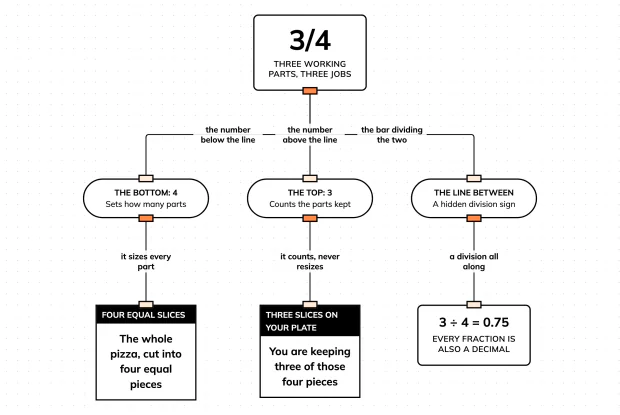
A fraction is not one number but two doing different jobs. Learn what the top and bottom each tell you, and build 3/4 down into its three working parts in an interactive playground.
How Can Two Different Fractions Be Equal?
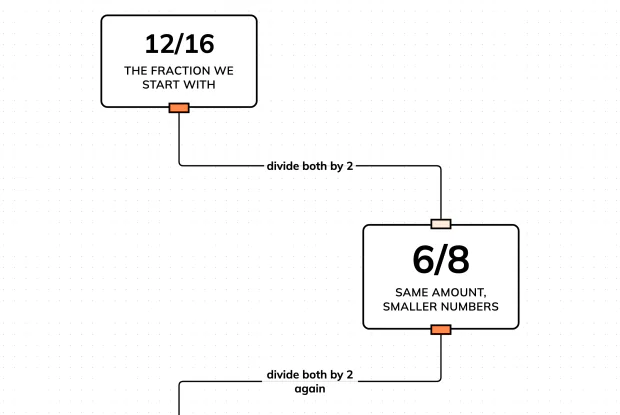
1/2, 2/4 and 8/16 are the same amount written three ways. Learn why multiplying or dividing both parts changes nothing.
How Do You Convert Between Fractions, Decimals and Percentages?
3/4, 0.75 and 75% are one value in three notations. Learn the move between each pair, then close the conversion loop yourself.
What Is a Percentage Actually Measuring?
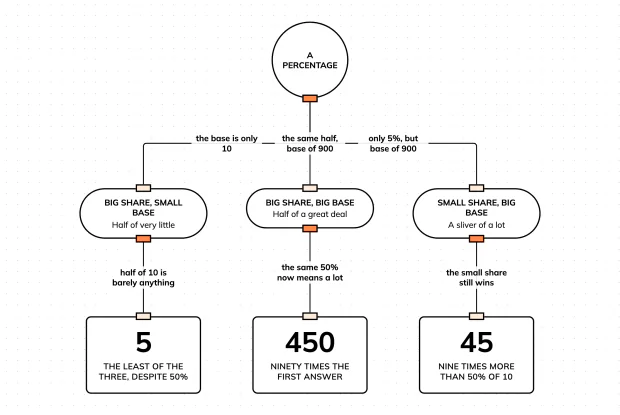
A percentage on its own tells you almost nothing — it needs something to be a percentage of. Learn why the base decides everything, in an interactive playground.