What Is a Clause, and When Can It Stand Alone?
Root Concept
A clause is a subject and a verb working together, and whether it can stand alone depends entirely on whether a word at the front makes it lean on something else.
CodePLU Goal
Upgrading Human Mental Models
Learn how to think in Workflows

Concept Development By codeplu.com
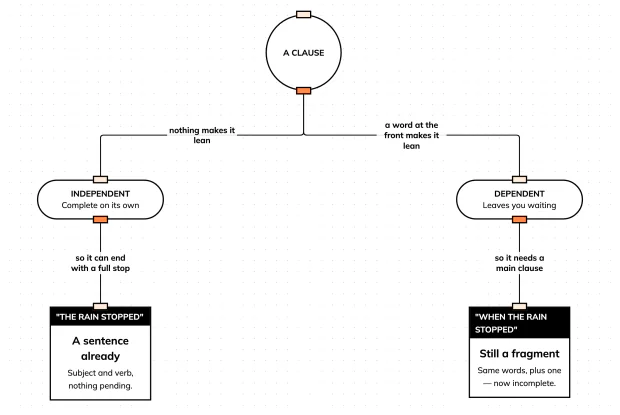
Two kinds of clause and what each can do alone, sorted by the word at the front
Why Is "When the Rain Stopped" Not a Sentence?
"The rain stopped" is a sentence. Add one word to the front — "When the rain stopped" — and it stops being one, even though nothing was removed. Read it aloud and you can feel the problem: you are waiting. When the rain stopped, what happened? The words are grammatically fine and the thought is unfinished, and that gap between the two is the whole subject of this tutorial.
The unit doing the work here is the clause. A clause is a subject and a verb working together — someone or something, and what it does. The previous track ended on exactly those parts, so a clause is the next level up: not a word doing a job, but a small working assembly of them. Sentences are built from clauses rather than directly from words, which is why so much punctuation advice makes no sense until you can see them.
And clauses come in two kinds, separated by one test. Can it stand alone as a sentence? If yes, it is independent — a complete statement, ready for a full stop. If it leaves you waiting, it is dependent, and it needs to attach to an independent clause to be finished. What decides which is usually a single word at the front. That is the most useful thing here: the difference is not length or complexity, it is one word.
The Two Kinds, and the Word That Decides
What exactly makes a group of words a clause?
A subject and a verb that belong to each other. "The rain stopped" has both: rain is the subject, stopped is the verb. "After the heavy rain" has neither doing anything — no verb, so it is a phrase rather than a clause. This distinction matters because phrases and clauses obey different rules: you can drop a phrase almost anywhere in a sentence without punctuation trouble, whereas joining two clauses is exactly where the errors live. So the first question to ask of any group of words is whether something in it is doing something.
How do I test whether a clause is independent?
Read it on its own and see whether you are left waiting. "She missed the bus" — nothing pending, it is a complete statement you could agree or disagree with. "Because she missed the bus" — now you are waiting for the consequence. That waiting sensation is not vague intuition; it is caused by a specific word. Remove because and completeness returns instantly. This is a test you can apply out loud in a second, and it beats memorising lists of clause types.
Which words make a clause dependent?
Two families. Subordinating conjunctions — because, although, when, if, while, since, unless, after, before, until — each of which announces a relationship and then leaves the main statement still to come. And relative pronouns — who, which, that — which attach a clause to a noun: "the man who missed the bus" leaves who missed the bus dangling until it is fixed to something. Both families do the same structural thing: they take a clause that was standing on its own and make it lean. Notice that none of them changes the subject or the verb.
Why is this worth knowing before you learn punctuation?
Because most punctuation rules are stated in terms of clauses, so they are unlearnable until you can see one. "Use a semicolon between two independent clauses" is useless advice to someone who cannot tell whether they have two. The most common serious punctuation error in English — joining two independent clauses with only a comma — cannot even be described without this vocabulary. Getting the clause solid first is why this tutorial comes before the one on joining them, rather than after.
Is a fragment always a mistake?
No, and it is worth saying so honestly. A dependent clause used alone is a fragment, and in formal writing it is normally an error. But experienced writers use fragments deliberately for emphasis and rhythm — "Because it works." — and they read as a choice rather than a slip precisely because the writer is visibly in control of the rule. The distinction is intent: a fragment that lands is deliberate, and a fragment caused by not noticing you left the reader waiting is the thing this test protects you from.
Real World Example
One Word, and a Sentence Becomes a Fragment
Watch what a single added word does to a complete statement, and what it does not do:
Standing alone
"The power came back on."
Subject, verb, nothing pending. This is an independent clause and it is already a sentence — a full stop is all it needs.
One word added
"After the power came back on."
Nothing was removed and the subject and verb are untouched. But after announces that something else is coming, so the reader is left waiting. It is now a dependent clause, and alone it is a fragment.
Attached to a main clause
"After the power came back on, we reset the clocks."
The dependent clause has something to lean on, so the whole thing is complete. Notice the comma appears only because the dependent clause came first — that is a rule about order, not about the clause itself.
The takeaway test
Read it alone and listen for waiting
You do not need to identify the word's grammatical family to apply this. If reading it aloud leaves you expecting more, it cannot stand alone. That one habit prevents most fragment errors.
FAQs
Final Words
A clause is a subject and a verb working together, and there are two kinds. An independent clause leaves nothing pending, so it is already a sentence. A dependent clause leaves you waiting, and it needs a main clause to lean on — and what makes it lean is usually one word at the front, from a small and learnable list.
The test is worth more than the terminology: read the words on their own and notice whether you are expecting more. That habit catches fragments without any labelling at all. With clauses visible, the next tutorial can do the thing this vocabulary was needed for — joining two of them without breaking the sentence, which is where the most common punctuation error in English lives.
Continue This Track
This concept is part 1 of Joining Sentences Without Breaking Them.
What Is a Clause, and When Can It Stand Alone?
Sentences are not built from words directly; they are built from clauses. Learn what a clause is, the single test that decides whether one can stand alone, and sort both kinds yourself in an interactive playground.
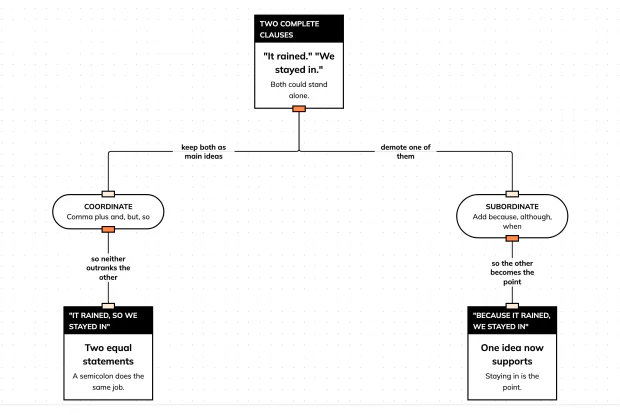
How Do You Join Two Clauses?
Two complete clauses can be joined two ways, and the choice is not stylistic: it tells the reader which idea is the main one. Build both routes and see where they part in an interactive playground.
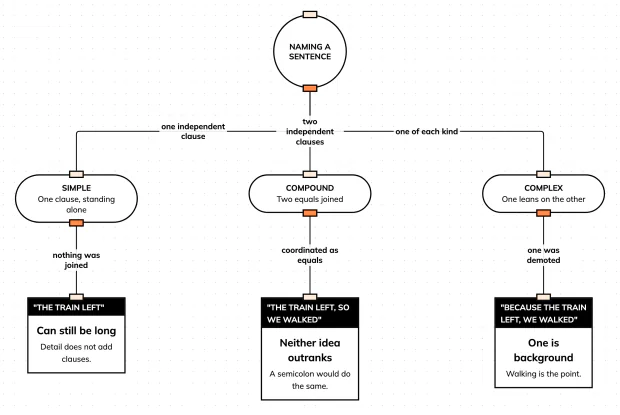
Simple, Compound or Complex — What Kind of Sentence Is This?
Sentence types sound like a separate topic to memorise. They are not — each name is a description of how many clauses you used and whether you demoted one. Sort them by what they are made of in an interactive playground.