Joining Sentences Without Breaking Them
Assumes you have done Building a Sentence From Its Parts, which ended on the three parts of a single sentence. This track goes one level up, to the unit sentences are actually built from. It opens on the clause, because most punctuation rules are stated in terms of clauses and are therefore unlearnable until you can see one — and the test for whether a clause can stand alone takes a second to apply out loud. The second part uses that test on the most common serious punctuation error in English, joining two complete clauses with only a comma, and shows that the two correct repairs are not interchangeable: one keeps both ideas equal, the other decides which idea is the point. The third part names what you have built, and the names turn out to be nothing more than a count of clauses and a note of whether one was demoted.
CodePLU Goal
Upgrading Human Mental Models
Learn how to think in Workflows
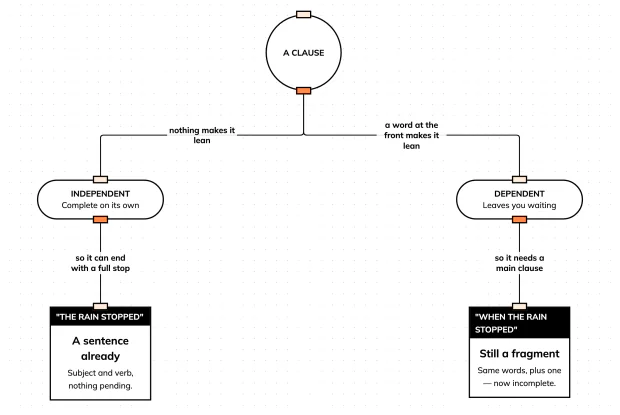
What Is a Clause, and When Can It Stand Alone?
Sentences are not built from words directly; they are built from clauses. Learn what a clause is, the single test that decides whether one can stand alone, and sort both kinds yourself in an interactive playground.
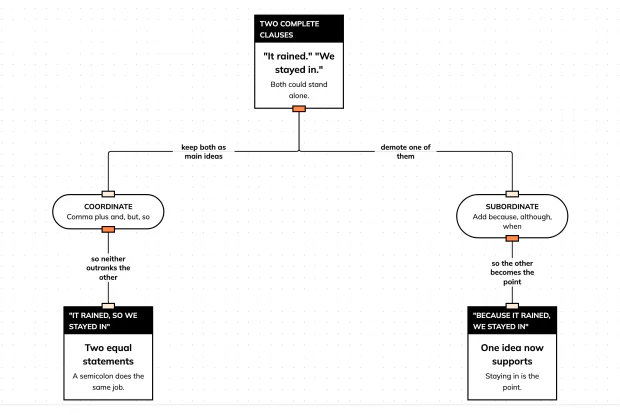
How Do You Join Two Clauses?
Two complete clauses can be joined two ways, and the choice is not stylistic: it tells the reader which idea is the main one. Build both routes and see where they part in an interactive playground.
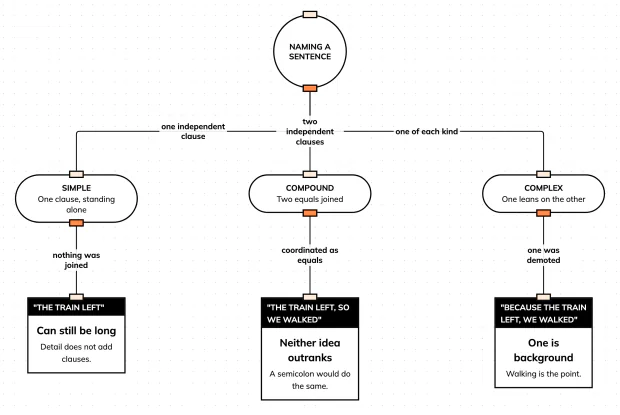
Simple, Compound or Complex — What Kind of Sentence Is This?
Sentence types sound like a separate topic to memorise. They are not — each name is a description of how many clauses you used and whether you demoted one. Sort them by what they are made of in an interactive playground.