Simple, Compound or Complex — What Kind of Sentence Is This?
Root Concept
Count the independent clauses, then ask whether a dependent one is attached — the three sentence types are just the answers to those two questions.
CodePLU Goal
Upgrading Human Mental Models
Learn how to think in Workflows

Concept Development By codeplu.com
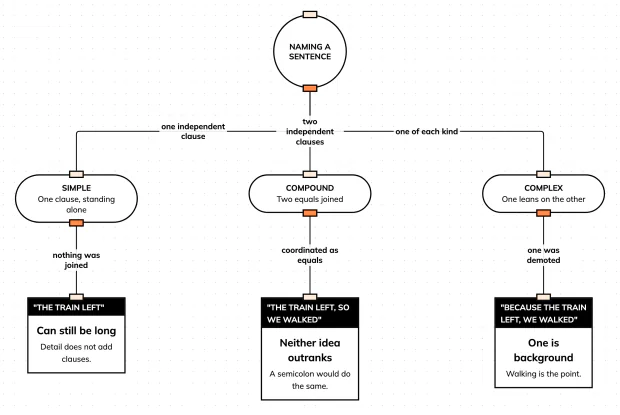
Three sentence types, each connected to the clause structure that produces it
Are These Really Three Different Things to Learn?
Simple, compound and complex are usually presented as a fresh topic with three definitions to memorise, and they are the last thing in this track for a reason: by now you have already built all three without being told what they are called. The names are not new information. They are labels for combinations of things you know — how many independent clauses are present, and whether a dependent one is attached.
That reduces the whole topic to two questions. Count the independent clauses: one, or more than one? Then check for a dependent clause: present, or not? One independent clause and nothing else is simple. Two independent clauses joined as equals is compound. One independent clause with a dependent clause attached is complex. There is a fourth combination — two independent plus a dependent — which is called compound-complex, and it is exactly as unmysterious as the arithmetic suggests.
The one thing worth unlearning here is the association between simple and short. A simple sentence can run to twenty-five words, because phrases, adjectives and lists add detail without adding clauses. "The last train to the coast left the crowded platform eleven minutes early" is a simple sentence — one subject, one verb, and a great deal of description. Simple describes the skeleton, not the length.
Two Questions, Four Answers
Why can a simple sentence be long?
Because the things that make sentences long are mostly not clauses. Adjectives, prepositional phrases, lists and adverbs all add words without adding a second subject-and-verb pair. "The last train to the coast left the crowded platform eleven minutes early" has one subject, train, and one verb, left — everything else is detail hanging off them, which is exactly the skeleton idea from the earlier track. So if you are asked whether a sentence is simple, do not measure it. Find the verbs that have their own subjects and count those.
What makes a sentence compound rather than complex?
Whether either clause was demoted. Compound means two clauses that could each still stand alone, held together as equals by a comma plus a conjunction or by a semicolon. Complex means one of them has been made dependent by a subordinator, so it can no longer stand alone. This is a genuine structural difference and not a stylistic label: in a compound sentence you could delete the join and get two valid sentences, and in a complex one you could not, because the dependent half would be a fragment.
How do you count clauses reliably?
Find every verb that has its own subject, then check which of those pairs is preceded by a subordinator. "Although the shop closed early, the queue stayed and nobody complained" has three subject-verb pairs — shop closed, queue stayed, nobody complained. The first carries although, so it is dependent. The other two are independent and joined by and. Two independent plus one dependent makes this compound-complex. The counting habit is doing all the work; the name is just the readout.
Why does the distinction matter for writing rather than for tests?
Because sentence type controls rhythm and emphasis, and using only one type is what makes prose feel wrong in a way most people cannot name. All simple sentences reads as abrupt and childlike. All compound reads as a breathless list where everything is equally important. All complex reads as heavy and hard to follow. Mixing them is not decoration — every time you choose compound over complex you are telling the reader that two ideas rank equally, and that signal accumulates across a paragraph.
Where do people go wrong most often?
Two places. Calling a long sentence complex because it is long, when it may have one clause and a lot of description — the fix is to count, not to judge. And missing that a sentence is compound when the second clause has been shortened by leaving out a repeated subject: "The train left and never came back" looks like two clauses, but the second has no subject of its own, so it is one clause with two verbs. That is a simple sentence, and spotting it is the same subject-and-verb test applied carefully.
Real World Example
One Paragraph, Rewritten Three Ways
The facts: the bus was late, the meeting started without her, she missed the vote. Watch what changes when only the structure does:
All simple
"The bus was late. The meeting started without her. She missed the vote."
Three simple sentences. Clear, and flat — nothing tells you which fact matters or how they connect, so the reader has to assemble the causation themselves.
All compound
"The bus was late, and the meeting started without her, and she missed the vote."
Everything is now equal in rank, which is its own kind of failure: a breathless list in which the consequence carries no more weight than the cause.
Complex, consequence promoted
"Because the bus was late and the meeting started without her, she missed the vote."
Two clauses demoted to background, one left independent. The sentence is now unmistakably about missing the vote, and the rest is explanation.
What this shows
Structure is emphasis
Identical facts, three readings. Choosing a sentence type is choosing what your reader takes away — which is why this is a writing skill rather than a labelling exercise.
FAQs
Final Words
Three names, two questions. Count the independent clauses, then check whether a dependent clause is attached. One alone is simple, two as equals is compound, one with a dependent attached is complex, and two with a dependent is compound-complex. Nothing new was introduced in this tutorial — the names describe structures you built in the previous two.
Two habits are worth keeping. Count subject-and-verb pairs rather than judging by length, because a simple sentence can run to twenty-five words. And treat the choice as signalling: coordination tells the reader two ideas rank equally, subordination tells them which one is the point, and a paragraph written in only one type says the same thing over and over regardless of what the words claim.
Continue This Track
This concept is part 3 of Joining Sentences Without Breaking Them.
What Is a Clause, and When Can It Stand Alone?
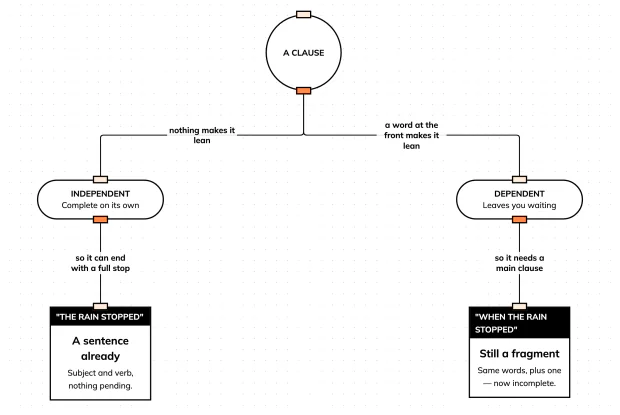
Sentences are not built from words directly; they are built from clauses. Learn what a clause is, the single test that decides whether one can stand alone, and sort both kinds yourself in an interactive playground.
How Do You Join Two Clauses?
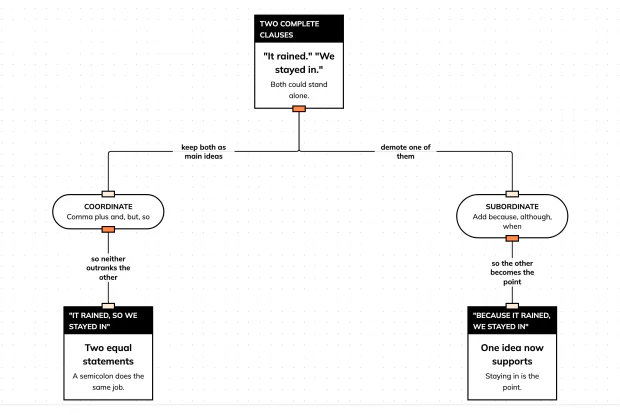
Two complete clauses can be joined two ways, and the choice is not stylistic: it tells the reader which idea is the main one. Build both routes and see where they part in an interactive playground.
Simple, Compound or Complex — What Kind of Sentence Is This?
Sentence types sound like a separate topic to memorise. They are not — each name is a description of how many clauses you used and whether you demoted one. Sort them by what they are made of in an interactive playground.