How Do You Join Two Clauses?
Root Concept
Coordination keeps both clauses as main ideas; subordination demotes one to a supporting role — so joining is a decision about emphasis, not just about punctuation.
CodePLU Goal
Upgrading Human Mental Models
Learn how to think in Workflows

Concept Development By codeplu.com
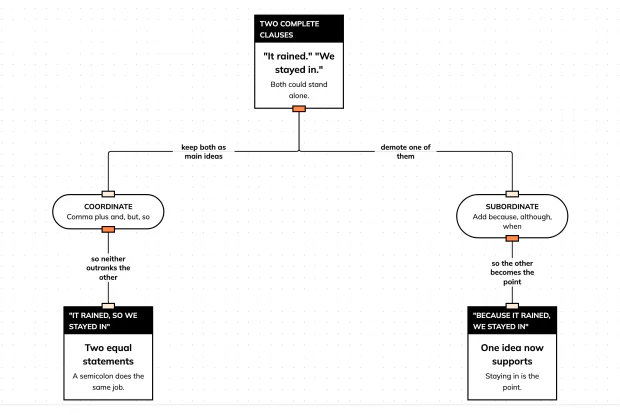
One pair of clauses joined two ways, forking on whether either idea is demoted
Why Is a Comma Not Enough?
"It rained, we stayed in." Almost everyone has written that sentence, and it is the single most common serious punctuation error in English. It has a name — a comma splice — and the reason it is wrong is structural rather than fussy: a comma is too weak to hold two complete statements together. Each of those clauses could end with a full stop. Putting only a comma between them is like joining two railway carriages with string.
There are two proper ways to do it, and the interesting part is that they are not interchangeable. You can coordinate — join them as equal partners, with a comma plus a word like and, but or so, or with a semicolon. Both clauses stay main ideas and the reader weighs them equally. Or you can subordinate — attach a word like because, although or when to one of them, which demotes it to a supporting role and leaves the other as the point of the sentence.
That is why this is a decision and not a rule to obey. "It rained, so we stayed in" reports two facts of equal standing. "Because it rained, we stayed in" says the point is that we stayed in, and the rain is merely why. Same information, different emphasis, and a reader picks up that emphasis whether or not they could name what you did.
The Two Joins, and the Error Between Them
What exactly is wrong with a comma splice?
A comma separates items inside a structure; it does not have the strength to join two structures. When both sides of your comma could stand alone as sentences, the comma is being asked to do a job it cannot do, and the reader momentarily runs the two statements together before reversing. Four fixes exist and all are one keystroke: a full stop, a semicolon, a comma plus a coordinating conjunction, or a subordinator on one clause. The test for whether you have a splice is exactly the test from the previous tutorial — cover each side and ask whether it could stand alone.
How does coordination work?
You add a coordinating conjunction after the comma — and, but, or, so, yet, for, nor — and both clauses keep equal rank. The conjunction carries the relationship: and adds, but contrasts, so concludes. A semicolon does the same structural job without naming the relationship, which is why it feels more formal: it asserts that the two statements belong together and leaves the reader to infer why. Both options say the same thing about rank — these two ideas are equals — and differ only in whether the link is spelled out.
How does subordination change the meaning?
It creates a hierarchy. Attaching because, although, when, while, if or since to a clause makes it dependent, as the previous tutorial showed — and a dependent clause is read as background. Whatever remains independent is taken as the main point. So the writer is deciding what the sentence is about. "Although the team practised hard, they lost" is a sentence about losing. "Although the team lost, they practised hard" is a sentence about their effort. Identical facts, opposite emphasis, and the choice of which clause to demote is the whole mechanism.
When should you pick one over the other?
Ask what the sentence is for. If both facts are genuinely of equal weight in your argument, coordinate — forcing a hierarchy on them misleads the reader about your point. If one fact exists only to explain or qualify the other, subordinate, because leaving it independent gives it more prominence than it deserves. A practical symptom of getting this wrong is prose made entirely of and and so, which reads as a list of equally important events and leaves the reader to guess which matter. Varying it is not decoration; it is signalling.
Does the order of the clauses matter?
For meaning, less than you would expect; for punctuation, yes. A dependent clause can go first or second, and the comma rule follows: put it first and it takes a comma — "Because it rained, we stayed in" — put it second and usually it does not — "We stayed in because it rained." Placing the dependent clause first also gives slight emphasis to the setup, which is useful when the condition is the surprising part. Coordination has no such freedom: the conjunction sits between the clauses and cannot move.
Real World Example
One Splice, Four Repairs, Four Different Sentences
Start with the error: "The deadline moved, the team relaxed." Both sides could stand alone, so the comma is not strong enough. Here is what each repair does:
Full stop
"The deadline moved. The team relaxed."
Two separate sentences. Correct, and it drops any claim about how the facts relate — the reader connects them unaided, which suits a plain narrative.
Semicolon
"The deadline moved; the team relaxed."
Equal rank, and it asserts that the two belong together without saying why. Formal, and it invites the reader to supply the link.
Comma plus conjunction
"The deadline moved, so the team relaxed."
Equal rank again, but now the relationship is named: so makes it a consequence. This is usually the clearest of the four for ordinary prose.
Subordination
"Because the deadline moved, the team relaxed."
Now there is a hierarchy. The moved deadline becomes background and the sentence is about the team relaxing. Choose this when one clause exists only to explain the other.
FAQs
Final Words
Two independent clauses cannot be held together by a comma. They can be coordinated — comma plus a conjunction, or a semicolon — which keeps both as main ideas of equal rank. Or one can be subordinated with a word like because or although, which turns it into background and leaves the other as the sentence's point.
So joining clauses is a decision about emphasis that happens to be made with punctuation. The test for whether you need one of these joins is the one from the previous tutorial: cover each side and ask whether it could stand alone. With both clauses and joins in place, the last tutorial in this track names what you have been building — simple, compound and complex sentences turn out to be descriptions of exactly these choices.
Continue This Track
This concept is part 2 of Joining Sentences Without Breaking Them.
What Is a Clause, and When Can It Stand Alone?
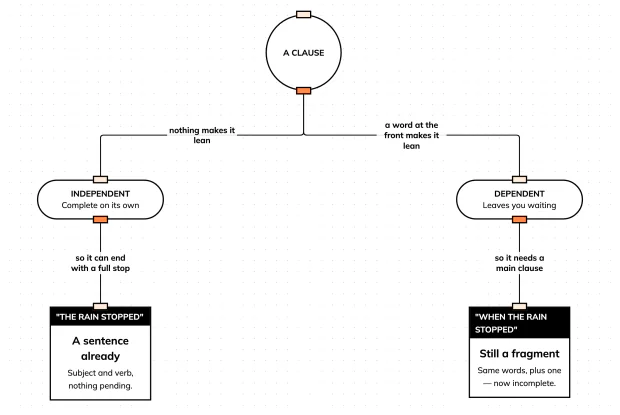
Sentences are not built from words directly; they are built from clauses. Learn what a clause is, the single test that decides whether one can stand alone, and sort both kinds yourself in an interactive playground.
How Do You Join Two Clauses?
Two complete clauses can be joined two ways, and the choice is not stylistic: it tells the reader which idea is the main one. Build both routes and see where they part in an interactive playground.
Simple, Compound or Complex — What Kind of Sentence Is This?
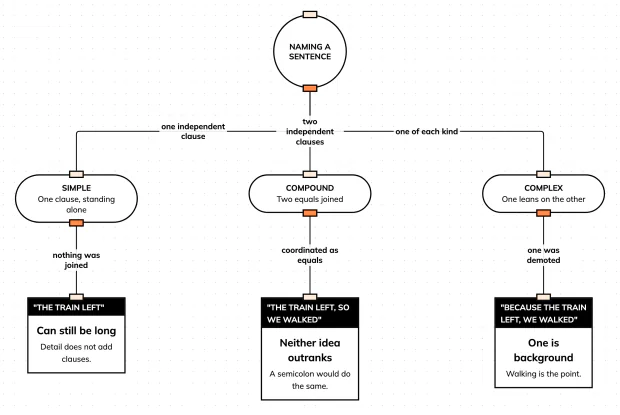
Sentence types sound like a separate topic to memorise. They are not — each name is a description of how many clauses you used and whether you demoted one. Sort them by what they are made of in an interactive playground.