What Happens When One Species Disappears?
Root Concept
Species are connected through a web, so removing one sends effects along every link it touched — sometimes reaching parts of the ecosystem that never interacted with it.
CodePLU Goal
Upgrading Human Mental Models
Learn how to think in Workflows

Concept Development By codeplu.com
One removal travelling along a chain of consequences to an unrelated part of the system
Can Removing One Animal Change the Shape of a River?
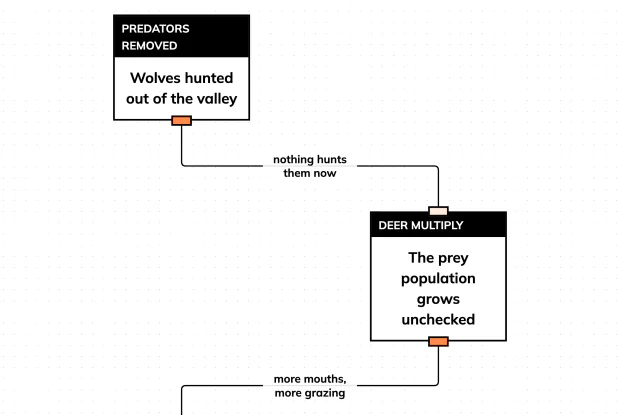
That question sounds like a trick and it is not. Remove the large predators from a valley and you have obviously changed things for those predators and for the animals they hunted. What is far less obvious is that you may also have changed which trees grow there, and after that, where the river runs.
The reason is that species are not arranged in tidy separate chains. They sit in a web, and every species touches several others — as food, as competition, as shelter, as the thing that keeps its numbers down. Pull one strand out and the tension changes across the whole web, not just at the point where you pulled.
Effects that travel this way are called cascades, and they follow a pattern you can reason about. Fewer predators means more prey. More prey means heavier grazing. Heavier grazing means fewer young trees. Fewer trees means less root holding the soil, and soil without roots washes away. By the last step, an event about animals has become an event about geology — and nothing in that chain required anything mysterious. In the playground below you will build exactly that sequence.
How Do Effects Travel Through an Ecosystem?
Why doesn't a removal stay local?
Because what a species does is not limited to being eaten or eating. A predator suppresses the numbers of its prey, and often changes their behaviour too, keeping them away from places where they are easy to catch. Remove it and both effects lift at once: there are more prey animals and they range more freely. That is already two changes for the price of one, and each of those changes touches whatever the prey species eats, competes with or shelters. Nothing here is unusual biology; it is just consequences following consequences. The mistake worth avoiding is imagining an ecosystem as a set of independent populations that happen to share a space. It is a set of populations that each hold each other in check, and removing one is closer to cutting a wire in a circuit than to taking a book off a shelf.
What are keystone species?
Some species matter far more than their numbers suggest, and those are called keystone species, after the wedge-shaped stone that holds an arch together. Sea otters are the classic case: they eat sea urchins, urchins eat kelp, and where otters were hunted out the urchin population exploded and stripped whole kelp forests down to bare rock. The kelp forest was habitat for a great many other species, so losing the otter cost far more than one animal. Beavers are keystone in a different way — by building dams they create wetlands that dozens of species depend on, so they change the physical environment rather than just the population balance. The practical lesson is that you cannot judge a species' importance by how common or conspicuous it is, which makes conservation decisions genuinely difficult.
Why are some ecosystems more fragile than others?
It comes down to how many alternatives each species has. If a predator eats six things and one of them vanishes, it shifts to the other five and the system absorbs the shock. If it eats only one thing, the loss of that species removes it too, and then whatever it was suppressing runs free. So biodiversity is not merely a count of species worth having for its own sake — it is redundancy, and redundancy is what makes a system able to take a hit. This is why specialists are so much more vulnerable than generalists, and why island ecosystems, which tend to have few species and many specialists, have suffered so many extinctions. A web with more strands can lose one without slackening; a web with few strands cannot.
Can these effects be reversed?
Sometimes, partly, and slowly. The most discussed case is the return of wolves to Yellowstone National Park in 1995, after around seventy years of absence. Elk numbers fell and their behaviour changed, willow and aspen recovered in places, and researchers described knock-on effects reaching as far as beaver activity and stream banks. It is a genuinely useful illustration of a cascade running in reverse — and it is also worth knowing that ecologists continue to debate how much of the change wolves caused, since drought, bears, human hunting and climate all shifted over the same period. That debate is not a weakness in the science; it is the normal business of separating one cause from several, and it is a good reminder that in a web, attributing an effect to a single strand is hard by design.
Real World Example
How Did Hunting Otters Destroy an Underwater Forest?
The sea otter story is the clearest documented cascade, and every step in it is ordinary:
The removal
Sea otters were hunted extensively for their fur along the North Pacific coast, and their populations collapsed to a fraction of what they had been. On its own that reads as a story about one animal, and for a long time that is how it was understood.
The consequence nobody was watching
Otters eat sea urchins. With far fewer otters, urchin numbers rose sharply, and urchins graze on kelp — specifically on the base that anchors it. Vast kelp forests were cut loose and lost, leaving stretches of seabed that ecologists call urchin barrens: bare rock covered in urchins and very little else.
Why that mattered far beyond kelp
Kelp forests are habitat. They shelter fish, invertebrates and other species, and they absorb wave energy before it reaches the shore. Losing them affected fisheries and coastlines, neither of which had any direct relationship with otters. Where otters have recovered, kelp has returned in many places — which is the same cascade running backwards, and the strongest evidence that the otter was the strand holding it together.
FAQs
Final Words
Species sit in a web, not in separate chains, so removing one sends effects along every link it touched. Fewer predators means more prey, means heavier grazing, means fewer trees, means soil that washes away — a chain that starts with animals and ends with geology, without a single mysterious step.
The two ideas worth keeping are that importance does not track abundance, which is what keystone species demonstrate, and that biodiversity functions as redundancy, which is what lets a system absorb a loss at all. And the Yellowstone debate is worth remembering for a different reason: in a web with many strands, proving which one caused an effect is genuinely difficult, and good science says so.
Continue This Track
This concept is part 4 of How the Living World Connects.
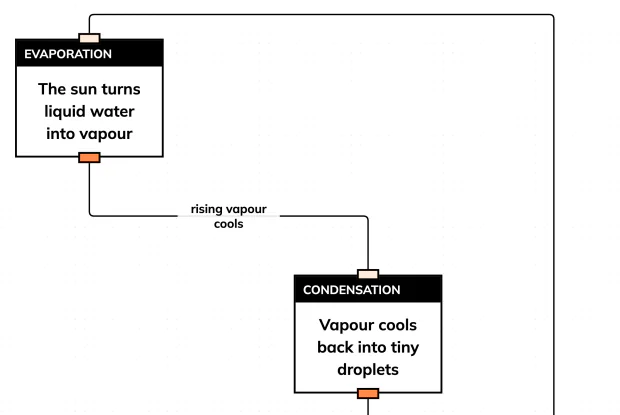
How Does Water Move Around the Planet?
The water in your glass has been round this loop countless times. Learn the four stages and close the loop yourself in an interactive playground.
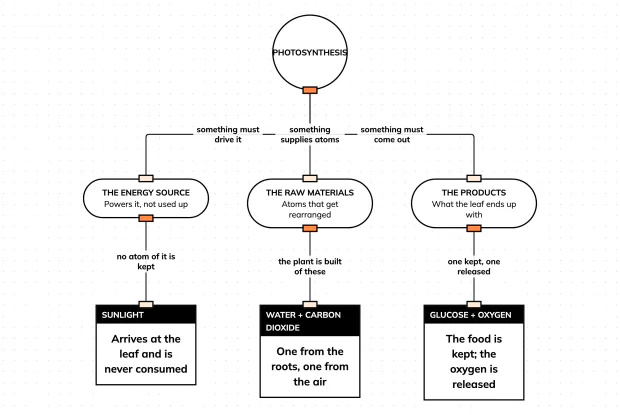
How Do Plants Make Their Own Food?
Plants do not eat soil — they build their own food out of air, water and light. Learn what each ingredient actually does.
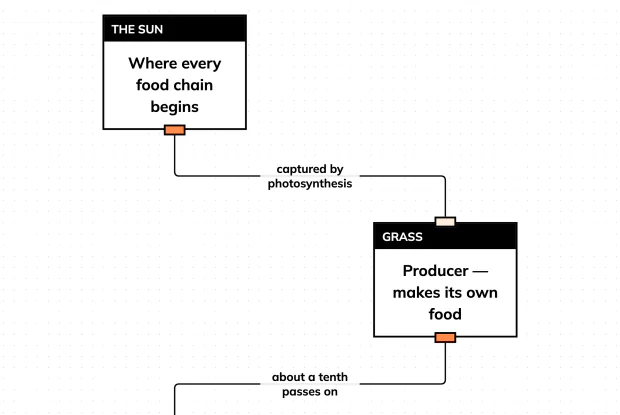
Where Does the Energy in a Food Chain Come From?
Every meal traces back to sunlight, and most energy is lost at each step. Learn why food chains are always short.
What Happens When One Species Disappears?
Removing one species rarely affects only that species. Learn how effects cascade through an ecosystem.