How Does Water Move Around the Planet?
Root Concept
Water endlessly changes state and location but is never created or destroyed — the same water has cycled through the planet for billions of years.
CodePLU Goal
Upgrading Human Mental Models
Learn how to think in Workflows

Concept Development By codeplu.com
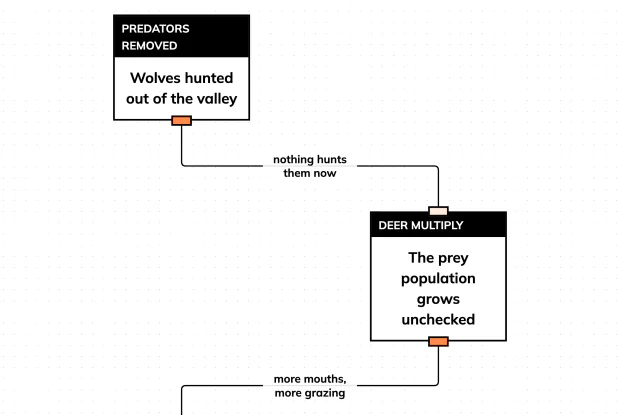
The four stages of the water cycle, closing back on themselves
Where Does Rain Come From, and Where Does It Go?
Here is a fact that sounds like an exaggeration and is not: the water in your glass is old. Not a few years old — likely billions. Earth does not manufacture water. The same supply has been circulating since long before there were people to drink it, changing form and location constantly while the total amount stays essentially the same.
That circulation is the water cycle, and it has four stages. The sun heats water and turns it into invisible vapour, which is evaporation. High up, where it is colder, the vapour turns back into tiny droplets, which is condensation and is what a cloud actually is. When those droplets grow heavy enough they fall as rain, snow or hail, which is precipitation. And then the water gathers in seas, rivers, lakes and underground, which is collection — until the sun warms it and the whole thing starts again.
The most important feature of this is the word cycle. There is no first stage and no last one; every stage is caused by the one before and causes the one after, forever. That is why the playground below is not a line but a loop, and why you have to close it — connecting collection back to evaporation is the step that turns four separate facts into one working system.
What Happens at Each Stage?
What actually happens during evaporation?
The sun delivers energy to the surface of the sea, a lake or a puddle, and that energy lets the fastest-moving water molecules escape into the air as vapour. The water has not vanished and it has not become something else — it has changed state from liquid to gas while staying water. Two things follow that surprise people. First, water vapour is completely invisible: what you see rising from a kettle is already condensing back into droplets, so the visible cloud is not the vapour. Second, evaporation does not need boiling. A puddle disappears on a cold day, just slowly, because the process depends on energy arriving rather than on any particular temperature being reached. Plants add to this too, releasing vapour through their leaves in a process called transpiration, which in forests moves enormous quantities of water.
Why do clouds form, and what are they made of?
Air gets colder as you go higher, so rising vapour eventually cools to a point where it cannot stay a gas, and it condenses onto tiny specks of dust and salt floating in the air. Those countless microscopic droplets together are a cloud. So a cloud is not vapour and it is certainly not empty — it is liquid water, suspended because each droplet is small enough for gentle rising air to hold it up. You can watch the same physics on any cold window: warm moist air from the room meets cold glass, cools, and condenses into droplets you can wipe off. The misconception worth clearing here is that clouds float because they are lighter than air. They are not. They stay up because the droplets are tiny and rising air currents support them, which is exactly why clouds sink and thin out as the air stops rising.
What makes water fall, and where does it end up?
Droplets in a cloud collide and merge, and once one grows heavy enough that rising air can no longer hold it, gravity wins and it falls. If the air is cold enough on the way down it arrives as snow or hail instead of rain — same water, different state. What happens next is more varied than most diagrams suggest. Some water runs across the surface into streams and rivers and eventually the sea. Some soaks into the ground and becomes groundwater, which can sit there for thousands of years before re-emerging. Some lands on ice sheets and stays frozen for millennia. So while the cycle never stops, an individual water molecule might race round it in days or be locked away for a very long time — the loop is one process running at wildly different speeds in different places.
Why does it matter that the cycle closes?
Because it tells you the total amount of water is fixed, and that changes how you think about a great many things. Water is never used up, only moved and changed in state — which means talk of running out of water is really about running out of clean, accessible, fresh water in a particular place at a particular time. Only a small fraction of Earth's water is fresh, and most of that is frozen or deep underground. The closed loop also explains why pollution is such a stubborn problem: there is no fresh supply arriving from anywhere, so whatever gets into the water stays in the system and travels with it. Understanding the cycle as closed rather than as a one-way journey from cloud to tap is the difference between two quite different mental models of the planet.
Real World Example
How Long Would One Water Molecule Take to Go Round?
The cycle is one process, but the time an individual molecule spends in it varies enormously depending on where it lands:
The fast route: days
Water evaporates from a warm sea, forms a cloud, and falls as rain onto that same sea a few days later. Nothing is stored anywhere, so the molecule completes the loop almost immediately. Most of the cycle's activity is this kind of rapid turnover over the oceans, which is where the majority of both evaporation and rainfall happens.
The slow route: thousands of years
The same rain instead falls on land and soaks deep into permeable rock, joining groundwater. It may move only a few metres a year. Water pumped from some deep aquifers today fell as rain thousands of years ago — which is why over-extracting groundwater is not like emptying a bucket that refills each winter.
The frozen route: hundreds of thousands of years
Snow falling on Antarctica is buried by more snow and compressed into ice. It can stay locked there for hundreds of thousands of years, and this is precisely why ice cores are useful — drill down and each layer is old precipitation, complete with trapped air, giving a record of past atmospheres. The cycle never stopped; that water was simply paused in the collection stage for a very long time.
FAQs
Final Words
The water cycle is four stages that never stop feeding each other: evaporation lifts water as invisible vapour, condensation turns it into the droplets we call clouds, precipitation drops it as rain or snow, and collection gathers it until the sun starts the process over. Closing that loop is what makes it a system rather than a list.
Two ideas are worth carrying away. Water changes state and place but is never created or destroyed, so shortages and pollution are both problems of a fixed supply. And the loop runs at wildly different speeds — days over the ocean, millennia in an ice sheet. The next concept follows energy rather than water, through a system where, unlike water, it genuinely does run out.
Continue This Track
This concept is part 1 of How the Living World Connects.
How Does Water Move Around the Planet?
The water in your glass has been round this loop countless times. Learn the four stages and close the loop yourself in an interactive playground.
How Do Plants Make Their Own Food?
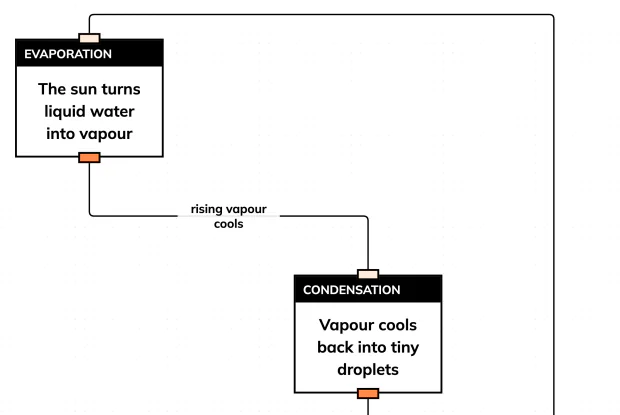
Plants do not eat soil — they build their own food out of air, water and light. Learn what each ingredient actually does.
Where Does the Energy in a Food Chain Come From?
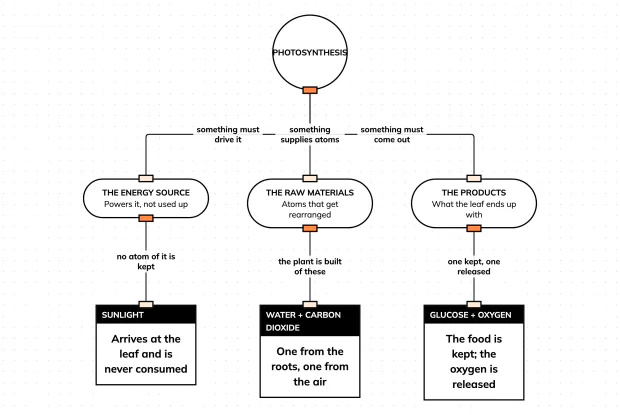
Every meal traces back to sunlight, and most energy is lost at each step. Learn why food chains are always short.
What Happens When One Species Disappears?
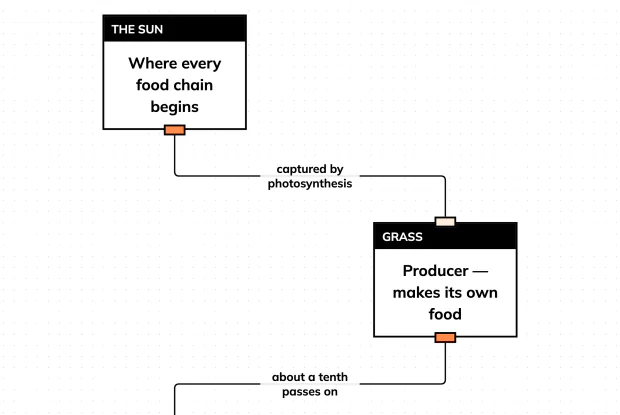
Removing one species rarely affects only that species. Learn how effects cascade through an ecosystem.