How Do Plants Make Their Own Food?
Root Concept
Photosynthesis uses light energy to rearrange water and carbon dioxide into glucose, releasing oxygen as a by-product — so a plant's mass comes mostly from air.
CodePLU Goal
Upgrading Human Mental Models
Learn how to think in Workflows

Concept Development By codeplu.com
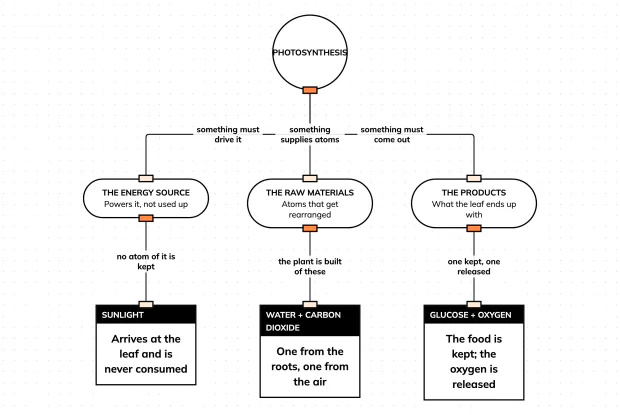
Separating the energy source, the raw materials and the products of photosynthesis
If Plants Don't Eat, Where Does Their Body Come From?
A young oak sapling weighs a few grams. The full-grown tree weighs tonnes. All that extra material had to come from somewhere, and almost everybody's first instinct is the soil — the plant must be eating it. But weigh the soil in a pot before and after growing a plant in it and you find barely any has gone. So where did the tree come from?
Overwhelmingly, from the air. A plant takes carbon dioxide gas from the atmosphere and water from the ground, and uses the energy in sunlight to rearrange their atoms into glucose — a sugar, which is food. That process is photosynthesis, and the tree is essentially built out of air and water, assembled using light.
The reason this feels so implausible is that we do not think of air as being made of anything substantial. It is: carbon dioxide contains carbon, and carbon is what wood is largely made of. There is also a by-product. The reaction produces more oxygen than the plant needs, and it releases the surplus — which is the oxygen you are breathing right now. In the playground below you will build photosynthesis down into the three roles, and each role down to what actually plays it, because mixing up the energy source with the raw materials is where most of the confusion lives.
How Does Photosynthesis Work?
What are the ingredients, and what does each one do?
Three things go in and they are not interchangeable. Sunlight is the energy source: it powers the reaction but is not a material and does not end up in the plant. Water arrives through the roots and carbon dioxide enters through tiny pores in the leaves, and these two are the raw materials — the actual atoms that get taken apart and rebuilt. Two things come out: glucose, which the plant keeps as food and as building material, and oxygen, which is surplus and gets released. Chlorophyll, the pigment that makes leaves green, is what captures the light, which is why leaves are the site of all this. The distinction between an energy source and a raw material is the one worth being precise about. Light makes the reaction possible; carbon dioxide and water are what the plant is made from.
Why is a tree mostly made of air?
Follow the carbon. Carbon dioxide is one carbon atom joined to two oxygen atoms, and photosynthesis strips the carbon out to build sugars, which the plant then links into cellulose — the main structural material of wood. So the carbon in every plank, every leaf and every tree ring arrived as gas. This was actually tested centuries ago: in the 1600s Jan van Helmont grew a willow in a weighed quantity of soil for five years, and found the tree had gained many kilograms while the soil had lost only a few grams. He drew the wrong conclusion, crediting the water alone, because carbon dioxide had not yet been discovered. That is a genuinely useful thing to notice about science: a careful experiment can be right about what it rules out while still being wrong about the explanation.
So what is soil actually for?
Soil does two jobs, and neither is feeding the plant in the sense people imagine. It provides water, and it provides small quantities of mineral nutrients — nitrogen, phosphorus, potassium and others — which plants need to build proteins and other essentials. It also physically anchors the roots. But those minerals are needed in tiny amounts compared with the bulk of the plant, which is why fertiliser is measured in handfuls while a tree gains tonnes. This is exactly why hydroponics works: give a plant water with dissolved minerals and enough light, and it grows perfectly well with no soil at all. If soil were the food, that would be impossible. Nutrients are more like vitamins than like meals.
Where does the oxygen we breathe come from?
It is the leftover. When photosynthesis splits water molecules to get at the hydrogen, oxygen is set free, and the plant releases what it does not need. Nearly all the oxygen in the atmosphere was produced this way over billions of years, and a large share of the current supply comes not from forests but from microscopic plankton in the oceans. Now a common misconception: plants do not only produce oxygen. Like all living things they also respire, using oxygen and releasing carbon dioxide, day and night. During daylight photosynthesis vastly outpaces respiration, so the net effect is oxygen out. In darkness photosynthesis stops while respiration continues, so a plant at night is a net consumer of oxygen — in harmless quantities, whatever you may have heard about houseplants in bedrooms.
Real World Example
What Would Happen If You Grew a Plant in a Sealed Jar?
Photosynthesis becomes concrete when you remove one ingredient at a time and see which absence kills the plant:
Sealed jar on a windowsill
A plant in a sealed glass jar with soil and water, in daylight, can survive for a remarkably long time — there are terrariums that have run for decades. Photosynthesis produces oxygen and sugar during the day, respiration uses them up, and the same carbon and water keep cycling round inside the jar. Nothing needs to come in except light.
The same jar in a cupboard
Move it into darkness and the plant dies, even though it still has soil, water and air. Without light there is no energy source, so the raw materials cannot be assembled into anything. This is the test that separates energy from materials: everything the plant is made from is still present, and it starves regardless.
Water and minerals, no soil
Now the reverse. Suspend the roots in water with dissolved minerals under good light and the plant thrives with no soil whatever — this is commercial hydroponics, growing much of the salad in supermarkets. Soil turns out to be a convenient delivery system for water and minerals rather than food, which is exactly what the sealed-jar and dark-cupboard results predicted.
FAQs
Final Words
Photosynthesis takes water and carbon dioxide and uses light energy to rearrange them into glucose, releasing oxygen it does not need. Keeping the roles separate is the whole idea: light is the energy, water and carbon dioxide are the materials, and soil supplies water and trace minerals rather than food. That is why a tree is mostly built from air.
It is also where nearly all the energy in living things enters the system, since animals cannot build food from light and must eat something that did. The next concept follows that energy as it moves up a food chain — and finds that unlike water, it does not go round in a loop.
Continue This Track
This concept is part 2 of How the Living World Connects.
How Does Water Move Around the Planet?
The water in your glass has been round this loop countless times. Learn the four stages and close the loop yourself in an interactive playground.
How Do Plants Make Their Own Food?
Plants do not eat soil — they build their own food out of air, water and light. Learn what each ingredient actually does.
Where Does the Energy in a Food Chain Come From?
Every meal traces back to sunlight, and most energy is lost at each step. Learn why food chains are always short.
What Happens When One Species Disappears?
Removing one species rarely affects only that species. Learn how effects cascade through an ecosystem.