Where Does the Energy in a Food Chain Come From?
Root Concept
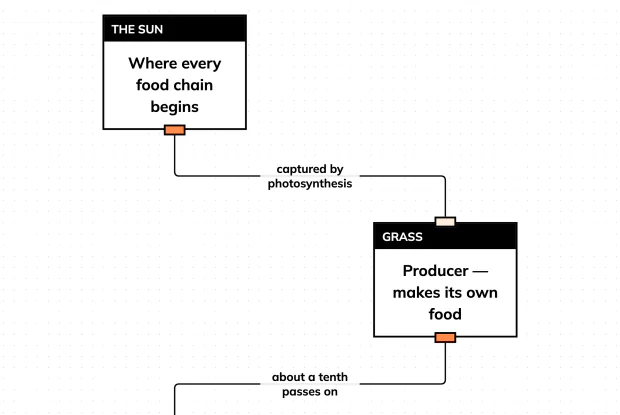
Energy enters a food chain as sunlight and flows one way, with roughly 90 percent lost at each link — which is why food chains have so few steps.
CodePLU Goal
Upgrading Human Mental Models
Learn how to think in Workflows

Concept Development By codeplu.com
Energy entering a food chain as sunlight and shrinking at every link
Why Are There Never Many Links in a Food Chain?
Grass, rabbit, fox. Three links, and that is fairly typical — food chains almost never run beyond four or five steps, and there is a reason that has nothing to do with a shortage of hungry animals. It is about energy running out.
Every food chain starts in the same place. Plants capture energy from sunlight and store it as food, which is what makes them producers. Everything else is a consumer: unable to build food from light, and therefore obliged to eat something that did, directly or indirectly. Trace any meal back far enough — a steak, a slice of bread, a fish — and you arrive at sunlight.
The crucial part is what happens at each handover. When a rabbit eats grass, only a small fraction of the grass's energy ends up stored in the rabbit. Most is spent staying alive, moving around and keeping warm, and a good deal leaves as waste and heat. A rough rule of thumb is that about a tenth carries forward. Do that twice and you are down to one per cent of what the plants captured, which is why the chain runs out of room. In the playground below you will build one, following the energy rather than the eating.
How Does Energy Move Through an Ecosystem?
What is the difference between a producer and a consumer?
A producer makes its own food from light, water and carbon dioxide, which means plants, algae and some bacteria. They are the doorway through which almost all energy enters the living world. A consumer cannot do that and must obtain energy by eating something else — every animal, every fungus, and us. Consumers get sorted by what they eat: herbivores eat producers, carnivores eat other consumers, and omnivores do both. There is a third group that gets left off most diagrams and matters enormously: decomposers, such as fungi and many bacteria, which feed on dead material and waste. Without them, nutrients would stay locked in corpses and fallen leaves rather than returning to the soil for producers to use again. A food chain drawn without decomposers is a food chain that quietly assumes rubbish disappears.
Which way do the arrows point, and why does it matter?
Arrows in a food chain point in the direction energy travels, which means from the eaten to the eater — grass to rabbit to fox. This trips people up constantly, because it feels natural to draw an arrow from the predator to its prey as though it indicated who hunts whom. It does not. The arrow means becomes food for, or more precisely passes its energy to. Getting this right is not a diagram convention for its own sake: it is what makes the whole picture readable as a flow of energy rather than a list of relationships. Once the arrows follow the energy, you can see immediately where energy enters a system, where it accumulates and where it leaks away — and that view is the entire point of drawing the chain.
Why is so much energy lost at each step?
Because animals spend energy on living. A rabbit uses most of what it eats to move, breathe, keep warm and repair itself, and all of that ends up as heat which cannot be passed on. Some of the plant material also passes straight through undigested. What remains stored in the rabbit's body — the only part a fox can get at — is roughly ten per cent of what the rabbit consumed, and that figure varies a lot but the order of magnitude holds. Compound the loss and the arithmetic becomes stark. If the grass captures 10 000 units, the rabbits hold about 1000, the foxes about 100, and a predator of foxes would have about 10 to live on. At some point the next link cannot find enough food to be worth being, and the chain simply stops.
Why isn't a food chain the whole picture?
Because almost nothing eats only one thing. A fox eats rabbits, but also birds, beetles and berries; a rabbit is eaten by foxes, buzzards and stoats. Draw all those overlapping chains together and you get a food web, which is a far more honest description of any real ecosystem. The distinction matters for a practical reason: webs are more robust than chains. If one prey species declines, a predator with several food sources can shift to another, whereas a specialist that depends on a single species is in serious trouble. So a food chain is a useful simplification for following energy, and a food web is what you need for predicting what happens when something changes — which is exactly the question the next concept asks.
Real World Example
Why Does a Vegetarian Diet Feed More People From the Same Land?
The energy loss at each link is not an abstract fact — it decides how many people a field can feed:
Eating the producer directly
Grow wheat on a field and eat the wheat. You are taking energy at the first link, right after the plants captured it, so nothing has been lost to an intermediate animal. This is why grain, rice and beans feed such large populations from relatively little land.
Adding a link
Now feed that same wheat to cattle and eat the beef instead. The cattle spend most of the energy living — moving, staying warm, growing bone and hide you will not eat. Only a fraction is left in the edible meat, so the same field now supports far fewer people. Nothing was wasted through carelessness; the loss is the ordinary cost of being an animal.
What this does and does not tell you
It explains why meat is energetically expensive to produce, and why predators are always rarer than their prey. It does not by itself settle what anyone should eat — some land grows grass but not crops, and diets involve nutrition, culture and economics too. The energy argument is one real input among several, and it comes directly from the ten per cent rule rather than from any opinion.
FAQs
Final Words
Energy enters the living world almost entirely through photosynthesis, then flows one way along a chain from producer to consumer to predator, shrinking by roughly ninety per cent at every handover. That loss is why chains are short, why predators are rare, and why eating lower down a chain feeds more people from the same land.
Two habits are worth taking: read arrows as energy moving from the eaten to the eater, and remember that a real ecosystem is a web rather than a chain. That second point is what the next concept depends on — because the effect of removing one species travels through a web in ways a single chain would never predict.
Continue This Track
This concept is part 3 of How the Living World Connects.
How Does Water Move Around the Planet?
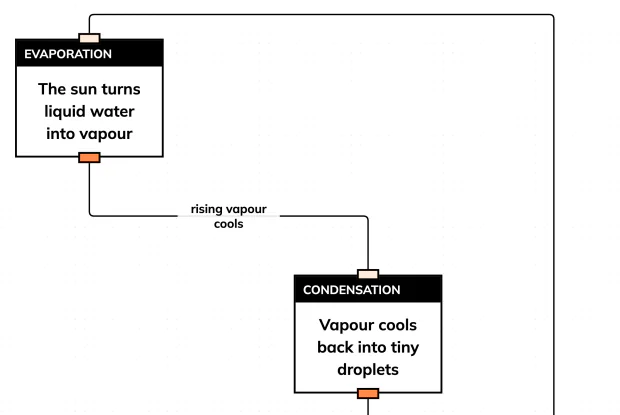
The water in your glass has been round this loop countless times. Learn the four stages and close the loop yourself in an interactive playground.
How Do Plants Make Their Own Food?
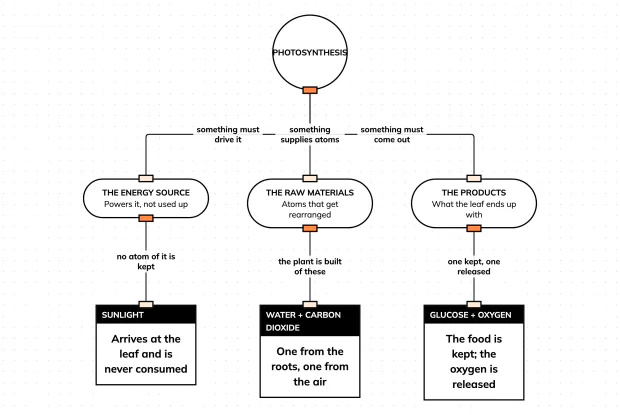
Plants do not eat soil — they build their own food out of air, water and light. Learn what each ingredient actually does.
Where Does the Energy in a Food Chain Come From?
Every meal traces back to sunlight, and most energy is lost at each step. Learn why food chains are always short.
What Happens When One Species Disappears?
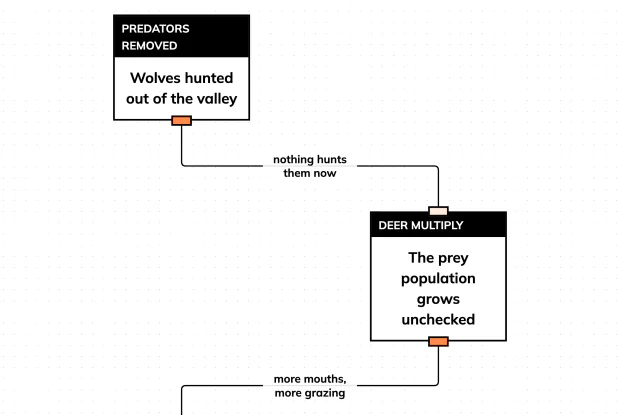
Removing one species rarely affects only that species. Learn how effects cascade through an ecosystem.