What Is the Structure of a Good Prompt?
Root Concept
A good prompt answers four questions before the AI has to guess them: what to make, who it is for, what shape the answer takes, and what to leave out.
CodePLU Goal
Upgrading Human Mental Models
Learn how to think in Workflows

Concept Development By codeplu.com
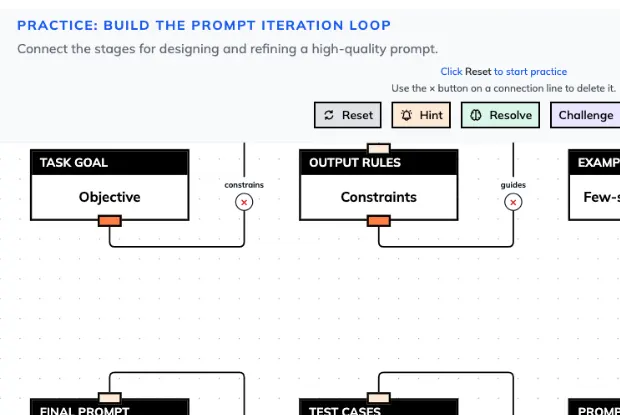
The four parts of a good prompt, assembled into one clear request
What Goes Into a Well-Built Prompt?
Walk into a bakery and say 'chocolate cake, please'. You will get a cake — but probably not the one in your head. Now try it properly: 'A chocolate cake for my daughter's eighth birthday, twelve children coming. Round, one layer, with Happy Birthday Zara written on top. No nuts, she is allergic, and please keep it not too sweet.' Same shop, same baker, wildly different odds of getting what you wanted.
Notice what the good order contains. What to make. Who it is for and why. What shape it should take. What to leave out. Those four pieces are exactly the structure of a good prompt — and each one exists for a single reason: to answer a question the AI would otherwise have to guess.
A well-built prompt is not a longer prompt. It is a prompt with no unanswered questions left in it. In the playground above you will assemble one part by part, in the order a sensible briefing naturally follows, and finish with the complete request.
What Are the Four Parts of a Good Prompt?
What is the task, and why is it not enough on its own?
The task is the job itself — write, summarise, translate, compare, plan, fix. It is the one part no prompt can do without, because without it there is nothing to make. But a task alone is almost always underspecified. 'Write a summary' leaves open how long, for whom, and what to keep. 'Summarise this article in five bullet points for someone who has not read it' is the same task with the guessing removed. So the useful habit is not just naming the task, but naming it in a way that is hard to misread: prefer 'compare these two phones on battery and price' over the vague 'tell me about these phones'.
What does context add that the task cannot?
Context is who the answer is for and why it exists. It is the single most powerful part, because it silently changes everything — vocabulary, depth, examples, even what gets left out. Tell the AI 'for a ten-year-old' and it reaches for simple words and everyday comparisons. Tell it 'for my manager, who will decide our budget' and the same request produces something crisper and more careful. Many beginners assume context is optional decoration for the real instruction. In practice it is the difference between a technically correct answer and a usable one, and it is the part people forget most often — precisely because the audience is so obvious inside their own head.
How do you control the shape of the answer?
Format is how the answer arrives: how long, and laid out how. Three sentences or two pages. A bulleted list, a table, an email, a numbered set of steps. This is the part that decides whether you can use the answer straight away or have to spend ten minutes reshaping it. It is also the easiest to state and the most satisfying to get right — 'as a five-row table with columns for pros, cons, and price' takes four seconds to type and saves the whole edit. And when the shape is fussy or unusual, do not describe it, show it: one small example of the layout you want communicates more than a paragraph of instructions.
Why tell the AI what to leave out?
Limits are the boundaries: no jargon, under 200 words, do not mention price, no invented statistics, avoid clichés. They feel negative, and beginners often skip them thinking restrictions can only make an answer worse. The opposite is true — limits are what stop the predictable failures. AI writing drifts toward padding, hedging, and confident guesses, so the instructions that ban those behaviours protect the answer's quality. A useful trick: whenever an answer disappoints you the same way twice, that recurring annoyance is a limit waiting to be written down, and once written it keeps working every time you reuse the prompt.
Does the order of the parts matter?
A little, and less than people expect. The AI reads your prompt from top to bottom, so leading with the task and the audience frames everything that comes after — which is why the natural briefing order works well: task, context, format, limits. What matters far more is that all four are present. And beware the trap this can lead to: seeing that detail helps, beginners start padding prompts with filler, repetition, and flattery. A bloated prompt buries its own instructions, and the rule that matters gets lost in the noise. Complete is the goal; long is a side effect at best. Four clear lines beat four paragraphs every time.
Real World Example
How Do You Build a Prompt to Sell Your Old Bicycle?
You want an advert for a second-hand bicycle you are selling online. Follow the same four parts you connected in the playground, added one at a time.
Start with the task alone
'Write an advert for my bicycle.' The AI returns something breathless and generic — 'Amazing bike, excellent condition, must see!' — that could describe any bicycle on earth. Nothing is wrong with it except that it is useless.
Add the context: who is reading, and why
'...a six-year-old city bike with a few scratches, being sold to a student on a small budget. Honest about the wear.' Now the AI knows the buyer and the tone, and it stops overselling — it starts sounding like a real person with a real bike.
Add the format: how it should arrive
'Under 80 words: two short lines of description, then a bulleted list of the specs, then the asking price on its own line.' The answer arrives shaped like an actual online listing, ready to paste into the form without rearranging anything.
Add the limits: what to leave out
'No exclamation marks, no words like amazing or perfect, and do not invent any details I have not given you.' This kills the salesy tone, and — importantly — stops the AI from cheerfully making up a brand name or a service history.
The finished prompt, and why it keeps paying
Four parts, roughly forty words, and the answer is a listing you would genuinely post. Better still, the prompt is now reusable: next time you sell something, swap the item and the specs and everything else still holds. That is what structure buys you — not one good answer, but a template for many.
FAQs
Final Words
A good prompt is not a magic sentence — it is a briefing with no gaps. Name the task so it cannot be misread, name the reader and the purpose, name the shape you want back, and name what to leave out. In the playground you assembled exactly that, one part at a time, in the order a sensible briefing follows.
Keep the bakery in mind: the baker was always capable, the order was what changed. And once one of your prompts works well, keep it — swap the details and the structure carries over to the next task. Next comes the natural question: prompts also come in recognisable kinds, each suited to a different job. That is the story of the types of prompts.
Continue This Track
This concept is part 2 of Writing Prompts That Work.
What Is Prompt Engineering?
Two people, the same AI, wildly different results — the difference is the prompt. Learn what prompt engineering really is: steering a fixed AI with the only thing you control, your words.
What Is the Structure of a Good Prompt?
A good prompt answers four questions before the AI has to guess them: what to make, who it is for, what shape it takes, and what to leave out. Learn to build one part by part.
What Are the Main Types of Prompts?
Some tasks need a plain request, some need examples, some need the AI to show its steps. Learn the recognisable kinds of prompts and how to pick the right one.
What Is the Prompt Iteration Loop?
Discover why your first prompt almost never works — and build the write-run-refine loop that turns vague requests into prompts that reliably deliver.