What Is Prompt Engineering?
Root Concept
The AI is fixed — your words are the only thing you control. Prompt engineering is the skill of steering the same AI toward the answer you actually wanted.
CodePLU Goal
Upgrading Human Mental Models
Learn how to think in Workflows

Concept Development By codeplu.com
Same goal, same AI — the prompt decides which answer you get
What Is Prompt Engineering, in Plain Words?
Two people sit down with the exact same AI chatbot on the same afternoon. One walks away calling it overhyped and useless. The other gets work done in ten minutes that would have taken an hour. The AI was identical for both. The only thing that differed was what they typed.
That gap is what prompt engineering is about. A prompt is simply the request you type. Prompt engineering is the skill of writing that request so the AI gives you what you actually wanted — not something technically related but practically useless. Here is the key realisation: you cannot change the AI. It is already built and trained. Your words are the one and only steering wheel you have.
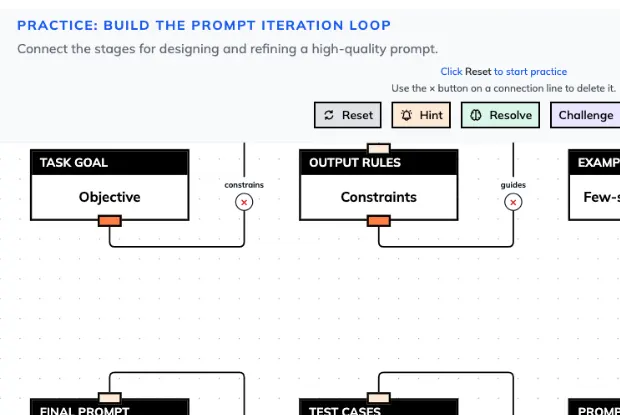
So this is not a programming skill, and there are no secret magic phrases. It is the everyday skill of saying clearly what you want — the same skill that separates a helpful set of directions from 'it's near the big tree'. In the playground above you will build both paths from one goal: the same question asked in a hurry, and asked with care, ending in two very different answers.
How Does Prompt Engineering Actually Work?
Why does the same AI give one person better answers?
Because the AI has no idea what you know, what you need, or who the answer is for — unless you say so. Ask 'tell me about dogs' and it has to guess whether you want a vet's explanation, a bedtime story, or a shopping guide. It picks something safely average, which is exactly why average is all you get. Many beginners conclude the AI is simply not that smart. Watch what happens when a skilled user takes the same chatbot and gets a perfect answer in one try, and the truth becomes obvious: the intelligence was always there, waiting for direction. Your words are the steering wheel, and a vague prompt is letting go of it.
What can your prompt actually control?
Far more than most people realise. You can set who the answer is for — a child, your boss, a beginner — and the AI will change its whole vocabulary. You can set the length: three sentences, one page, five bullet points. You can set the tone: warm, formal, funny, blunt. You can set the shape: a table, a list, an email, a step-by-step recipe. And you can rule things out: no jargon, no invented facts, no mention of price. Every one of these is a dial you either set on purpose or leave to chance. Prompt engineering is nothing more mysterious than turning the dials that matter for the answer you need.
Is prompt engineering the same as programming?
No — and this is the misconception that keeps people from trying. Traditional programming means writing exact instructions in a special language, where a single missing comma breaks everything. A prompt is written in ordinary human language, and small imperfections are fine. If you can explain a task clearly to a new colleague, you can write a good prompt. What the two skills share is a mindset, not a syntax: being precise about what you want, thinking about edge cases, and expecting to improve your first attempt. That is why people who are good at giving instructions to humans usually turn out to be good at prompting too.
Why doesn't the AI just ask me what I meant?
A thoughtful colleague, handed a vague request, would ask a question back: 'For whom? How long? By when?' Most AI tools do not do this by default — they take your words at face value and produce something immediately. So the burden of clarity sits with you, up front. It helps to picture the AI as an extremely well-read new assistant on their first hour of work: enormous knowledge, willing, fast — and zero context about your life, your audience, or your standards. Nobody would hand that person a two-word instruction and expect a usable result. A prompt is the briefing you would naturally give them.
Do I need secret magic words to get good results?
No. Collections of 'magic phrases' circulate constantly, and beginners often believe the skill is about knowing the right incantations. It is not — most of those phrases work only because they smuggle in real information the prompt was missing. 'Act as an experienced teacher' helps not through magic, but because it tells the AI the audience and the tone. Once you understand that, you can skip the tricks and state what you mean directly: who it is for, how long, what tone, what to avoid. Clarity beats cleverness every time, and unlike a list of phrases, clarity keeps working when the AI tools change.
Real World Example
Why Did Two Job Applicants Get Such Different Help?
Two people have just finished interviews and want to send a thank-you email. Follow what each of them types, and what comes back.
Person A types the obvious thing
'Write a thank you email after a job interview.' Four seconds later they have a polite, colourless template: 'I am writing to express my gratitude for the opportunity...' Correct English, zero substance, recognisable instantly as AI filler by any recruiter who reads it.
Person A blames the AI and gives up
They conclude the tool is useless for real work and go back to writing it themselves. Nothing about the AI was the problem — their nine-word request simply never mentioned the job, the interview, the tone, or the length.
Person B briefs the AI like a colleague
'Write a short thank-you email — under 120 words — to Priya, who interviewed me this morning for a junior data analyst role. Mention that I enjoyed hearing about their customer dashboard project. Friendly but professional. No clichés like "express my gratitude".'
Person B gets something they can send
The reply names Priya, references the dashboard conversation, sounds like a human being, and fits in a phone screen. Person B changes two words and hits send. Total time: about the same as Person A spent being disappointed.
The only difference was the prompt
Same model, same day, same task. Person B never learned a secret trick — they simply said who, what, how long, what tone, and what to avoid. That is prompt engineering in its entirety, and it is why the skill is worth ten minutes of your attention.
FAQs
Final Words
Prompt engineering turns out to be far less exotic than its name suggests. The AI is fixed and already built; your words are the only lever you hold. In the playground you saw the whole idea in one picture — one goal, asked in a hurry and asked with care, producing a wall of useless facts on one side and three lines you could read aloud tonight on the other.
Carry the core idea with you: anything you leave unsaid, the AI will guess. Name the audience, the length, the tone, and the limits, and average answers turn into useful ones. Next comes the natural follow-up question — what exactly goes into a well-built prompt, and in what order? That is the anatomy of a good prompt, waiting in the next concept.
Continue This Track
This concept is part 1 of Writing Prompts That Work.
What Is Prompt Engineering?
Two people, the same AI, wildly different results — the difference is the prompt. Learn what prompt engineering really is: steering a fixed AI with the only thing you control, your words.
What Is the Structure of a Good Prompt?
A good prompt answers four questions before the AI has to guess them: what to make, who it is for, what shape it takes, and what to leave out. Learn to build one part by part.
What Are the Main Types of Prompts?
Some tasks need a plain request, some need examples, some need the AI to show its steps. Learn the recognisable kinds of prompts and how to pick the right one.
What Is the Prompt Iteration Loop?
Discover why your first prompt almost never works — and build the write-run-refine loop that turns vague requests into prompts that reliably deliver.