What Is the Prompt Iteration Loop?
Root Concept
Good prompts are not written — they are iterated: write, run, spot the gaps in the answer, refine, and loop until the AI reliably gives you what you actually wanted.
CodePLU Goal
Upgrading Human Mental Models
Learn how to think in Workflows

Concept Development By codeplu.com
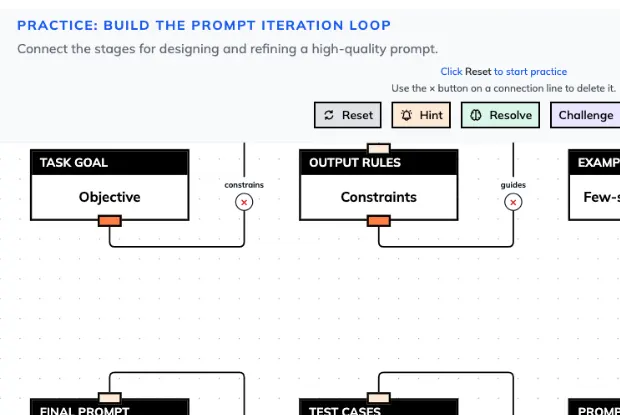
The prompt iteration loop: write, run, spot the gaps, refine — and around again
What Is the Prompt Iteration Loop, in Plain Words?
Imagine texting a friend who is brilliant, endlessly patient — and takes every word you say completely literally. Ask them to 'write something about dogs' and you will get a random essay: wrong length, wrong tone, wrong everything. Not because your friend is dumb, but because your request could mean a thousand different things. Working with an AI chatbot is exactly like this.
That is why professionals never expect the first prompt to work. Instead they run a small loop: write the prompt, run it, read the answer critically to spot what is wrong or missing, then refine the prompt with the rule it was missing — and run it again. Two or three trips around this loop usually turn a useless answer into exactly what you wanted.
The big mental shift is this: the AI's answer is not just a result — it is feedback about your prompt. Every flaw in the answer points at a missing instruction. In the playground above you will build this loop yourself, including the edge that closes it, because a refined prompt always goes straight back in for another run.
How Does Each Trip Around the Loop Work?
Why does the first prompt almost never work?
Because your first prompt carries far less information than you think. When you type 'plan my weekend trip', your head silently holds the budget, who is coming, what you enjoy, and how much walking your knees can take. The AI holds none of that — it only knows the words you typed, so it fills every gap with guesses. Here is the misconception to drop first: beginners blame the AI for a poor answer, as if it should have known what they meant. It cannot. There is no mind-reading — a vague request in, a generic answer out. The loop exists precisely because nobody, not even experts, states everything perfectly on the first try.
What goes into a well-written prompt?
Three ingredients cover most of the job. First, the goal: what exactly you want, for whom, and how long it should be — 'a 100-word birthday message for my colleague' beats 'write a birthday message'. Second, the rules: tone, format, and what to avoid — 'friendly but professional, no jokes about age'. Third, when the shape of the output matters, show an example of what good looks like; showing beats describing, the same way a photo of the haircut you want beats explaining it in words. You do not need all three in every prompt — but when an answer disappoints, it is almost always because one of these was missing.
How do you read the AI's answer like an engineer?
Most people read an AI answer and just feel disappointed. A prompt engineer reads it like a mirror of the prompt: every specific flaw in the answer maps to a specific missing instruction. Too formal? You never stated the tone. Too long? You never gave a length. Confidently stating things that are not true? You never said 'if you are not sure, say so'. Ignoring half your request? Your prompt buried it in a wall of text. This is the skill that separates loop from luck: instead of concluding 'the AI is bad at this', you conclude 'my prompt is missing a tone rule' — a problem you can actually fix on the next trip.
How do you refine without making things worse?
Refine like a careful cook seasoning a dish: one change at a time, then taste again. If you rewrite the whole prompt after every disappointing answer, you will never know which change helped and which hurt. Add the one rule that fixes the biggest gap, run it, and check. Keep the wording that works; adjust only what does not. And drop the myth that longer prompts are automatically better — a prompt stuffed with padding buries its own rules, and important instructions get lost in the noise. Clear beats long, every time. When the answer comes back right — and comes back right again on a second run — the loop has done its job.
Real World Example
How Do You Get a Usable Trip Plan Out of an AI?
Watch the loop work on an everyday task: asking an AI to plan a short family holiday. Notice how each answer's flaws tell you exactly what the next prompt needs.
Trip 1 — write and run the obvious prompt
You type: 'Plan me a trip to Turkey.' The AI returns an epic ten-city, two-week tour with museums at dawn and overnight buses. Impressive — and useless. You have five days, two kids, and a budget.
Trip 1 — spot the gaps instead of blaming the AI
Read the answer as feedback: it did not know your dates, your budget, or that children are coming — because you never said so. Every absurdity in the plan points at a rule the prompt was missing.
Trip 2 — refine with the missing facts and run again
New prompt: 'Plan a 5-day family trip to Istanbul with two kids aged 6 and 9, mid-range budget.' The answer is far better — right city, right length — but the days are crammed morning to night, and your six-year-old naps after lunch.
Trip 3 — one more rule closes the biggest gap
You add: 'Maximum one main activity per day, afternoons free, everything reachable by tram.' Now the plan is genuinely usable — relaxed mornings, tram-friendly stops, free afternoons. Three trips around the loop, three minutes of work.
What the loop just taught you
The AI never got smarter between trips — your prompt did. Each answer revealed exactly what was missing, you added one rule at a time, and the final prompt is now a keeper: next holiday, you start from it instead of from scratch.
FAQs
Final Words
You now own the working habit that separates frustrated AI users from effective ones: write, run, spot the gaps, refine — and around again. In the playground you built it as a true loop, because that is what it is: a refined prompt goes straight back in, and two or three trips usually beat an hour of hoping the first attempt lands.
Keep the mental shift close: the AI's answer is feedback about your prompt. Wrong tone, wrong length, invented facts — each flaw points to a rule you have not written yet. Master this loop on everyday tasks like trip plans and emails, and you are ready for the deeper prompt patterns waiting in the rest of this track.
Continue This Track
This concept is part 4 of Writing Prompts That Work.
What Is Prompt Engineering?
Two people, the same AI, wildly different results — the difference is the prompt. Learn what prompt engineering really is: steering a fixed AI with the only thing you control, your words.
What Is the Structure of a Good Prompt?
A good prompt answers four questions before the AI has to guess them: what to make, who it is for, what shape it takes, and what to leave out. Learn to build one part by part.
What Are the Main Types of Prompts?
Some tasks need a plain request, some need examples, some need the AI to show its steps. Learn the recognisable kinds of prompts and how to pick the right one.
What Is the Prompt Iteration Loop?
Discover why your first prompt almost never works — and build the write-run-refine loop that turns vague requests into prompts that reliably deliver.