What Are the Main Types of Prompts?
Root Concept
Prompts come in a few recognisable kinds, and each one suits a different job — the skill is matching the way you ask to what the task actually needs.
CodePLU Goal
Upgrading Human Mental Models
Learn how to think in Workflows

Concept Development By codeplu.com
A prompt branches into three styles, each right for a different job
Why Are There Different Types of Prompts?
Think about how you ask people for things. If you want a coffee, you just ask. If you want your handwriting copied onto forty wedding invitations, you hand over a sample and say 'like this'. And if you want someone to check your tax arithmetic, you ask them to show their working — because the answer alone is not enough, you need to see how they got there.
Prompts work the same way. There is no single best way to ask an AI; there are a few recognisable kinds, and each earns its keep on a different sort of job. Plain requests handle ordinary tasks. Prompts carrying examples pin down a style or shape. Prompts that ask for the steps expose the reasoning where mistakes hide. And prompts that assign a role quietly set the audience and tone.
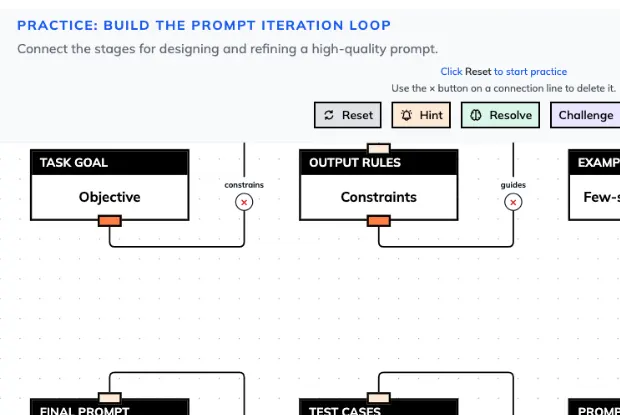
Knowing the kinds matters less than knowing when to reach for each. In the playground above you will build a prompt down into three ways of asking — and the labels on your connections tell you when each one is the right call.
Which Kind of Prompt Should You Use?
When is a plain request all you need?
For the huge majority of everyday tasks, just asking works: summarise this, translate that, fix the grammar here, explain this word. These are things the AI has effectively done a thousand times while learning, so it already knows what a good answer looks like. Engineers have a name for this — a zero-shot prompt, meaning you gave it zero examples. Do not read 'plain' as 'inferior'. A simple request with a clear task and audience beats an elaborate one most of the time, and it takes seconds to write. Reach for the fancier kinds when a plain request has actually let you down, not in advance out of habit.
Why does showing examples work so well?
Some things are almost impossible to describe and trivial to demonstrate. Try explaining in words exactly how your product titles are worded, or the particular way your team writes meeting notes — then compare that with pasting two real ones and saying 'twenty more like these'. The AI is extremely good at spotting a pattern and continuing it, so examples carry style, length, structure, and tone all at once. This is what people mean by a few-shot prompt: a few examples included in the request. Reach for it whenever the answer must match something that already exists, especially when you would struggle to turn that something into rules.
When should you ask the AI to show its steps?
For anything involving arithmetic, comparisons, logic, or a decision with several moving parts, ask the AI to work through it in order instead of jumping to an answer. The reason is practical: answering in one leap can produce a confident, fluent, completely wrong result — and a wrong answer with no working is undetectable. When the steps are laid out, mistakes become visible and you can spot the bad assumption in the third line. Many beginners skip this because typing 'work through it step by step' feels like babysitting the machine. It is the opposite: it is the cheapest quality check you will ever apply to an AI answer.
What does giving the AI a role actually do?
'Act as an experienced maths teacher' is the most famous prompting trick in the world, and it does work — but not for mysterious reasons. Assigning a role is a fast way of supplying context: in four words it sets the expertise level to write at, the audience to imagine, and the tone to adopt. That is genuinely useful shorthand. What it cannot do is make the AI know more than it knows. Calling it a doctor adds no medical knowledge; calling it a lawyer does not make its advice safe to act on. Treat a role as a convenient way to set voice and level, never as a power-up for reliability.
How do you pick the right kind — and can you mix them?
Start plain, then escalate based on what actually went wrong. If the answer was right in substance but wrong in style, add examples. If it was fluent but the reasoning looked shaky, ask for the steps. If it was pitched at the wrong level, set a role or name the audience directly. And yes, these mix freely: a real working prompt often assigns a role, includes one example, and asks for step-by-step reasoning, all inside the four-part structure of task, context, format, and limits. The types are not rival techniques to choose between — they are tools on one belt, and the job in front of you decides which you pick up.
Real World Example
How Did One Shop Owner Fix Two Bad AI Answers?
Maya runs a small online shop. She tries an AI assistant on two very different tasks, gets poor results on both, and fixes each by changing the kind of prompt rather than the tool.
Job one: she just asks, and gets a mess
Maya needs twenty product titles for new stock, so she types 'Write 20 product titles for my handmade candles'. Back come twenty titles in about twenty different styles — some poetic, some shouty, some with prices — none of them matching the fifty titles already live on her shop.
Job one, fixed: she shows what good looks like
She pastes two of her existing titles — 'Lavender Soy Candle — 40 Hour Burn, Hand Poured' — and writes 'twenty more in exactly this style'. The pattern lands immediately, and all twenty come back consistent enough to publish with barely an edit.
Job two: she just asks, and gets a confident wrong answer
Next she compares two suppliers with different unit prices, delivery fees, and bulk discounts, asking which is cheaper over two years. The AI answers instantly and decisively — Supplier B — with a total that, when she checks it on paper, is simply wrong.
Job two, fixed: she asks for the working
She asks again: 'Work it out step by step — show the unit costs, the delivery, the discount, and the yearly totals before you answer.' This time the arithmetic appears line by line, she can see exactly where the earlier reply went astray, and the cheaper supplier turns out to be A.
What actually changed
Nothing about the AI. Maya matched the kind of asking to the job: examples where a style had to be copied, steps where arithmetic could hide a mistake. Each fix took one extra sentence — and both prompts now sit in her notes, ready to reuse next season.
FAQs
Final Words
There is no single correct way to prompt — there are a few kinds of asking, and the job decides between them. Plain requests for everyday work. Examples when a style or shape must match. Steps when a mistake could hide inside confident-sounding reasoning. A role when the level and tone need setting quickly. In the playground you matched three of these to the jobs they fit, and the labels showed you why each pairing works.
Two habits will carry you a long way: start plain, and escalate based on the actual failure rather than out of habit. And remember these kinds stack freely inside the four-part structure you already know. Once you have chosen your kind of prompt and built it well, one thing remains — running it, reading the answer critically, and refining. That is the prompt iteration loop.
Continue This Track
This concept is part 3 of Writing Prompts That Work.
What Is Prompt Engineering?
Two people, the same AI, wildly different results — the difference is the prompt. Learn what prompt engineering really is: steering a fixed AI with the only thing you control, your words.
What Is the Structure of a Good Prompt?
A good prompt answers four questions before the AI has to guess them: what to make, who it is for, what shape it takes, and what to leave out. Learn to build one part by part.
What Are the Main Types of Prompts?
Some tasks need a plain request, some need examples, some need the AI to show its steps. Learn the recognisable kinds of prompts and how to pick the right one.
What Is the Prompt Iteration Loop?
Discover why your first prompt almost never works — and build the write-run-refine loop that turns vague requests into prompts that reliably deliver.