What Are the Three States of Matter?
Root Concept
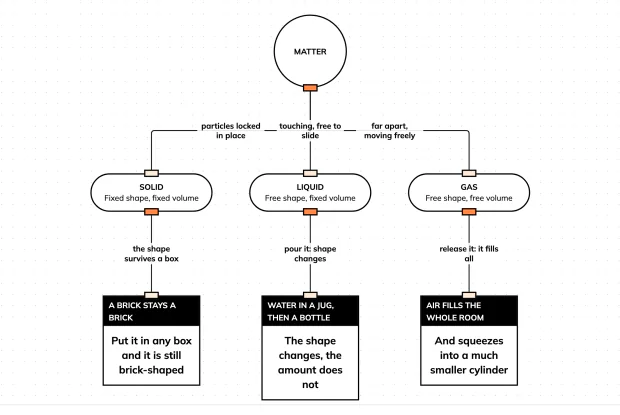
A substance's state depends on how much its particles are held together — locked in place, touching but sliding, or far apart and free.
CodePLU Goal
Upgrading Human Mental Models
Learn how to think in Workflows

Concept Development By codeplu.com
Matter branches into three states by particle arrangement, each with an everyday example
Why Does the Same Substance Behave in Three Different Ways?
Ice, water and steam are the same substance. Not similar substances, not related ones — identical, molecule for molecule. Yet one you can stand on, one runs through your fingers, and one you cannot see at all. Nothing was added or taken away between them, so whatever makes them different is not what they are made of.
It is how the particles are arranged. In a solid they are packed closely and held in fixed positions, able only to vibrate where they sit, which is why a solid keeps its own shape. In a liquid they are still touching but no longer fixed, so they slide over each other — which is why a liquid flows into the shape of its container while keeping the same volume. In a gas they have broken away entirely and move independently through mostly empty space, which is why a gas expands to fill whatever it is in.
That single idea explains an enormous number of everyday observations, and it makes them predictable rather than memorised. Why can you compress air but not water? Why does a puddle spread but not evaporate instantly? Why do solids expand slightly when heated? All of it follows from how tightly the particles are held. In the playground below you will build matter down into its three states — each one settled by what its particles are doing — and link every state to something you have already seen.
How Do the Three States Differ?
What is happening inside a solid?
The particles in a solid are close together and held in fixed positions by forces of attraction between them. They are not motionless — they vibrate constantly about their positions, and they vibrate harder when heated — but they cannot swap places, and that is what gives a solid its own shape. Because the particles are already close, a solid is very difficult to compress: there is almost no empty space to squeeze out. Two misconceptions are worth clearing here. First, solids are not still at the particle level; stillness is what you see, not what is happening. Second, a solid is not necessarily hard — butter, wax and rubber are all solids, because the defining feature is fixed particle positions rather than any particular stiffness.
What makes a liquid flow?
In a liquid the particles are still touching, so the substance takes up almost exactly the same room as it did when solid. What has changed is that they now have enough energy to overcome being held in place, so they can slide past one another. That sliding is what flowing is. It explains the peculiar combination liquids have: they change shape freely, taking the form of any container, while keeping a fixed volume — pour a litre into a wide dish and you still have a litre. Like solids, liquids are hard to compress, because the particles are already in contact. This is exactly why hydraulic brakes work: push on a liquid in a sealed pipe and the pressure transmits through it rather than squashing it, which would be impossible with a gas.
Why can a gas be squeezed?
In a gas the particles have broken free of each other entirely. They travel in straight lines until they collide, and the space between them is far larger than the particles themselves — which means a gas is mostly empty space. That is what makes it compressible: squeeze it and you are pushing the particles closer, not deforming them. It also explains why a gas spreads to fill any container, why a smell reaches across a room, and why gas pressure exists at all — pressure is simply countless particles striking the walls. Heat a gas in a sealed container and the particles move faster, hit harder and more often, and the pressure rises. Nearly everything about gas behaviour comes from that one picture of fast particles in mostly empty space.
Are there only three states?
Three is the useful starting set, and the honest answer is that there are more. Plasma is a fourth: heat a gas enough and its particles lose electrons, producing something that conducts electricity and responds to magnetic fields, as in lightning, neon signs and stars. There are stranger ones still at extremely low temperatures. There are also everyday things that resist the classification — glass behaves like a solid but its particles are arranged irregularly like a liquid's, and toothpaste holds its shape until you squeeze it. This is a good example of how scientific categories work: three states is not a rule the universe obeys, it is a model that explains most of what you meet, and the exceptions are where more interesting physics lives rather than where the model fails.
Real World Example
Why Can You Compress Air in a Tyre but Not Water in a Pipe?
The gap between particles is not a detail — entire pieces of engineering depend on which state you choose:
Air in a bicycle tyre
Pump a tyre and you force more and more air into a fixed space. This works because gas particles are far apart with plenty of room between them, so they can be pushed closer together. The squashed air then pushes back, and that springiness is exactly what cushions the ride.
Brake fluid in a car
Now the opposite requirement. Press the brake pedal and you need the force to arrive at the wheel immediately, with nothing absorbed on the way. So the pipe is filled with liquid, whose particles are already touching and cannot be pushed closer. The liquid transmits the push rather than swallowing it, which is why brakes feel firm.
What happens when the wrong state gets in
If air leaks into a brake line, the brakes go spongy — you press and some of the movement is spent compressing the gas rather than gripping the wheel. Mechanics bleed brakes specifically to get gas out of a system designed around a liquid. The failure is a direct, physical consequence of particle spacing, which is about as concrete as a science idea gets.
FAQs
Final Words
Solid, liquid and gas are three arrangements of the same particles, not three kinds of material. Locked in place gives a fixed shape; touching but sliding gives flow with fixed volume; far apart and free gives a gas that fills and compresses. Once you picture the arrangement, the behaviour stops needing to be memorised.
That picture also explains real engineering, from why tyres cushion to why brake lines must be free of air. The next concept sets those arrangements in motion — what actually happens to the particles when a solid melts or a liquid boils, and why the change runs in both directions.
Continue This Track
This concept is part 1 of What Everything Is Made Of.
What Are the Three States of Matter?
Solid, liquid and gas are not three kinds of stuff — they are three arrangements of the same particles. Learn what each arrangement does, in an interactive playground.
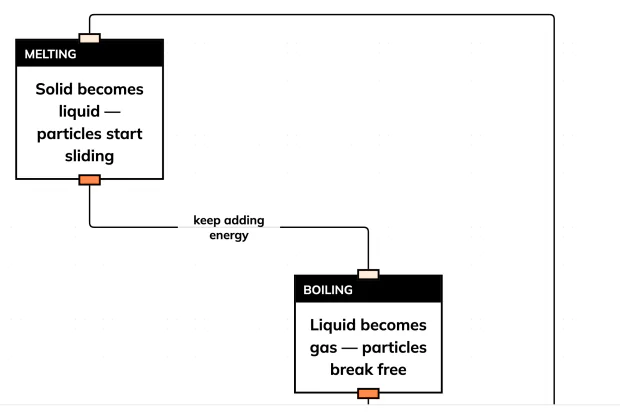
What Happens to Particles When Ice Melts?
Every change of state is energy going in or coming out, and every one can be reversed. Learn what the particles do at each step.
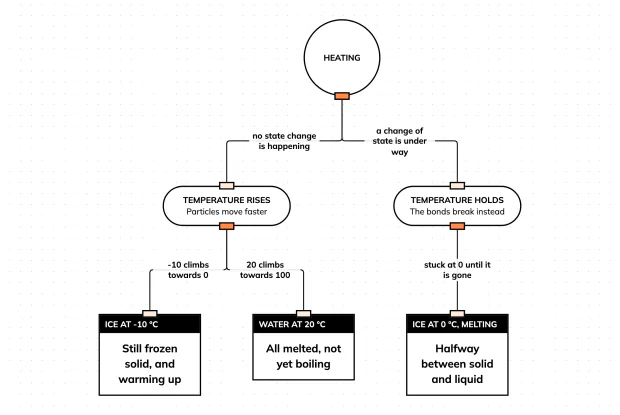
Why Doesn't Ice Water Get Warmer While It Melts?
Heat a glass of ice water and the temperature refuses to budge until every last piece has melted. Learn where that energy goes, in an interactive playground.
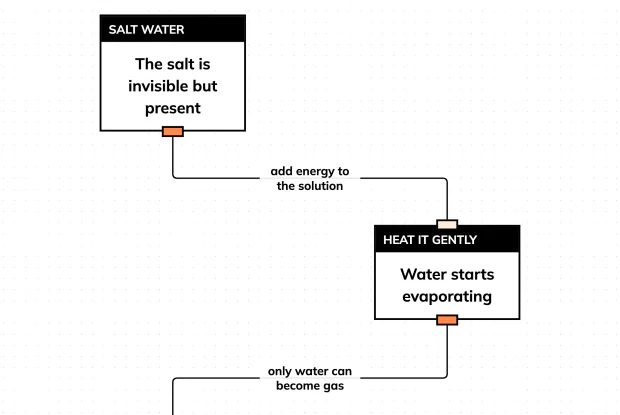
How Do You Get the Salt Back Out of Salt Water?
Dissolved salt looks gone but is still entirely there. Learn why dissolving is not melting, and recover the salt step by step.