How Do You Get the Salt Back Out of Salt Water?
Root Concept
Dissolving spreads a solid between a liquid's particles without changing either substance, so evaporating the liquid recovers the solid unchanged.
CodePLU Goal
Upgrading Human Mental Models
Learn how to think in Workflows

Concept Development By codeplu.com
Recovering a dissolved solid by removing the liquid it was spread through
If the Sugar Has Gone, Why Is the Tea Still Sweet?
Stir sugar into tea and it disappears. Look as hard as you like and there is no sugar in there. But the tea tastes sweet, so plainly the sugar has not left — and if you evaporated the tea away you would find the sugar again, in exactly the quantity you added.
What happened is dissolving. The sugar was broken up into individual particles and those particles spread out among the water particles, distributing so evenly and so finely that there is nothing left large enough to see. The sugar is still sugar and the water is still water. Neither has been changed into anything, which is precisely why the process can be undone.
This gets confused with melting constantly, and it is worth separating them properly, because they are unrelated. Melting is a change of state driven by heat: a solid becomes a liquid version of itself. Dissolving needs no heat at all — sugar dissolves happily in cold water — and the solid does not become a liquid, it simply gets distributed through one. In the playground below you will run the process backwards and recover a dissolved solid, which is the clearest possible proof that nothing was destroyed.
What Is Really Happening When Something Dissolves?
What does dissolving actually do?
Two things are involved: the solute, which is the substance being dissolved, and the solvent, which is the liquid doing the dissolving. Water is by far the most common solvent, which is why it is sometimes called the universal solvent. When salt meets water, the water particles surround the salt and pull it apart into individual particles, which then spread throughout the liquid. The result — a solution — is a mixture, not a new substance, and its particles are distributed so evenly that every sip of the tea tastes equally sweet. The key point is that no particle was altered. Salt particles are still salt particles, just no longer stacked together in a crystal. That is exactly why the process is reversible, and why dissolving belongs with physical changes rather than chemical ones.
How is dissolving different from melting?
They look similar — a solid seems to vanish — and the mechanisms have nothing in common. Melting is a change of state: the solid becomes liquid, it needs energy, and it happens at a specific temperature with no other substance required. Ice melts on its own on a warm day. Dissolving needs a solvent, does not require heat, and the solid does not become a liquid at all. Sugar dissolves in cold water, and sugar's actual melting point is around 186 degrees Celsius, nowhere near the temperature of your tea. A useful test is to ask whether another substance was needed. If a solid vanished all by itself when warmed, it melted. If it vanished into a liquid, it dissolved — and the temperature of that liquid is beside the point.
Why does stirring and heating make things dissolve faster?
Neither changes how much can dissolve; both change how quickly. Stirring moves fresh solvent past the solid, so particles that have already been pulled away are carried off and new water gets to work on the surface. Heating makes the solvent particles move faster, so they collide with the solid more often and more energetically. Breaking the solid into smaller pieces helps for the same reason — more surface is exposed for the solvent to attack. Heating usually does raise the total amount that can dissolve, which is why hot tea takes more sugar than iced tea before any settles at the bottom. Once no more will dissolve, the solution is saturated, and any extra simply sits there undissolved no matter how long you stir.
How do you get the dissolved substance back?
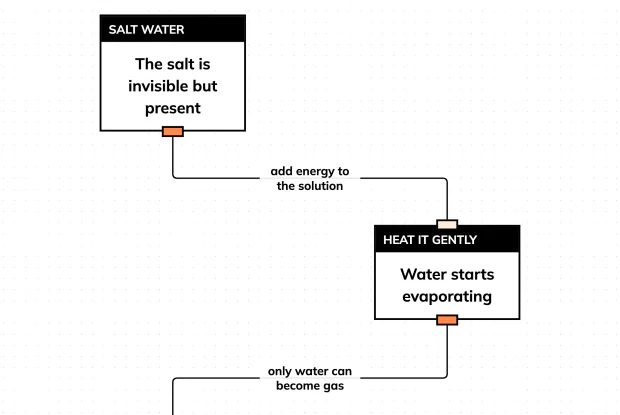
You remove the solvent and leave the solute behind, and the reason this works is that only one of them can become a gas at reasonable temperatures. Heat salt water gently and the water evaporates while the salt, which would need a temperature of hundreds of degrees to boil, stays put as crystals. This is how sea salt has been produced for thousands of years, using sunlight and shallow pans rather than a burner. If instead you want the water rather than the salt, you catch and cool the vapour so it condenses back to pure liquid — that is distillation, and it is how drinking water is made from seawater. Same separation, opposite thing kept, and in both cases nothing was created or destroyed at any point.
Real World Example
How Do You Get Drinking Water From the Sea?
Desalination plants supply drinking water to millions of people, and the underlying idea is exactly the playground you just built:
The problem
Seawater is a solution of salts in water, and the salt is spread so evenly through it that no filter with holes can catch it — the dissolved particles are as small as the water particles around them. Straining seawater through anything, however fine, gives you strained seawater.
Separating by state, not by size
So you separate them by a property where they differ enormously instead: the temperature at which each becomes a gas. Heat the seawater and the water evaporates while the salt cannot follow. Then, rather than discarding the vapour, you cool it so it condenses into pure liquid water, and you collect that. The salt stays behind as a concentrated brine.
Why it costs so much
The expense is latent heat, from the previous concept. Turning water into vapour requires an enormous amount of energy, and that is the whole bill. Modern plants reduce it — some use reduced pressure so water evaporates at lower temperatures, others push water through membranes fine enough to hold back dissolved particles. But the physics of why fresh water from the sea is expensive comes straight down to the energy needed for a change of state.
FAQs
Final Words
Dissolving spreads a solid through a liquid as individual particles without changing either substance. That is why the sugar is still in the tea, why the mass adds up exactly, and why the whole thing can be run backwards — evaporate the solvent and the solute is left sitting there.
It is worth keeping firmly apart from melting, which is a change of state caused by heat and needs no second substance. With both straight, you have the full set for this track: how particles are arranged, how energy moves them between arrangements, why the temperature pauses while it does, and how a solid can seem to vanish without any of that happening at all. What none of it asked is what a substance is made of in the first place. The next track sorts everything into elements, compounds and mixtures — and explains why the salt could be recovered at all.
Continue This Track
This concept is part 4 of What Everything Is Made Of.
What Are the Three States of Matter?
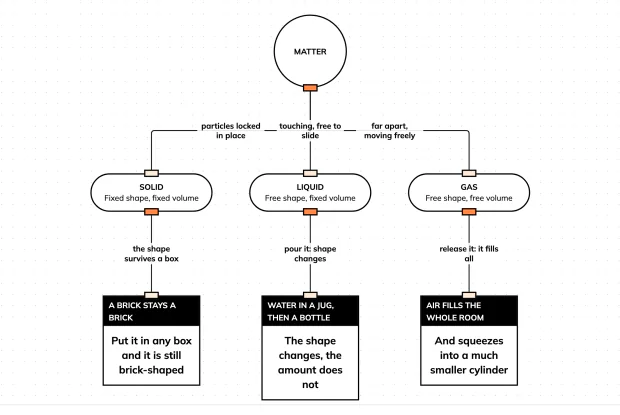
Solid, liquid and gas are not three kinds of stuff — they are three arrangements of the same particles. Learn what each arrangement does, in an interactive playground.
What Happens to Particles When Ice Melts?
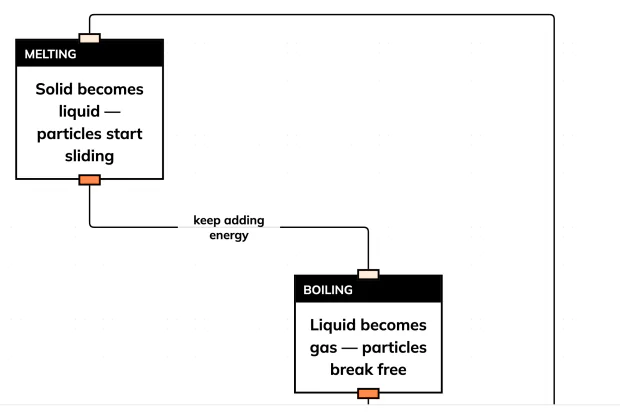
Every change of state is energy going in or coming out, and every one can be reversed. Learn what the particles do at each step.
Why Doesn't Ice Water Get Warmer While It Melts?
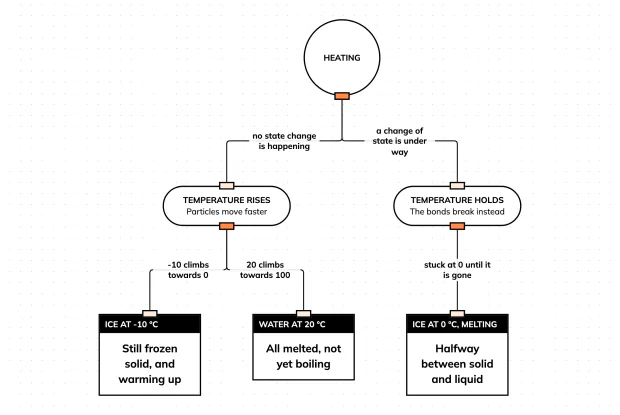
Heat a glass of ice water and the temperature refuses to budge until every last piece has melted. Learn where that energy goes, in an interactive playground.
How Do You Get the Salt Back Out of Salt Water?
Dissolved salt looks gone but is still entirely there. Learn why dissolving is not melting, and recover the salt step by step.