Why Doesn't Ice Water Get Warmer While It Melts?
Root Concept
During a change of state, added energy goes into breaking the forces between particles rather than making them move faster — so the temperature stays put until the change is complete.
CodePLU Goal
Upgrading Human Mental Models
Learn how to think in Workflows

Concept Development By codeplu.com
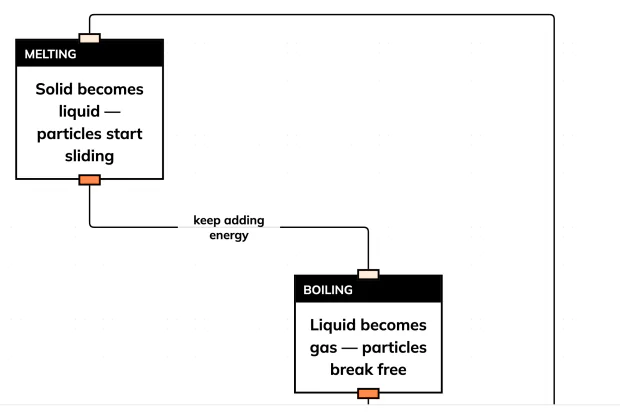
Identical heating producing three different outcomes, depending on whether a state change is under way
Where Does the Heat Go If Not Into the Temperature?
Put a glass of ice and water on a warm windowsill with a thermometer in it. Energy is arriving continuously, so you would expect the temperature to creep up continuously. It does not. It sits at zero degrees, stubbornly, for as long as any ice remains — and only once the final piece has melted does it start to climb.
That is genuinely strange the first time you notice it, because energy is clearly going in and it seems to be going nowhere. It is not disappearing. It is being spent on a different job.
Temperature measures how fast particles are moving. But energy can also be spent breaking the forces that hold particles in place, and while a substance is changing state that is where all of it goes. The particles are being freed from their fixed positions, not sped up — so the thermometer reads the same throughout. Only when there is nothing left to free does the incoming energy go back to increasing speed, and the temperature resumes rising. This is called latent heat, latent meaning hidden, and in the playground below you will build heating down into its two outcomes, and see which cases share one.
How Can Heating Something Not Make It Hotter?
What does temperature actually measure?
Temperature is a measure of the average kinetic energy of particles — in plain terms, how fast they are moving or vibrating. That is worth being precise about, because it means temperature and energy are not the same thing, and confusing them is what makes latent heat feel impossible. A bath at forty degrees contains far more energy than a cup of tea at eighty, because there are so many more particles in it, even though the tea is hotter. Temperature reports the average energy per particle; total energy depends on how many particles there are as well. Once you separate the two ideas, the melting puzzle becomes much less mysterious: energy can go into a substance and increase its total energy without increasing the average speed of its particles at all.
So where does the energy go during melting?
Into breaking the forces of attraction that hold particles in fixed positions. Think of each particle in ice as held by springs to its neighbours. Warming ice below zero makes those springs vibrate faster, and that shows up as rising temperature. But at zero degrees the springs start snapping instead, and snapping them takes energy — energy that is spent on separation rather than on speed. So while ice and water sit together, incoming energy is going into converting solid to liquid, particle by particle, and the average speed stays constant. The thermometer, which only reports speed, therefore reads zero the whole time. Once the last spring has snapped there is nothing left to break, and further energy has no choice but to increase speed again, so the temperature climbs.
Why does boiling need so much more energy than heating?
Because breaking particles apart completely takes far more energy than merely loosening them, and the numbers are startling. Heating water from zero to a hundred degrees takes a certain amount of energy; turning that same water at a hundred degrees into steam takes more than five times as much again. This is why a pan of water comes to the boil reasonably quickly and then takes a very long time to boil dry. It also explains why steam burns are so much worse than hot-water burns. Steam at a hundred degrees carries all that extra energy, and when it touches your skin and condenses it releases the lot — so you receive both the condensing energy and the cooling energy, from something at exactly the same temperature as boiling water.
Does the same thing happen in reverse?
Exactly, and it is just as useful. When water freezes, the energy that went into breaking the forces has to come back out, so a freezing substance releases energy while staying at the same temperature. Fruit growers exploit this directly: spraying orchards with water before a frost means the water freezes first, and the energy it releases as it does so helps keep the buds from freezing. Evaporation is the version everyone experiences daily. Turning liquid into gas requires energy, and that energy is taken from whatever the liquid is touching — which is why sweat cools you, why a wet towel feels cold, and why rubbing alcohol on skin feels dramatically colder than water. Nothing is being chilled. Energy is simply being carried away by the particles that escape.
Real World Example
Why Does Ice Keep a Drink Cold Better Than Cold Water?
Latent heat explains something you have relied on all your life without needing a reason for it:
The glass of cold water
Fill a glass with water at zero degrees, no ice. Heat leaks in from the room, and every bit of it goes straight into raising the temperature, because there is no state change to absorb it. Within minutes the drink is noticeably warmer and heading for room temperature.
The glass with ice in it
Now the same drink with ice cubes floating in it. Heat still leaks in at the same rate, but now it has a much bigger job to do first: melting the ice. Every joule spent melting is a joule not spent warming the drink, so the temperature holds near zero for as long as any ice survives. The ice is not just cold, it is a buffer.
Which is why the last cube matters
Watch what happens the moment the final piece of ice vanishes — the drink starts warming immediately and quickly. Nothing changed in the room; the buffer simply ran out. The same principle is why a cool box packed with ice outperforms one packed with chilled bottles, and why ice, rather than merely cold things, is what keeps food safe in transit.
FAQs
Final Words
Energy and temperature are not the same thing. Temperature reports how fast particles are moving, so while energy is being spent breaking the forces between particles instead of speeding them up, a thermometer registers nothing at all. That is latent heat, and it is why melting ice holds at zero and a pan takes so long to boil dry.
It runs both ways, which is what makes it so useful in practice — ice buffers a drink because melting absorbs energy, and sweat cools you because evaporating does. The final concept in this category deals with the other way solids seem to vanish, which looks like melting and is something else entirely.
Continue This Track
This concept is part 3 of What Everything Is Made Of.
What Are the Three States of Matter?
Solid, liquid and gas are not three kinds of stuff — they are three arrangements of the same particles. Learn what each arrangement does, in an interactive playground.
What Happens to Particles When Ice Melts?
Every change of state is energy going in or coming out, and every one can be reversed. Learn what the particles do at each step.
Why Doesn't Ice Water Get Warmer While It Melts?
Heat a glass of ice water and the temperature refuses to budge until every last piece has melted. Learn where that energy goes, in an interactive playground.
How Do You Get the Salt Back Out of Salt Water?
Dissolved salt looks gone but is still entirely there. Learn why dissolving is not melting, and recover the salt step by step.