What Happens to Particles When Ice Melts?
Root Concept
Adding energy loosens the forces holding particles together and removing it lets them re-form, so every change of state has an exact reverse.
CodePLU Goal
Upgrading Human Mental Models
Learn how to think in Workflows

Concept Development By codeplu.com
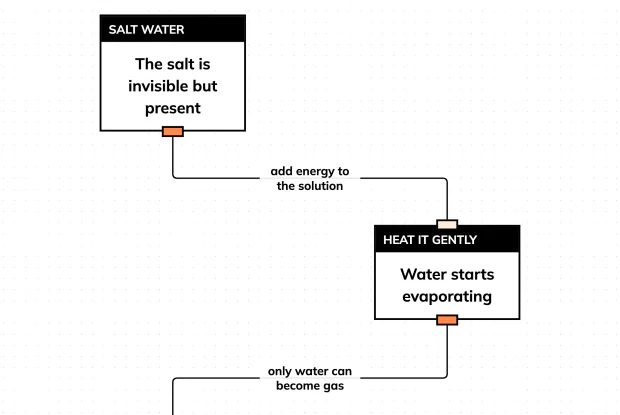
The four common changes of state, forming a loop driven by energy in and energy out
What Actually Changes When a Solid Turns Into a Liquid?
An ice cube melts and you are left with the same water you started with, in the same quantity. Nothing was created and nothing destroyed. So what did the heat actually do?
It weakened the grip. The particles in ice are held in fixed positions by forces of attraction between them, and heating supplies energy that makes those particles vibrate harder and harder until the forces can no longer hold them in place. At that point they begin to slide past each other, and sliding is what being a liquid means. Keep adding energy and eventually they break away from each other entirely, which is boiling.
The important consequence is that every one of these changes runs both ways. Melting has freezing as its exact reverse; boiling has condensing. Adding energy moves you one direction round the loop and removing it brings you back, with no change to the substance itself. This is why the playground below is a circle rather than a line — and it is also the difference between a change of state, which is physical and reversible, and a chemical change like burning, which is neither.
What Happens at Each Change?
What happens during melting and freezing?
Heating a solid makes its particles vibrate more violently until they have enough energy to escape their fixed positions, though not enough to leave each other entirely. They stay in contact but begin to move past one another, and the solid becomes a liquid. Freezing is precisely this in reverse: remove energy, the particles slow, and the forces of attraction are able to lock them back into fixed positions. The temperature at which this happens is the same in both directions — water's melting point and freezing point are both zero degrees Celsius, because they are the same boundary approached from opposite sides. Water is unusual in one respect worth knowing: it expands when it freezes, because its molecules lock into an open structure. That is why ice floats and why pipes burst, and most substances do the opposite.
What happens during boiling and condensing?
Keep heating a liquid and some particles gain enough energy to break away from the others completely and become gas. Condensing is the reverse — a gas cooling until its particles no longer have enough energy to stay independent, so they rejoin as a liquid. It helps to see how much bigger a change this is than melting: melting only loosens particles that stay in contact, while boiling separates them entirely, so the same quantity of substance suddenly occupies vastly more space. That expansion is exactly what a steam engine harnesses, and it is why a sealed container of boiling liquid is dangerous. Bubbles in boiling water are worth naming too: they are water that has become gas inside the liquid, not air escaping.
Why is evaporation not the same as boiling?
Both turn a liquid into a gas, and they are not the same process. Boiling happens throughout a liquid, at one particular temperature, when every part of it has enough energy. Evaporation happens only at the surface and at any temperature, whenever individual fast-moving particles happen to escape. That is why washing dries on a cold day and why a puddle disappears without ever approaching a hundred degrees. It also explains why evaporation cools what is left behind: the particles that escape are the most energetic ones, so the average energy of those remaining drops. That is the mechanism behind sweating — and it is why a wet shirt in a breeze feels far colder than a dry one at the same air temperature.
Why is a change of state reversible when burning is not?
Because a change of state is physical rather than chemical: the particles are rearranged, but each particle is still the same particle. Water molecules in ice, water and steam are identical water molecules, so reversing the energy flow reverses the change exactly. Burning is different — it is a chemical change, in which particles are taken apart and recombined into different substances. Burn wood and you get ash, carbon dioxide and water vapour, and no amount of cooling will reassemble the log. The test is whether you can get your original substance back by simply reversing the temperature. Melting, freezing, boiling and condensing all pass it. Burning, rusting and cooking an egg all fail, which is why they belong to a different category of change altogether.
Real World Example
Why Does a Fridge Get Cold Inside?
A fridge does not create cold. It moves heat, and it does so by driving a substance round the same loop you built in the playground:
Evaporating inside, to take heat in
A liquid refrigerant flows through pipes inside the fridge, where it evaporates. Turning from liquid to gas requires energy, and it takes that energy from its surroundings — the air and the food. Removing energy from something is exactly what making it colder means, so the inside of the fridge cools.
Condensing outside, to give heat out
The gas is then pumped to coils on the back or underneath, where it is compressed and condenses back into a liquid. Condensing releases the energy that evaporating absorbed, and that energy leaves into the room. This is why the back of a fridge is warm, and why a fridge with the door open would heat a sealed kitchen rather than cool it.
Round and round, forever
The refrigerant then returns to the inside pipes and evaporates again. Nothing is used up — the same substance cycles endlessly, absorbing energy where it evaporates and releasing it where it condenses. An air conditioner and a heat pump are the same machine; a heat pump simply runs the loop so the useful end is indoors.
FAQs
Final Words
Every change of state is energy going in or coming out. Adding it makes particles vibrate until they slide, then break free entirely; removing it lets them rejoin and lock back into place. Because each particle is unchanged throughout, every change has an exact reverse, which is why melting and freezing happen at the same temperature.
That reversibility is what separates a physical change from a chemical one — you can cool steam back to ice, but you cannot cool ash back into wood. There is one more surprise hiding in the loop, though: while a substance is actually changing state, heating it does not make it any hotter. The next concept is about why.
Continue This Track
This concept is part 2 of What Everything Is Made Of.
What Are the Three States of Matter?
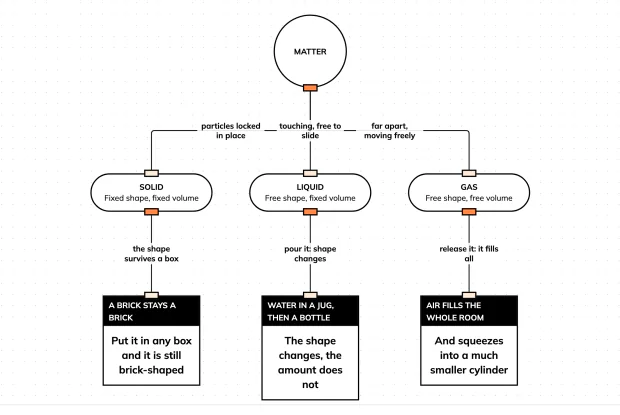
Solid, liquid and gas are not three kinds of stuff — they are three arrangements of the same particles. Learn what each arrangement does, in an interactive playground.
What Happens to Particles When Ice Melts?
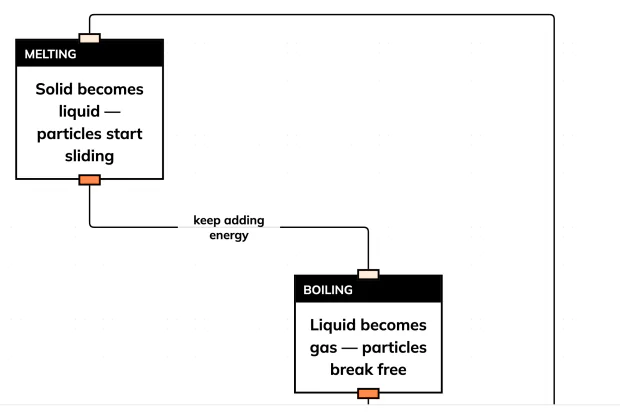
Every change of state is energy going in or coming out, and every one can be reversed. Learn what the particles do at each step.
Why Doesn't Ice Water Get Warmer While It Melts?
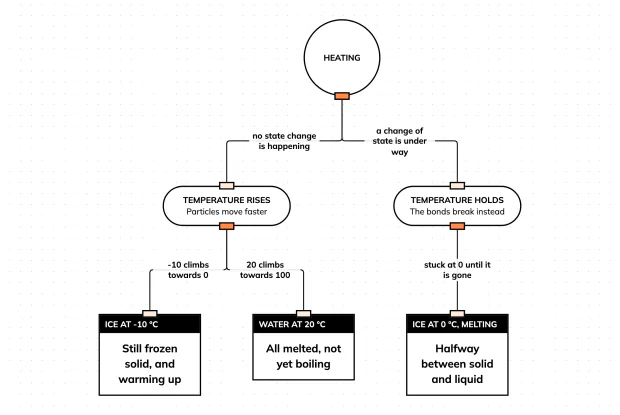
Heat a glass of ice water and the temperature refuses to budge until every last piece has melted. Learn where that energy goes, in an interactive playground.
How Do You Get the Salt Back Out of Salt Water?
Dissolved salt looks gone but is still entirely there. Learn why dissolving is not melting, and recover the salt step by step.