What Are Coordinates and How Do You Plot a Point?
Root Concept
Coordinates are an ordered pair, so (2, 3) and (3, 2) are different places — the order carries as much meaning as the numbers.
CodePLU Goal
Upgrading Human Mental Models
Learn how to think in Workflows

Concept Development By codeplu.com
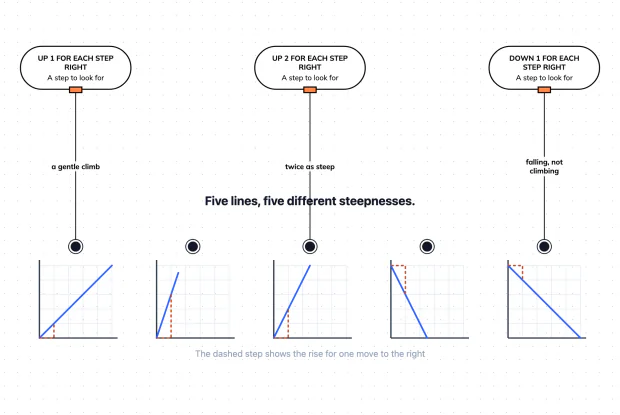
Along the corridor, then up the stairs — match each address to its point
How Do You Describe Exactly Where a Point Is?
Put a dot anywhere on a blank page and try to tell somebody over the phone where it is. You cannot, because there is nothing to measure from. Draw two lines at right angles first — one across and one up — and suddenly every dot on the page has an address: how far along, and how far up.
Those two lines are the axes, the across one called the x-axis and the up one the y-axis, and they meet at a corner called the origin. A point's address is written as a pair in brackets, the across number first: (2, 3) means start at the origin, go two along, then three up.
The order is not a convention you can be casual about. (2, 3) and (3, 2) are two different places on the page, and swapping them by accident is easily the most common mistake here. The phrase most people are taught is along the corridor, then up the stairs, and it is worth keeping. In the playground below, five points are marked on one grid and you match three addresses to them — one of the decoys is a swapped pair.
How Do You Find a Point?
Which number comes first?
The across one, always. In (2, 3) the 2 is how far to move along the x-axis and the 3 is how far up the y-axis, so you travel right two then up three. Getting this backwards puts you at (3, 2), which is a different point entirely, and nothing on the page will tell you the mistake was made. The memory aid worth keeping is along the corridor, then up the stairs, because you cannot climb stairs you have not reached yet. A second one that helps is that x comes before y in the alphabet, in the same order they come in the bracket. Whichever you prefer, use one of them every single time until the habit stops needing help.
What are the axes and the origin?
The x-axis is the horizontal line and the y-axis is the vertical one, and the point where they cross is the origin, written (0, 0). Every address is measured from there, which is why the grid has to be drawn before any point can be described. A point sitting on the x-axis has not moved up at all, so its second number is zero — (4, 0) is four along and flat on the axis. A point on the y-axis has not moved along, so its first number is zero. Those two cases look like special rules and are not; they are ordinary addresses that happen to have a zero in them.
How do you plot a point that is given to you?
Start at the origin every time, rather than from the last point you drew. Count along the x-axis to the first number, then count up from there to the second, and mark the spot where you land. Counting from your previous point is a genuine time-saver that causes genuine errors, because one miscount then moves everything after it. Two habits make plotting reliable: use the gridlines rather than judging distances by eye, and put a small clear dot rather than a large scribble, because on a graph a fat mark can cover most of a square and make a point look like it is somewhere it is not.
Real World Example
Where Do People Use Coordinates Without Calling Them That?
The idea is much older and more common than the algebra lesson it turns up in:
A seat in a cinema
Row F, seat 12
A cinema ticket gives you a row and a seat number, and between them they pick out exactly one chair in a room holding several hundred. Neither number alone is any use — row F describes a whole line of seats, and seat 12 describes a whole column. It is the pair that does the work, and the order is fixed by convention so that nobody sits in the wrong place. That is precisely what a coordinate pair is. Mathematics writes it as two numbers in a bracket instead of a letter and a number, and measures from a corner rather than a wall, but the idea is identical.
A square on a chessboard
e4
Chess names every square with a letter for the file and a number for the rank, always in that order. The opening move e4 means the pawn on the e file moves to the fourth rank, and the whole of chess notation depends on nobody ever writing 4e by mistake. Notice that the board is eight by eight and the naming handles all sixty-four squares with only sixteen symbols, because a pair carries far more information than the two things in it separately. A grid with the same numbers on both axes does exactly the same job.
A pin on a map
(28.6, 77.2)
Every place on Earth has a latitude and a longitude, which is a coordinate pair measured from the equator and from a line through Greenwich. Delhi sits at roughly 28.6 north and 77.2 east. The numbers are decimals rather than whole squares and the surface is curved rather than flat, but the structure is the one you are learning here: two measurements from a fixed origin, in a fixed order, naming one place. Swap them and you are in the sea somewhere off Somalia, which is the same error as plotting (3, 2) for (2, 3).
FAQs
Final Words
A coordinate pair is an address on a grid, measured from the origin where the two axes cross. The first number is how far across and the second is how far up, and that order is the whole point — (2, 3) and (3, 2) are different places.
Plot by counting from the origin every time, using the gridlines rather than your eye. With points in place, the next question is what happens when a whole set of them is marked at once — which is where a graph comes from.
Continue This Track
This concept is part 1 of Algebra on a Grid.
What Are Coordinates and How Do You Plot a Point?
A pair of coordinates is an address on a grid, and the order is the whole of it. Learn how to read and plot a point in an interactive playground.
How Do You Read a Value Off a Graph?
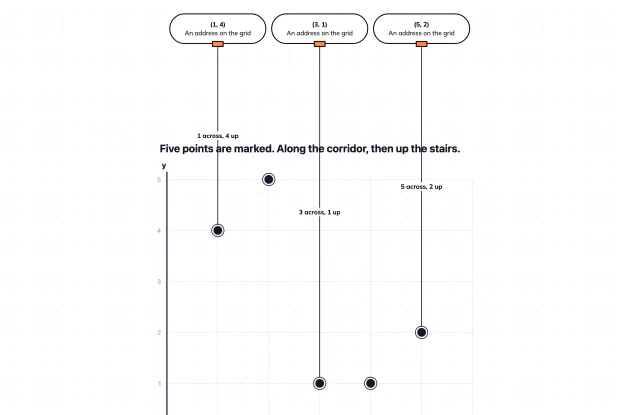
A graph answers questions you never calculated, if you can read it. Learn how to go from an x value to its y value, and find three of them in a playground.
What Does the Graph of an Equation Look Like?
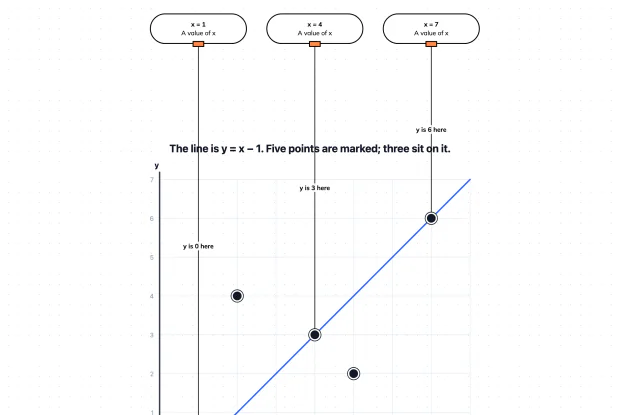
A graph is not a picture of an equation — it is every solution of it, plotted at once. Learn what the line means and match three equations in a playground.
What Makes a Graph a Straight Line?
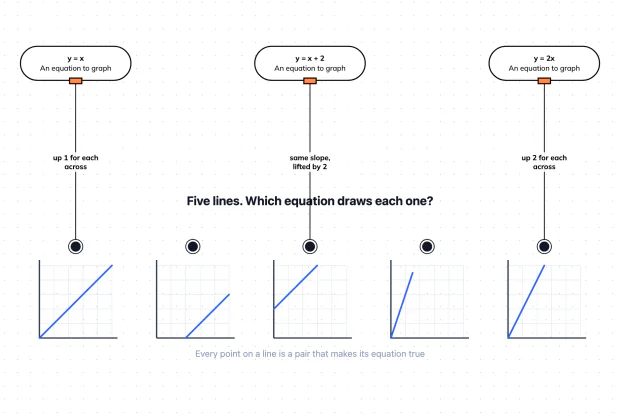
A graph is straight when the rise per step never changes. Learn what steepness means, what a downward line says, and match three steps in a playground.