How Do You Construct a Triangle from Three Sides?
Root Concept
The third corner of a triangle is where arcs of the two remaining side lengths, struck from each end of the first side, cross.
CodePLU Goal
Upgrading Human Mental Models
Learn how to think in Workflows

Concept Development By codeplu.com
Three side lengths fix a triangle completely. That is why the two arcs can only cross where they do.
Three Lengths and Nothing Else
This is the construction the whole track has been building towards, and it uses both instruments: a ruler to set out one side, and compasses to find where the third corner has to be. No angle is measured anywhere.
The method is short. Draw the longest side with a ruler and label its ends. Open the compasses to the length of the second side, put the point on one end and swing an arc. Open them to the third side, put the point on the other end and swing again. Where the two arcs cross is the remaining corner, and joining it to both ends completes the triangle.
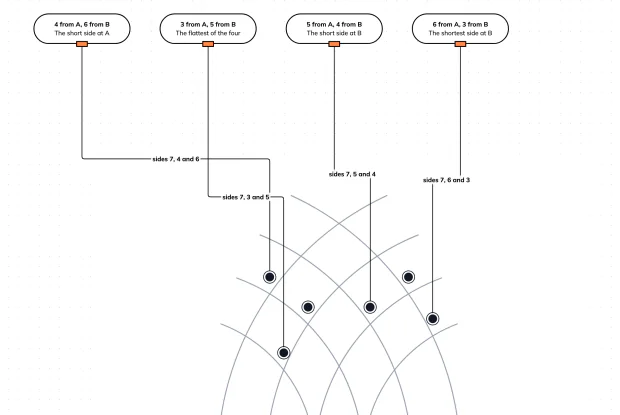
The reason it works is worth saying plainly: every point on the first arc is the second side's length away from that end, and every point on the second arc is the third side's length away from the other end. Only a crossing satisfies both at once. In the playground below, arcs have been drawn at several radii from each end of a 7 cm base, and your job is to find the apex each pair of lengths produces.
Why the Crossing Is the Answer, and What Can Go Wrong
Why does the crossing give the right corner?
Because each arc records one of the conditions the corner must satisfy. If the second side is 4 cm, the corner has to be exactly 4 cm from A — and that is precisely the set of points making up an arc of radius 4 centred on A. If the third side is 6 cm, the corner also has to be 6 cm from B, which is the arc of radius 6 about B. A point that satisfies both conditions must lie on both arcs, so it has to be a crossing. There is nothing approximate about it: the crossing is the one place in the plane where both lengths come out right.
Why does the order of the two lengths matter?
Because swapping them gives a different triangle. Four centimetres from A and six from B puts the apex over towards A; six from A and four from B puts it over towards B. The two triangles are mirror images of each other and both are perfectly valid answers to "a triangle with sides 7, 4 and 6", but only one of them matches a question that names which side is which. Both of the spare crossings in the playground are exactly this swap, which is the error the construction most invites — the compass work is right and the lengths went on the wrong ends. Reading the question twice before setting the compasses costs less than redrawing the triangle.
Why are there two crossings for every pair?
Because the arcs cross above the line and below it. Both points give a genuine triangle with the right three side lengths, and the two are reflections of each other in the base. Convention is to work above the line and draw only the upper halves of the arcs, which is what the playground shows, so in practice the choice never comes up. It is worth knowing it exists, because a question that fixes the triangle's position on a grid may want the lower one, and the construction is identical with the arcs swung downwards. The two triangles are congruent to each other, so every length and angle matches; only which side of the base they sit on differs.
What if the arcs do not cross at all?
Then no triangle exists with those three lengths. If the two shorter sides together are less than the base, their arcs stop short of each other and there is nothing to join — the sides are simply not long enough to reach across. If they add to exactly the base length, the arcs touch at one point lying on the base, and the three sides collapse flat into a line with no height at all. That is the triangle inequality met earlier in geometry, and the construction shows it rather than asserting it: the arcs physically fail to meet. If your arcs will not cross, add the two shorter lengths and compare them with the base before assuming the compasses are at fault.
Real World Example
Setting Out Foundations on a Building Site
Marking out a building begins with exactly this construction, scaled up from a sheet of paper to a field.
Step 1
One side and a tape
A builder marks the first wall line with two pegs and a string, which is the base AB. To find the third corner of a triangle they do not reach for a protractor, because a protractor a few centimetres wide cannot set an angle accurately over ten metres — a half-degree error at the instrument becomes several centimetres at the far end. Instead they measure from each peg with a tape, which is as accurate at ten metres as at one. The tape swung from a peg is a compass arc with a person on the end of it, and the geometry is identical.
Step 2
Two tapes, one corner
With one person holding a tape at each peg, the corner is where the two required distances meet — the same crossing of two arcs. A common version is the three-four-five method: measure 3 metres along one wall line and 4 along the other, and when the diagonal between those marks is exactly 5 metres the corner is square. That works because 3, 4 and 5 satisfy Pythagoras, so the triangle they build has a right angle, and the builder has constructed a right angle without owning anything that measures angles. Larger multiples such as 6, 8 and 10 are used on big sites, because a longer triangle pins the direction down more tightly.
Step 3
Check the diagonals
Once four corners are pegged, the builder measures both diagonals of the rectangle. If they are equal, the shape really is a rectangle; if not, it is a parallelogram leaning one way, however square each corner looked. This is the same reasoning once more — a length that can be measured directly is trusted over an angle that has to be judged. Every stage of setting out a building reduces angles to distances, which is exactly what construction with compasses does on paper. The tape and the compasses are the same instrument at different scales, and both answer the question by finding the one point that is the right distance from two others.
FAQs
Final Words
Three side lengths are enough to build a triangle exactly. Draw the longest side, swing an arc of the second length from one end and an arc of the third from the other, and the corner is where they cross — because that is the only point at the right distance from both ends at once. No angle is measured at any stage.
Put the two lengths on the wrong ends and you get the mirror triangle, which is the slip this construction most invites. And when the arcs refuse to meet, that is the triangle inequality showing itself physically rather than as a rule. With this, the track is complete: you can bisect a line, bisect an angle, and build a whole triangle from nothing but lengths — every one of them with compasses and a straight edge, and not a measured number anywhere.
Continue This Track
This concept is part 3 of Drawing It Yourself.
How Do You Construct a Perpendicular Bisector?
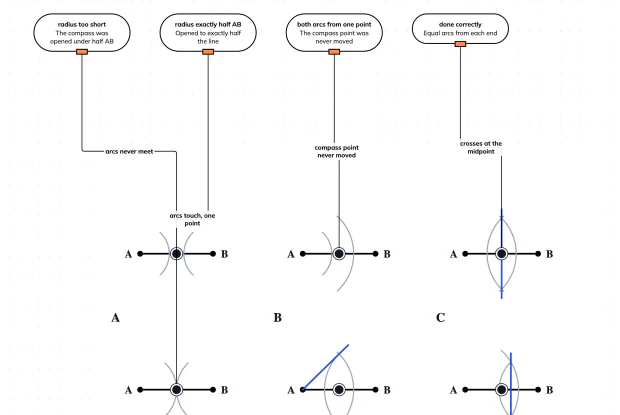
The perpendicular bisector of a line cuts it in half at a right angle, and a pair of compasses finds it exactly. Diagnose six attempted constructions in an interactive playground.
How Do You Bisect an Angle?
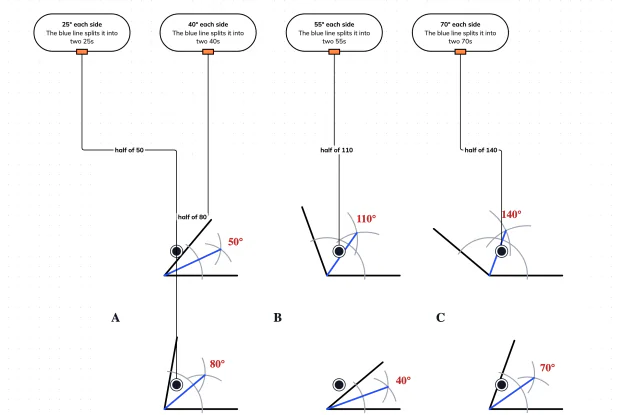
Bisecting an angle splits it into two equal halves using compasses only, with no protractor and no measuring. Work out the half-angle for four constructions in an interactive playground.
How Do You Construct a Triangle from Three Sides?
Given three side lengths, a ruler and compasses build the triangle exactly: draw one side, then swing an arc from each end. Find the apex for four triangles in an interactive playground.