Drawing It Yourself
Every other geometry track works something out. This one puts the reasoning down and picks up a pair of compasses. Nothing here is measured at all: a construction produces its answer exactly, with no scale to misread and no rounding to accumulate, which is why these methods have survived from Euclid more or less unchanged. The perpendicular bisector comes first, built from equal arcs struck from each end of a line, and every common failure in it turns out to be a compass failure: too narrow and the arcs miss, exactly half and they only touch, and a point that was never moved gives arcs that cannot meet at all. Bisecting an angle uses the same symmetry argument turned on a corner instead of a line. The track closes by building a whole triangle from three lengths, where two arcs cross at the only point that is the right distance from both ends at once — and where arcs that refuse to meet are the triangle inequality showing itself rather than being asserted.
CodePLU Goal
Upgrading Human Mental Models
Learn how to think in Workflows
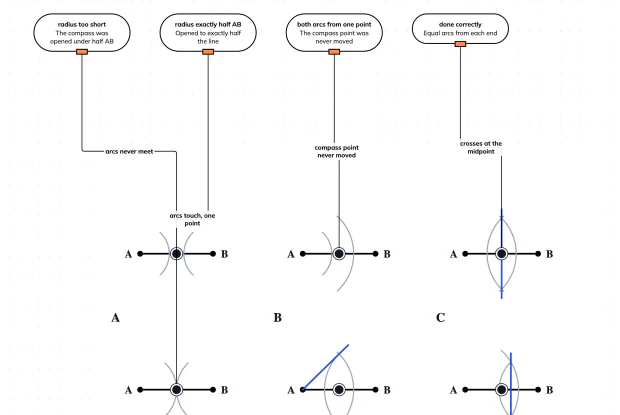
How Do You Construct a Perpendicular Bisector?
The perpendicular bisector of a line cuts it in half at a right angle, and a pair of compasses finds it exactly. Diagnose six attempted constructions in an interactive playground.
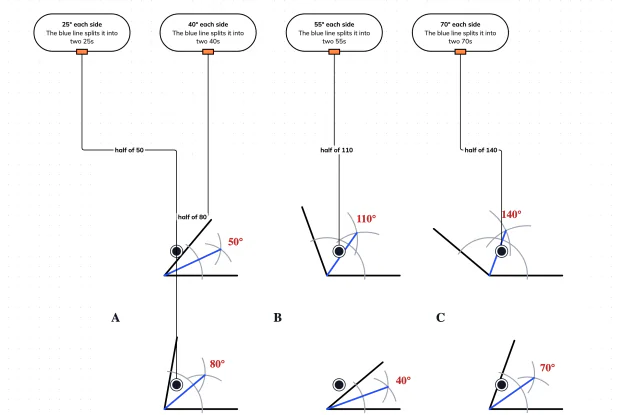
How Do You Bisect an Angle?
Bisecting an angle splits it into two equal halves using compasses only, with no protractor and no measuring. Work out the half-angle for four constructions in an interactive playground.
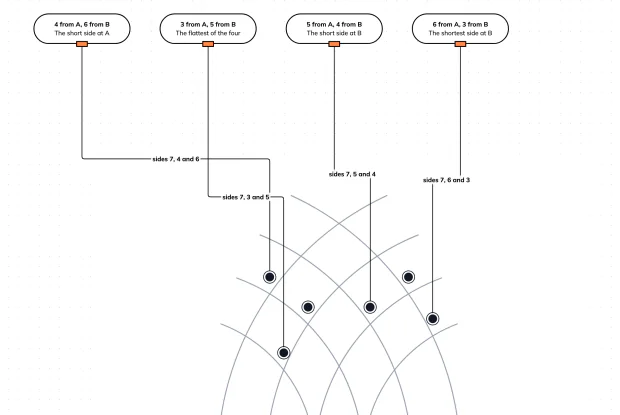
How Do You Construct a Triangle from Three Sides?
Given three side lengths, a ruler and compasses build the triangle exactly: draw one side, then swing an arc from each end. Find the apex for four triangles in an interactive playground.